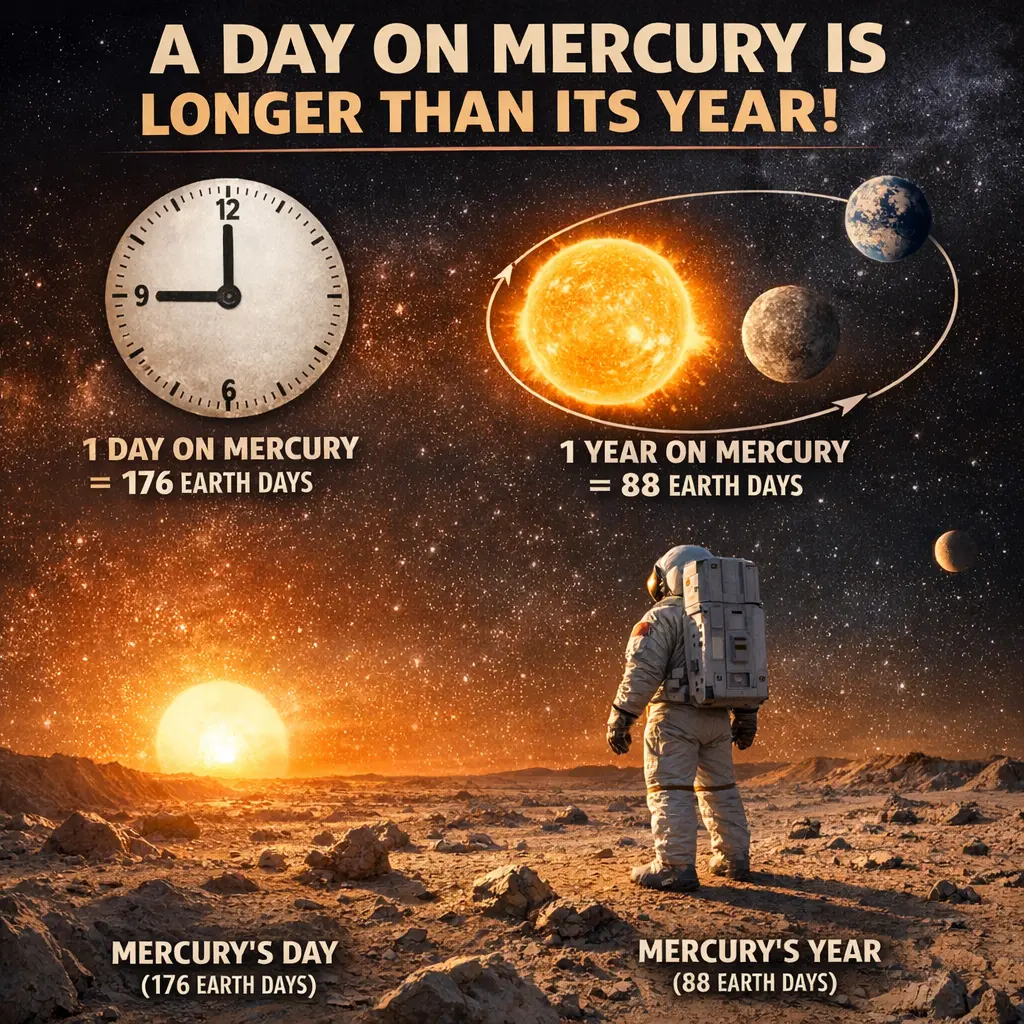
On Mercury, the planet closest to the Sun, a single day—from one sunrise to the next—lasts about 176 Earth days. However, Mercury completes one full orbit around the Sun, or one “year,” in only about 88 Earth days. This means that a day on Mercury is actually twice as long as its year, a surprising fact caused by the planet’s slow rotation and quick orbit.
A day on Mercury is longer than its year
On Mercury, the planet closest to the Sun, a single day—from one sunrise to the next—lasts about 176 Earth days. However, Mercury completes one full orbit around the Sun, or one “year,” in only about 88 Earth days. This means that a day on Mercury is actually twice as long as its year, a surprising fact caused by the planet’s slow rotation and quick orbit.
💡 Key Takeaways
- Mercury’s solar day is about 176 Earth days, longer than its ~88‑day year.
- Understand sidereal day vs. solar day and how Mercury’s 3:2 spin‑orbit resonance contributes to the long solar day.
- Long days on Mercury lead to extreme temperature swings between day and night.
- This day–year relationship has practical implications for mission planning and timing around Mercury.
❓ Frequently Asked Questions
What does it mean that a day on Mercury is longer than its year?
Mercury's solar day (sunrise to sunrise) is about 176 Earth days, while its orbital year around the Sun is about 88 Earth days.
How long is Mercury's year around the Sun?
About 88 Earth days.
How long is Mercury's day (solar day)?
About 176 Earth days (roughly two Mercury orbits).
Why does Mercury have a long day relative to its year?
Mercury is in a 3:2 spin–orbit resonance: it rotates three times for every two orbits. This slow rotation plus its quick orbit makes the solar day roughly twice as long as a Mercury year.