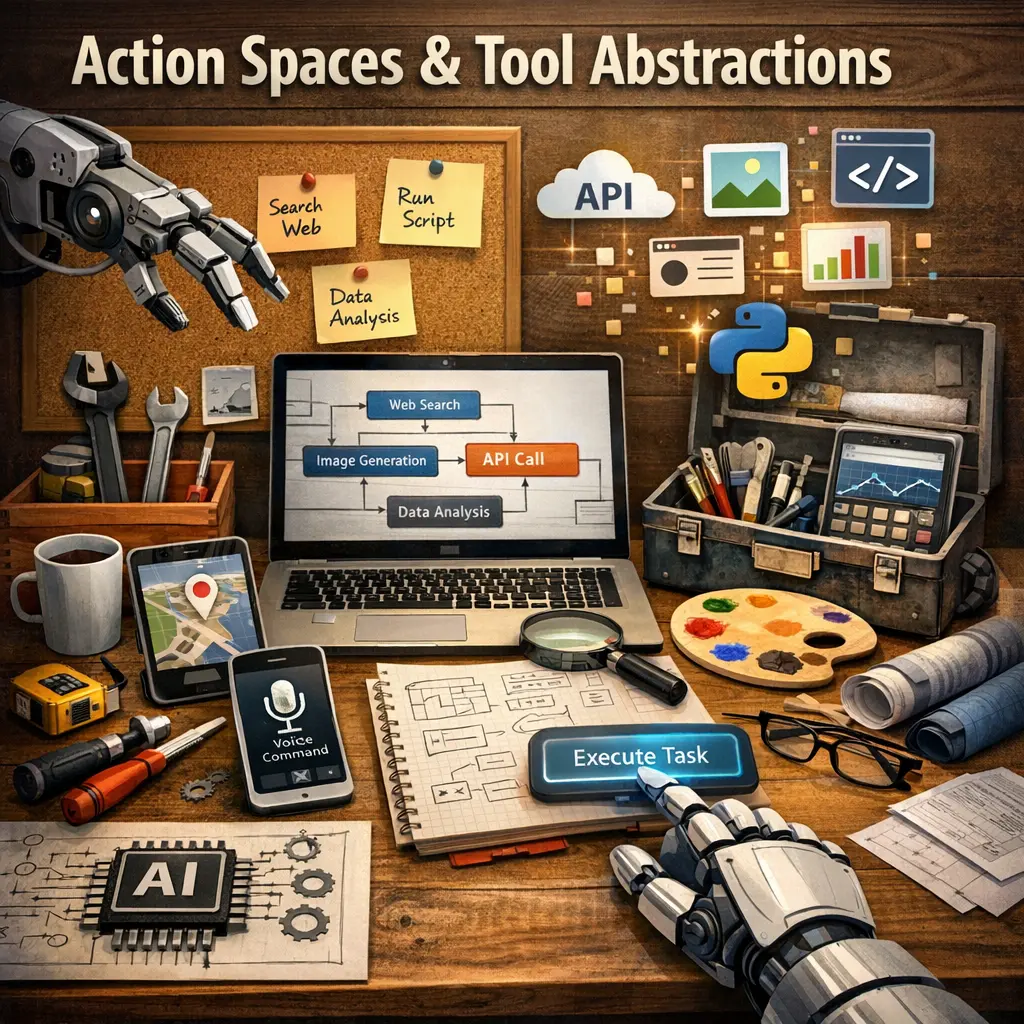
Action Spaces & Tool Abstractions in agent architecture refer to the structured set of possible actions an agent can take (action spaces) and the simplified representations of complex tools or functionalities (tool abstractions) available to the agent. Together, they define how an intelligent agent interacts with its environment, selects appropriate actions, and utilizes tools efficiently, enabling flexible, scalable, and goal-oriented behavior within various computational or real-world tasks.
Action Spaces & Tool Abstractions+50
Action Spaces & Tool Abstractions in agent architecture refer to the structured set of possible actions an agent can take (action spaces) and the simplified representations of complex tools or functionalities (tool abstractions) available to the agent. Together, they define how an intelligent agent interacts with its environment, selects appropriate actions, and utilizes tools efficiently, enabling flexible, scalable, and goal-oriented behavior within various computational or real-world tasks.
💡 Key Takeaways
- Define what an action space is and how it governs an agent's possible moves.
- Differentiate discrete and continuous action spaces with practical examples.
- Explain tool abstractions and how to wrap external tools as reusable actions for modular agents.
- Identify design considerations such as action masking, constraints, and trade-offs between expressiveness and learning efficiency.
❓ Frequently Asked Questions
What is an action space?
An action space defines all the actions an agent can take at any decision point, outlining the permissible moves and their structure (e.g., discrete choices or continuous values).
What is a tool abstraction in this context?
A tool abstraction models external capabilities (tools) that an agent can invoke, such as a calculator or search API, allowing the agent to extend its abilities beyond its internal reasoning.
What is the difference between discrete and continuous action spaces?
Discrete action spaces have a finite set of actions (e.g., move left, move right), while continuous spaces allow a range of values (e.g., velocity or angle) and are typically handled via optimization or sampling.
How do action spaces and tool abstractions work together?
An agent can choose actions from its action space or call tools through abstractions. Tools expand capabilities, and tool invocations can be treated as specialized actions within the action space.