Active filters are electronic circuits that use active components like operational amplifiers, along with resistors and capacitors, to process signals. LPF (Low Pass Filter) allows low-frequency signals to pass while attenuating high frequencies. HPF (High Pass Filter) does the opposite, allowing high frequencies and blocking low ones. BPF (Band Pass Filter) permits frequencies within a certain range to pass and attenuates frequencies outside that range. These filters are vital in signal processing applications.
Active filters: LPF, HPF, BPF design
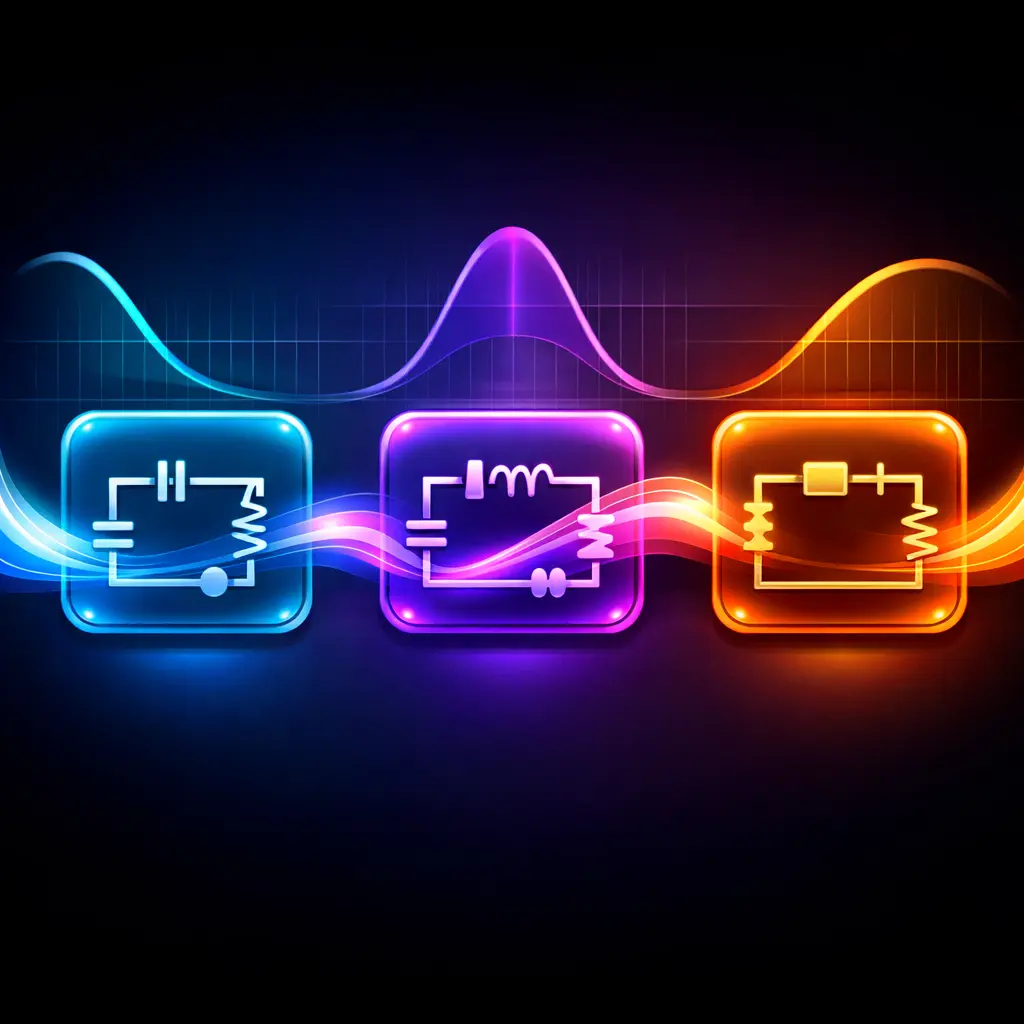
Active filters are electronic circuits that use active components like operational amplifiers, along with resistors and capacitors, to process signals. LPF (Low Pass Filter) allows low-frequency signals to pass while attenuating high frequencies. HPF (High Pass Filter) does the opposite, allowing high frequencies and blocking low ones. BPF (Band Pass Filter) permits frequencies within a certain range to pass and attenuates frequencies outside that range. These filters are vital in signal processing applications.
💡 Key Takeaways
- Understand the purpose and differences of active low-pass, high-pass, and band-pass filters in signal processing.
- Learn common active-filter topologies (e.g., Sallen-Key and multiple-feedback) and how to choose cutoff frequency and Q for a given design.
- Recognize how op-amp limitations (gain-bandwidth product, slew rate, and output swing) influence filter performance and stability.
- Practice deriving and interpreting the transfer function and frequency response (magnitude and phase) of LPF, HPF, and BPF circuits.
❓ Frequently Asked Questions
What is an active filter and how does it differ from a passive filter?
An active filter uses an amplifier (usually an op-amp) to realize the filter, providing gain and buffering. This enables sharper responses and higher Q without inductors, but introduces op-amp bandwidth and power considerations.
What are LPF, HPF, and BPF in filter design?
LPF (low-pass) passes frequencies below a cutoff; HPF (high-pass) passes frequencies above a cutoff; BPF (band-pass) passes a limited frequency band around a center frequency.
What are common topologies for active LPF/HPF designs?
Common second-order topologies include Sallen-Key (simplest) and Multiple-Feedback (MFB). For higher-order filters, cascaded sections or state-variable filters are used.
What factors should you consider when designing active LPF/HPF/BPF?
Consider the op-amp GBW, supply rails, desired gain, noise, component tolerances, and achievable Q or bandwidth for the target cutoff.