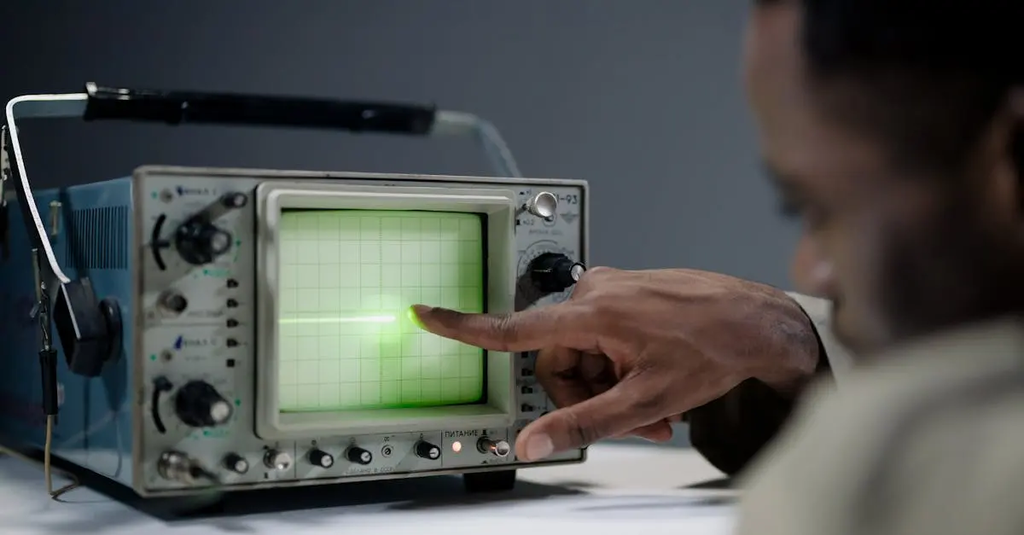
Advanced diagnostics with an oscilloscope involve using this instrument to analyze and troubleshoot complex electronic signals within circuits. By visualizing voltage changes over time, technicians can detect irregularities such as signal distortion, noise, or timing issues. This capability enables pinpointing faults in components, verifying circuit performance, and ensuring proper operation of digital and analog systems, making oscilloscopes essential for effective and accurate electronic diagnostics.
Advanced Diagnostics with Oscilloscope
Advanced diagnostics with an oscilloscope involve using this instrument to analyze and troubleshoot complex electronic signals within circuits. By visualizing voltage changes over time, technicians can detect irregularities such as signal distortion, noise, or timing issues. This capability enables pinpointing faults in components, verifying circuit performance, and ensuring proper operation of digital and analog systems, making oscilloscopes essential for effective and accurate electronic diagnostics.
💡 Key Takeaways
- Read oscilloscope traces to identify distortion, noise, and timing issues in circuits encountered in the field.
- Use triggers, timebase, vertical controls, and probes to capture clean, representative waveforms.
- Measure key parameters (amplitude, frequency, rise/fall time) and use cursors or markers to quantify faults.
- Apply practical field diagnostic workflows for common scenarios (digital signals, PWM, power electronics, automotive sensor signals) and verify fixes.
❓ Frequently Asked Questions
What is the primary purpose of an oscilloscope in advanced diagnostics?
To visualize voltage as a function of time, allowing technicians to see circuit behavior and quickly spot anomalies such as distortion, noise, or timing errors.
How can an oscilloscope help you identify distortion, noise, or timing issues?
By displaying waveforms and enabling measurements of amplitude, rise/fall times, jitter, and timing intervals to locate where signals deviate from expected behavior.
Which oscilloscope settings are essential when diagnosing a circuit, and why?
Vertical scale (volts/div) to fit the signal, horizontal time base (time/div) to reveal timing events, trigger settings to stabilize the display, and proper probe grounding/compensation for accurate readings.
What is the difference between time-domain and frequency-domain analysis on an oscilloscope?
Time-domain shows how signals change over time, ideal for transients and timing; frequency-domain (via FFT) reveals the signal's spectral content, useful for noise and EMI analysis.