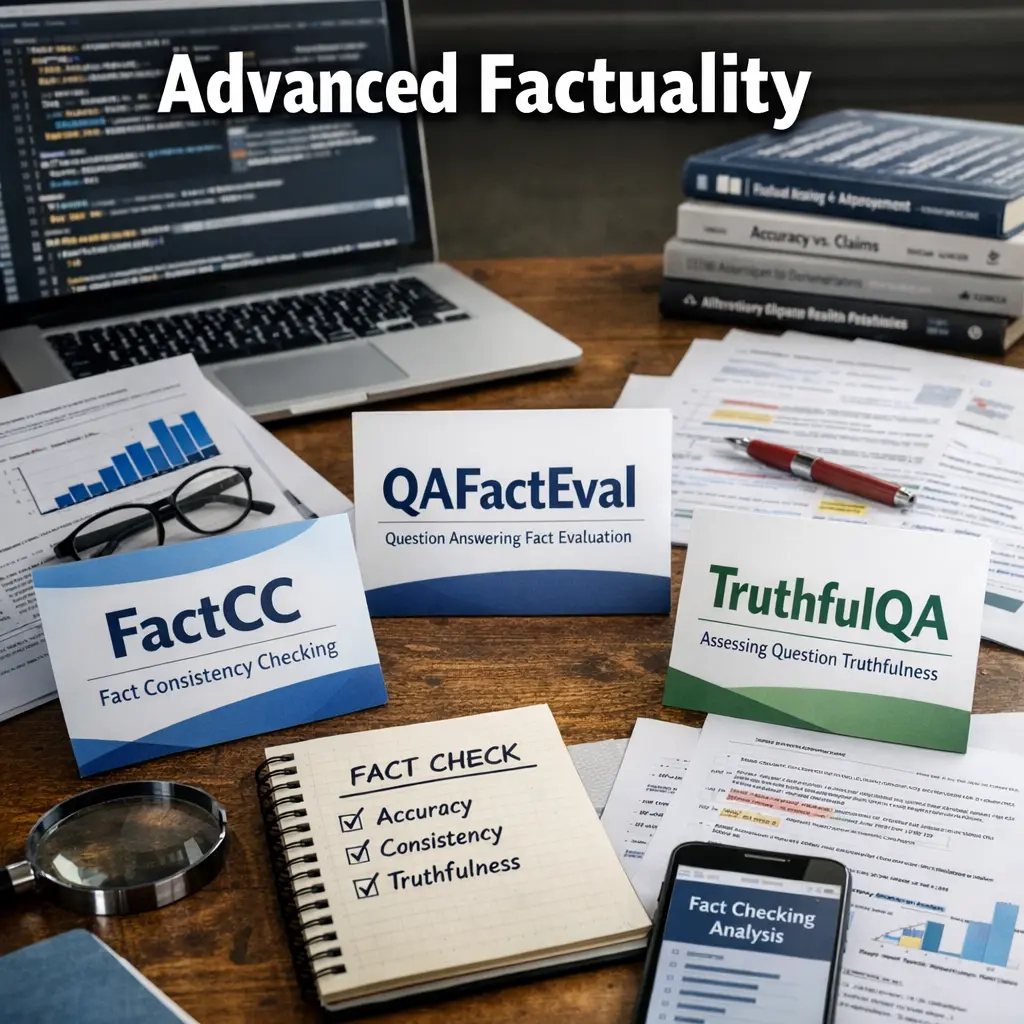
Advanced Factuality refers to sophisticated methods and benchmarks used to assess the accuracy and truthfulness of language model outputs. Tools like FactCC, QAFactEval, and TruthfulQA are evaluation frameworks designed to systematically test whether generated responses align with established facts. These LLM evaluations help identify factual inconsistencies, measure model reliability, and guide improvements in AI systems to ensure the information they provide is trustworthy and accurate.
Advanced Factuality: FactCC, QAFactEval, TruthfulQA
Advanced Factuality refers to sophisticated methods and benchmarks used to assess the accuracy and truthfulness of language model outputs. Tools like FactCC, QAFactEval, and TruthfulQA are evaluation frameworks designed to systematically test whether generated responses align with established facts. These LLM evaluations help identify factual inconsistencies, measure model reliability, and guide improvements in AI systems to ensure the information they provide is trustworthy and accurate.
💡 Key Takeaways
- Understand the goals and methods of FactCC, QAFactEval, and TruthfulQA as benchmarks for AI factuality.
- Compare automated factuality metrics and human evaluation to see what each one measures and where they disagree.
- Learn how these benchmarks influence model evaluation, safety, and trustworthiness in real-world applications.
- Identify strategies to improve model factuality, including source citation, retrieval augmentation, and calibration against benchmarks.
- Recognize limitations and pitfalls of factuality benchmarks, and how to choose appropriate benchmarks for your use case.
❓ Frequently Asked Questions
What is FactCC and what does it measure?
FactCC is a benchmark for assessing factual consistency in generated text (e.g., summaries) by checking whether the stated facts align with reliable source data or ground-truth information.
What is QAFactEval and what does it assess?
QAFactEval is an evaluation framework for factuality in question‑answering outputs, measuring whether model answers are supported by evidence or match reference facts.
What is TruthfulQA and what does it test?
TruthfulQA is a benchmark designed to probe a model's truthfulness on questions that can tempt plausible but incorrect answers, highlighting the model's tendency to be confident even when wrong.
How do these tools differ and when should you use them?
FactCC checks consistency with source facts, QAFactEval checks factual accuracy of QA responses, and TruthfulQA tests truthfulness in open-ended prompts. Use them together for a comprehensive view of factuality and honesty in AI outputs.