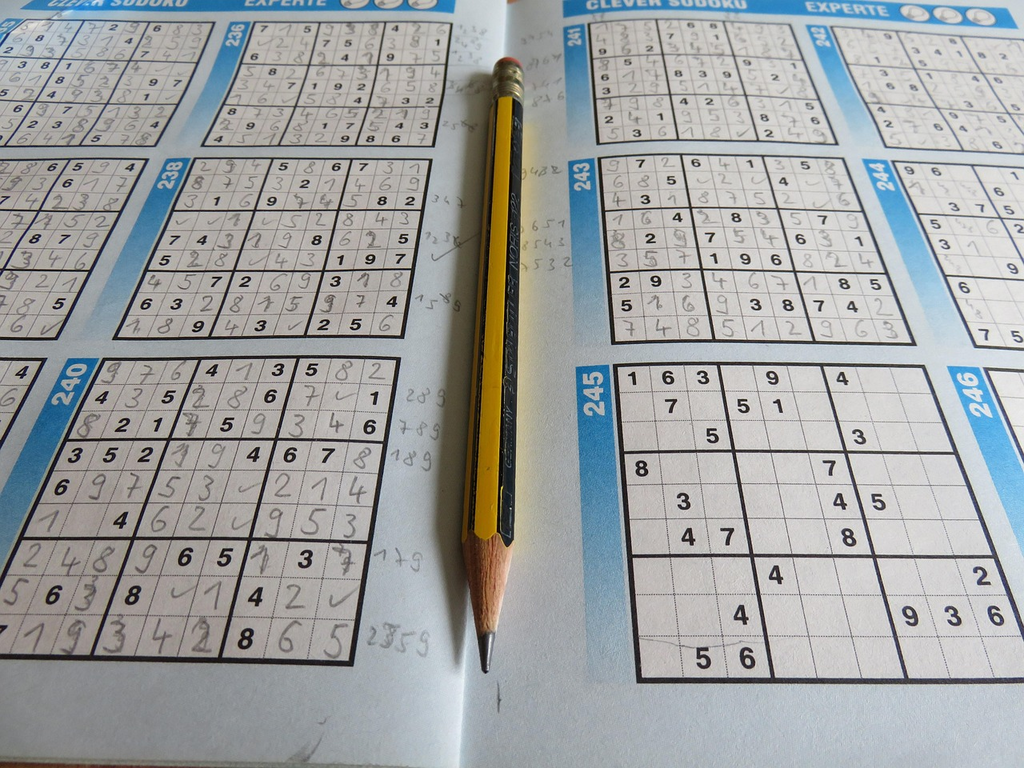
Advanced Sudoku (Puzzles for All Ages) refers to a collection of challenging Sudoku puzzles designed to engage and stimulate logical thinking for individuals of varying skill levels and ages. These puzzles go beyond basic grids, often featuring complex patterns and requiring advanced solving techniques. The phrase suggests that, despite the increased difficulty, the puzzles are accessible and enjoyable for both younger and older enthusiasts, promoting mental agility and problem-solving skills across generations.
Advanced Sudoku
Advanced Sudoku (Puzzles for All Ages) refers to a collection of challenging Sudoku puzzles designed to engage and stimulate logical thinking for individuals of varying skill levels and ages. These puzzles go beyond basic grids, often featuring complex patterns and requiring advanced solving techniques. The phrase suggests that, despite the increased difficulty, the puzzles are accessible and enjoyable for both younger and older enthusiasts, promoting mental agility and problem-solving skills across generations.
💡 Key Takeaways
- Master advanced Sudoku techniques such as X-Wing and Swordfish to systematically eliminate candidates.
- Apply hidden pairs, triples, and quads to prune options and unlock difficult puzzles.
- Strengthen logical reasoning to solve without guessing and minimize backtracking.
- Develop a structured solving workflow for faster and more accurate completions.
- Identify recurring grid patterns and choose the right technique to progress efficiently.
❓ Frequently Asked Questions
What is a candidate list in Sudoku, and how is it used in solving?
A candidate list shows all possible digits for an empty cell. You eliminate impossible candidates using Sudoku rules, and use advanced patterns to reduce options until a cell has a single choice.
What are Naked Pair and Hidden Pair, and how do they help?
Naked Pair: two cells in a unit share the exact same two candidates; you can remove those two digits from other cells in that unit. Hidden Pair: two digits appear only in the same two cells of a unit; those cells must be those digits, so other candidates can be dropped.
What is the X-Wing technique and when is it applied?
X-Wing finds two rows (or columns) where a candidate appears in exactly two cells, aligned in the same two columns (or rows). This lets you eliminate that candidate from other cells in those columns/rows.
When should you avoid guessing (backtracking) in a Sudoku puzzle, and what can you do instead?
If a puzzle is well-posed, use logic-based moves first. Reserve guessing for when no logical step is available, and backtrack only methodically with clear reasoning for each assumption.