Advanced thermal solutions, such as heatpipes and vapor chambers, are critical components in modern electronic devices for efficient heat management. Heatpipes use phase-change technology to rapidly transfer heat away from sensitive components, while vapor chambers provide uniform heat spreading across larger surfaces. These technologies help prevent overheating, enhance device performance, and extend component lifespan, making them essential in high-performance electronics like CPUs, GPUs, and power modules.
Advanced thermal solutions: heatpipes and vapor chambers
Advanced thermal solutions, such as heatpipes and vapor chambers, are critical components in modern electronic devices for efficient heat management. Heatpipes use phase-change technology to rapidly transfer heat away from sensitive components, while vapor chambers provide uniform heat spreading across larger surfaces. These technologies help prevent overheating, enhance device performance, and extend component lifespan, making them essential in high-performance electronics like CPUs, GPUs, and power modules.
💡 Key Takeaways
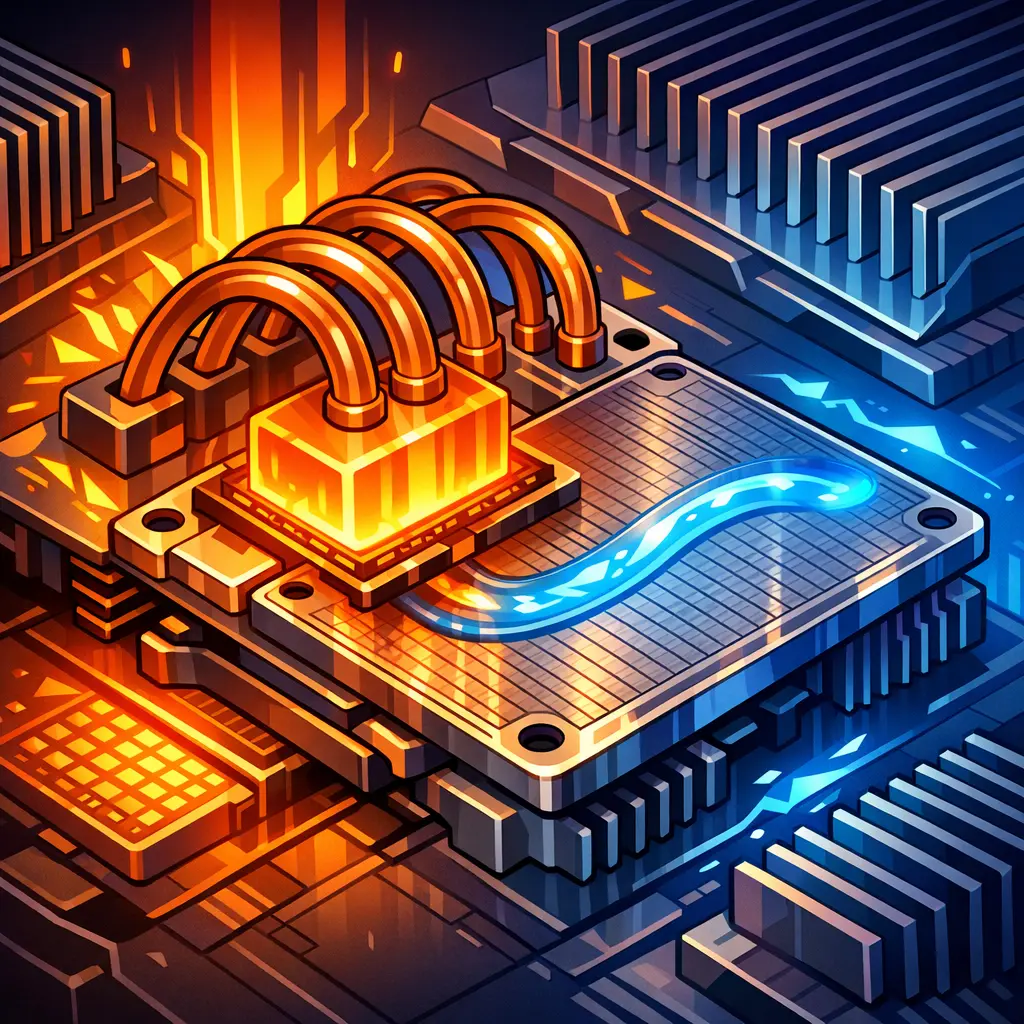
- Understand how heat pipes and vapor chambers transfer heat through phase change and capillary action
- Learn the key components (working fluid, wick, sealed chamber) and their roles
- Compare heat pipes and vapor chambers: advantages, limitations, and typical electronics cooling uses
- Explore design considerations such as fluid selection, wick structure, fill ratio, and orientation for optimal performance
❓ Frequently Asked Questions
What is a heat pipe and how does it work?
A heat pipe is a sealed tube containing a working fluid. The hot end evaporates the fluid, the vapor travels to the cooler end where it condenses and releases heat, and the liquid returns to the hot end via a wick or gravity to repeat the cycle.
What is a vapor chamber and how does it differ from a heat pipe?
A vapor chamber is a flat, sealed cavity that spreads heat across a surface using phase change. It provides wide-area, planar cooling (often with a wick). Heat pipes are typically cylindrical and optimized for high local heat flux; vapor chambers distribute heat over a larger surface area.
What factors affect the performance of heat pipes and vapor chambers?
Fluid choice, wick design, vacuum quality, operating temperature, and orientation all influence performance. Higher capillary pumping and lower thermal resistance improve heat transfer; extreme temperatures or wick failure can reduce efficiency.
Where are these cooling solutions commonly used?
CPUs/GPUs, laptops and other compact electronics, power electronics, LEDs, telecom gear, and aerospace applications where efficient, compact heat spreading is needed.