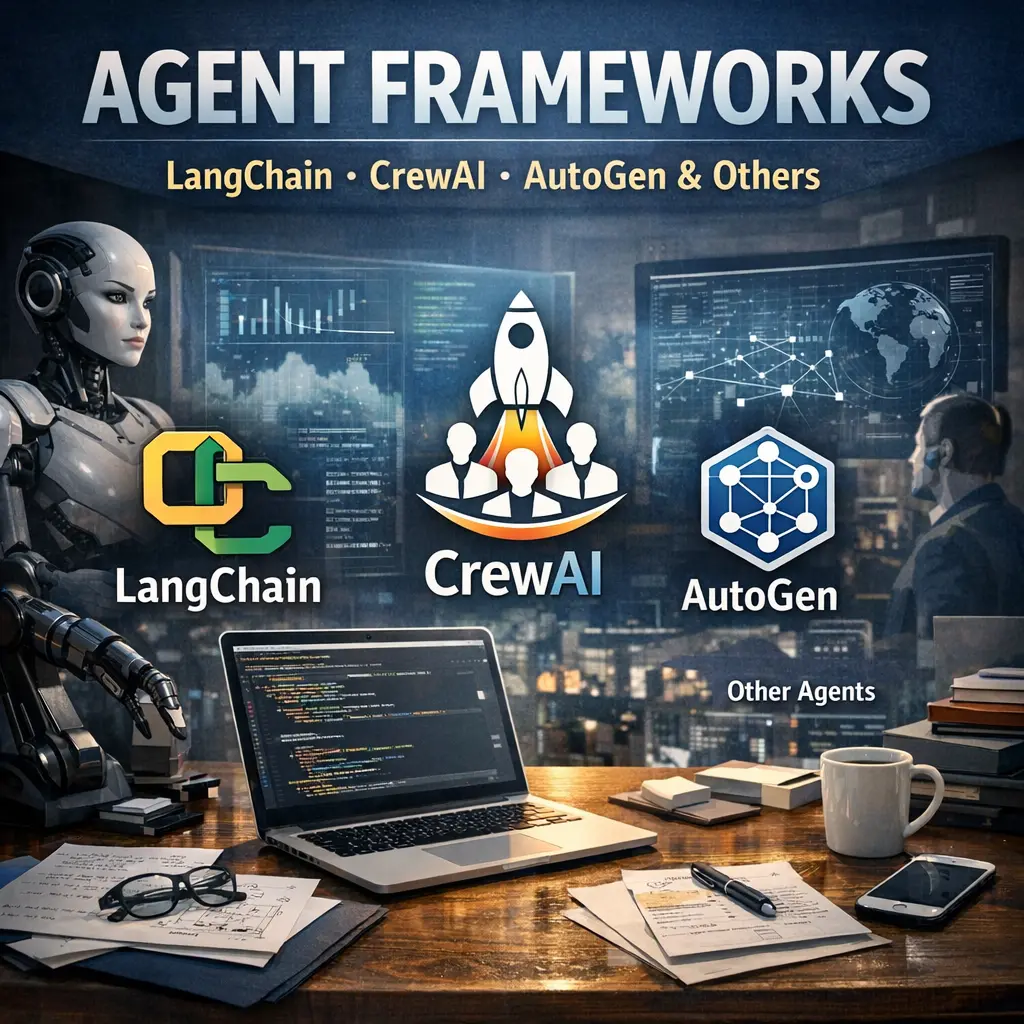
Agent frameworks like LangChain, CrewAI, and AutoGen provide structured environments for building, managing, and orchestrating AI agents. These frameworks enable agents to perform complex tasks, interact with data sources, and collaborate with other agents or humans. Their agent architectures typically include modules for planning, memory, tool integration, and communication, streamlining the development of autonomous and multi-agent systems for applications such as automation, information retrieval, and workflow management.
Agent Frameworks: LangChain, CrewAI, AutoGen & Others
Agent frameworks like LangChain, CrewAI, and AutoGen provide structured environments for building, managing, and orchestrating AI agents. These frameworks enable agents to perform complex tasks, interact with data sources, and collaborate with other agents or humans. Their agent architectures typically include modules for planning, memory, tool integration, and communication, streamlining the development of autonomous and multi-agent systems for applications such as automation, information retrieval, and workflow management.
💡 Key Takeaways
- Understand what agent frameworks are and how they enable autonomous AI tasks using tools and memory.
- Learn the core ideas behind LangChain, CrewAI, AutoGen, and other frameworks, including their typical components and strengths.
- Discover how to choose the right framework for your project based on ecosystem, language support, and community resources.
- Explore practical agent workflows: tool invocation, planning, memory management, error handling, and end-to-end task automation.
❓ Frequently Asked Questions
What is an agent framework in AI?
A library that helps build AI systems where an agent senses data, reasons, and takes actions, often by chaining language models with tools and memory.
What is LangChain used for?
A popular framework for creating LLM-powered apps, providing prompts, chains, tools, and memory to connect language models with data sources and APIs.
What is AutoGen?
A library for building autonomous AI agents that plan, decide, and act using tools, with a focus on reducing boilerplate.
What is CrewAI?
A framework for collaborative or multi-agent AI workflows, enabling agents and humans to coordinate tasks and share context.
How do LangChain, CrewAI, AutoGen & others differ?
They differ in focus and features: LangChain centers on general LLM-powered apps with chains/tools; AutoGen emphasizes autonomous agents; CrewAI focuses on collaborative workflows; others vary by language, tooling, and community.