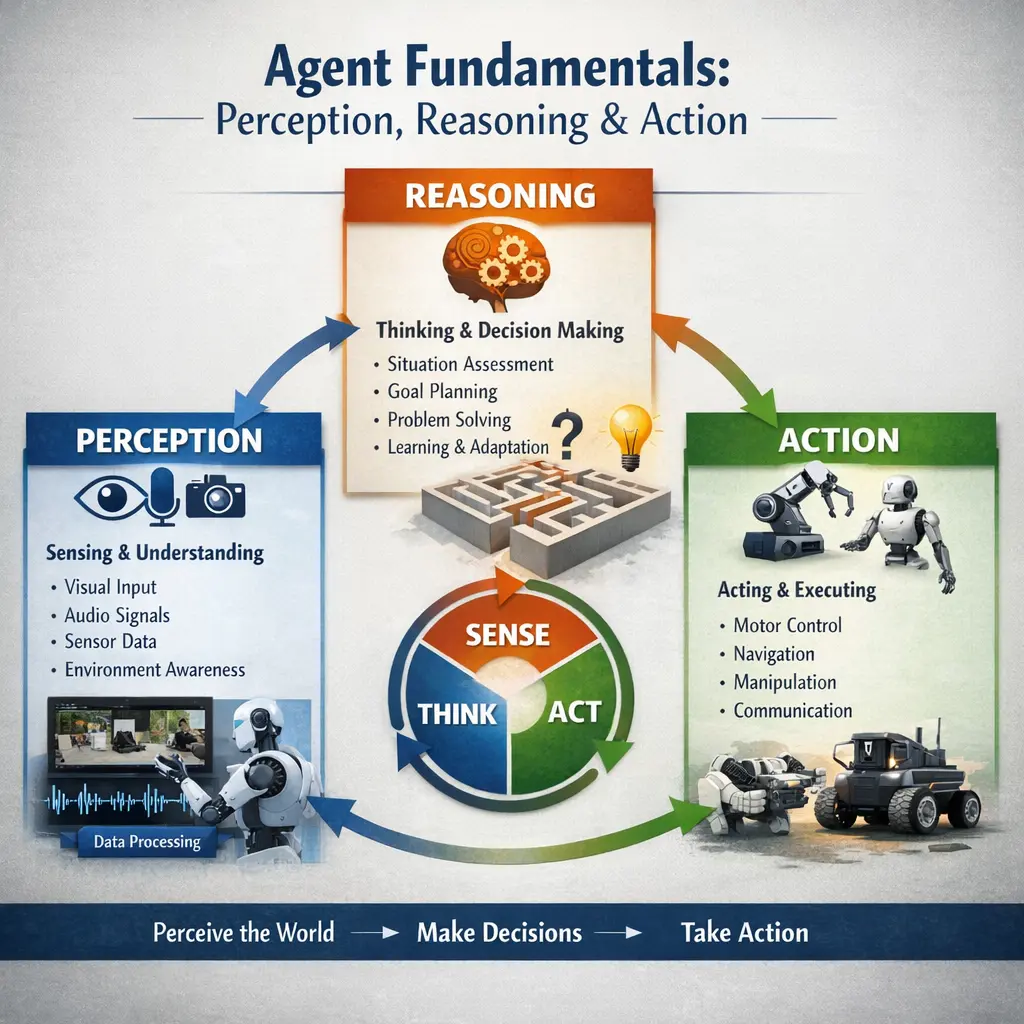
Agent Fundamentals: Perception, Reasoning & Action (Agent Architecture) refers to the core components that define how an intelligent agent operates. Perception involves gathering information from the environment through sensors. Reasoning processes this information, making sense of it and formulating decisions. Action is the execution of those decisions through actuators to influence the environment. Together, these elements form the agent architecture, enabling adaptive and autonomous behavior in dynamic settings.
Agent Fundamentals: Perception, Reasoning & Action+50
Agent Fundamentals: Perception, Reasoning & Action (Agent Architecture) refers to the core components that define how an intelligent agent operates. Perception involves gathering information from the environment through sensors. Reasoning processes this information, making sense of it and formulating decisions. Action is the execution of those decisions through actuators to influence the environment. Together, these elements form the agent architecture, enabling adaptive and autonomous behavior in dynamic settings.
💡 Key Takeaways
- Understand how agents perceive their environment using sensors and build representations to guide decisions.
- Learn how agents reason about possible actions, using rules, planning, or goal-driven search to achieve objectives.
- Explore how an agent's decisions are translated into concrete actions through actuators to affect the environment.
- Compare reactive and deliberative agent architectures and see how perception, reasoning, and action work together for behavior.
❓ Frequently Asked Questions
What are the three core capabilities of an agent?
Perception, reasoning, and action. Perception collects data from the environment via sensors; reasoning uses that data to decide goals or plans; action carries out the chosen plan through actuators to influence the environment.
What does perception mean for an intelligent agent?
The ability to observe the environment with sensors and build a current state representation for decision-making.
What does reasoning involve for an intelligent agent?
Processing observations to infer goals, plan actions, and make decisions (often handling uncertainty with rules, planning, or probabilistic methods).
What does action mean for an intelligent agent?
Executing chosen actions through actuators to change the environment, which then leads to new observations and feedback.