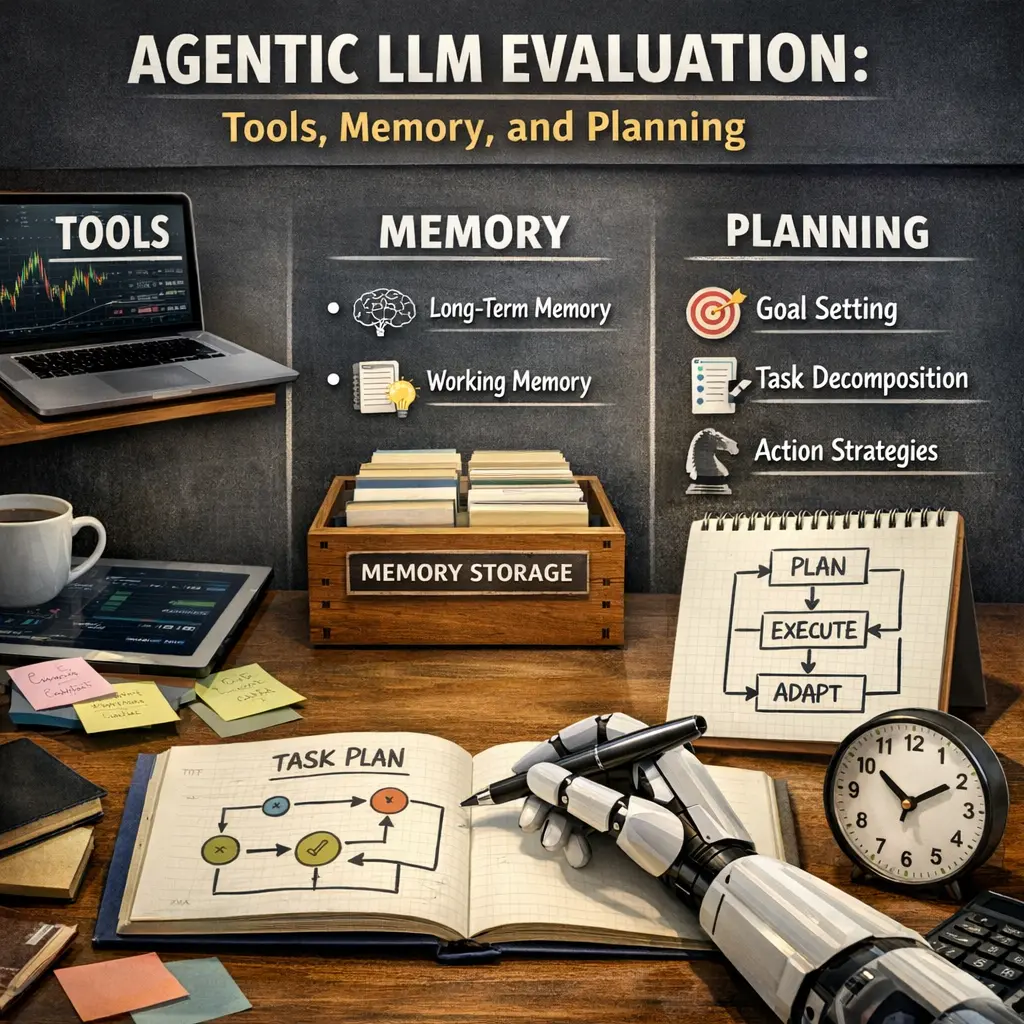
Agentic LLM Evaluation refers to assessing large language models (LLMs) that demonstrate agency, such as autonomous decision-making and problem-solving. This evaluation focuses on how well LLMs utilize tools, manage memory, and plan actions to achieve goals. By simulating real-world tasks, evaluators analyze the model’s ability to interact with external resources, retain relevant information, and execute multi-step strategies, ensuring robust and reliable performance in complex, dynamic environments.
Agentic LLM Evaluation: Tools, Memory, and Planning
Agentic LLM Evaluation refers to assessing large language models (LLMs) that demonstrate agency, such as autonomous decision-making and problem-solving. This evaluation focuses on how well LLMs utilize tools, manage memory, and plan actions to achieve goals. By simulating real-world tasks, evaluators analyze the model’s ability to interact with external resources, retain relevant information, and execute multi-step strategies, ensuring robust and reliable performance in complex, dynamic environments.
💡 Key Takeaways
- Understand what agentic LLMs are and how they differ from standard LLMs in goal-directed behavior.
- Learn how agentic LLMs access and use external tools (APIs, calculators, search) to complete tasks.
- Explore memory mechanisms in agentic LLMs, including context management and retrieval, and their trade-offs.
- Examine planning processes in agentic LLMs: goal setting, task decomposition, action sequencing, and monitoring.
❓ Frequently Asked Questions
What does 'agentic' mean in LLM evaluation?
In this context, agentic means the LLM acts as an autonomous agent that can take actions beyond text generation—using tools, remembering information, and planning steps to reach goals, under defined constraints.
What kinds of tools might an agentic LLM use, and why are they evaluated?
Tools include external APIs, calculators, web search, code execution, or memory retrieval systems. Evaluations measure how effectively the LLM selects and uses tools to complete tasks, including success rate and error handling.
How does memory contribute to agentic LLM performance, and what memory types matter?
Memory allows the model to recall past interactions and maintain context across steps. Key types are short-term working memory (context window) and external long-term memory (databases or vector stores). Evaluation checks recall accuracy and impact on task success.
What is planning in an agentic LLM, and how is it evaluated?
Planning means forming a sequence of actions to achieve a goal. Evaluation considers plan quality (feasibility and completeness), how well plans drive tool use, and robustness to tool failures.