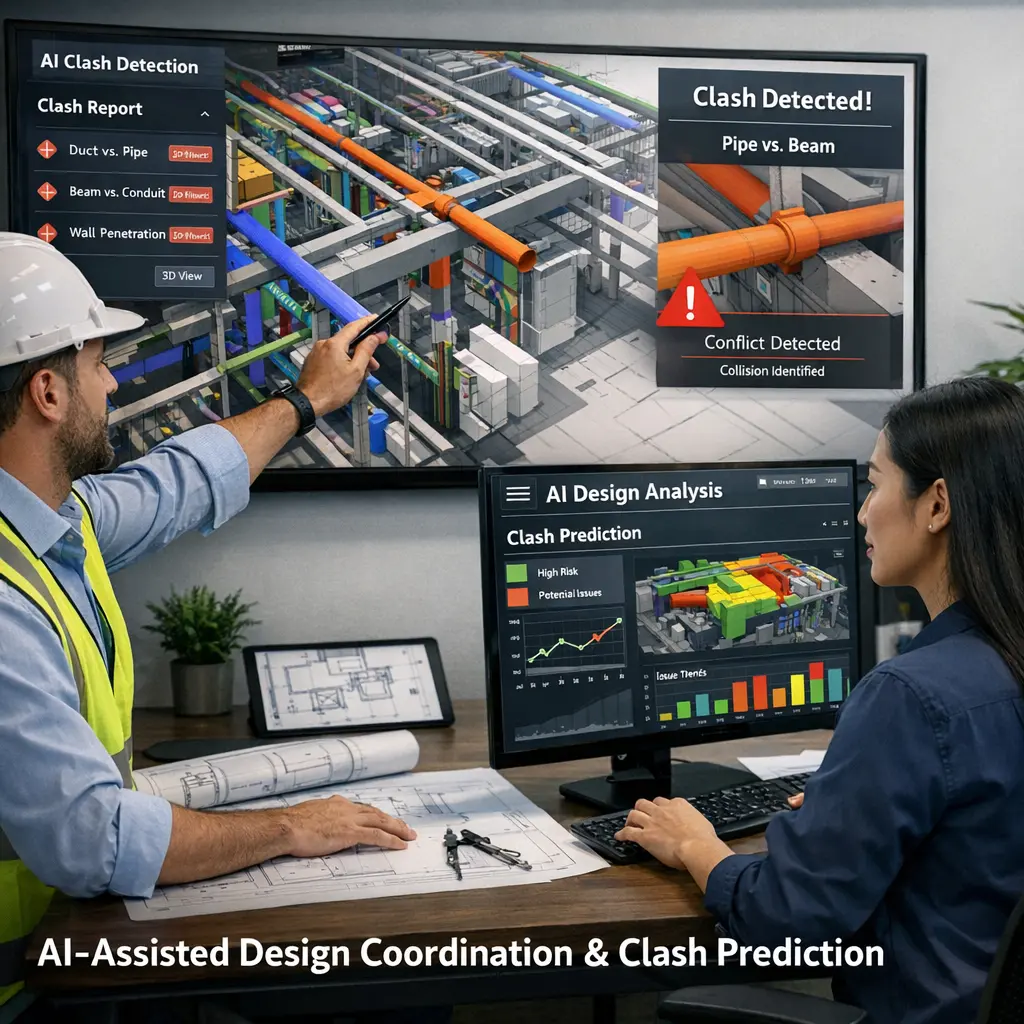
AI-Assisted Design Coordination and Clash Prediction refers to the use of artificial intelligence in managing and integrating multiple construction design models. These digital applications automatically detect and highlight conflicts or "clashes" between architectural, structural, and MEP elements before construction begins. By streamlining coordination among project stakeholders, AI tools reduce errors, minimize rework, and enhance efficiency, leading to improved project outcomes and cost savings in the construction industry.
AI-Assisted Design Coordination and Clash Prediction
AI-Assisted Design Coordination and Clash Prediction refers to the use of artificial intelligence in managing and integrating multiple construction design models. These digital applications automatically detect and highlight conflicts or "clashes" between architectural, structural, and MEP elements before construction begins. By streamlining coordination among project stakeholders, AI tools reduce errors, minimize rework, and enhance efficiency, leading to improved project outcomes and cost savings in the construction industry.
💡 Key Takeaways
- Understand how AI assists in coordinating multidisciplinary design models and identifying clashes early in the project lifecycle.
- Learn how AI-driven clash prediction can reduce rework, improve constructability, and accelerate decision-making.
- Discover how to integrate AI tools within BIM workflows, including data standards, model sharing, and collaboration practices.
- Recognize the limitations, data requirements, and validation steps for AI-generated design coordination insights.
❓ Frequently Asked Questions
What is AI-assisted design coordination?
Using AI-powered tools to align multi-disciplinary design data (architecture, structure, MEP) and automatically flag inconsistencies early, helping teams resolve issues before construction.
What is clash prediction in BIM?
The process of forecasting potential interferences between building components in digital models (e.g., pipes, ducts, structures) before they are built, often using AI to improve accuracy.
How does AI improve clash detection compared to manual reviews?
AI analyzes large models quickly, learns from past projects, reduces false positives, prioritizes critical clashes, and streamlines coordination workflows.
What inputs are needed for AI-driven clash detection?
Digital BIM/3D models (e.g., IFC, Revit), associated metadata, design rules, constraints, and historical clash data to train or guide the AI.