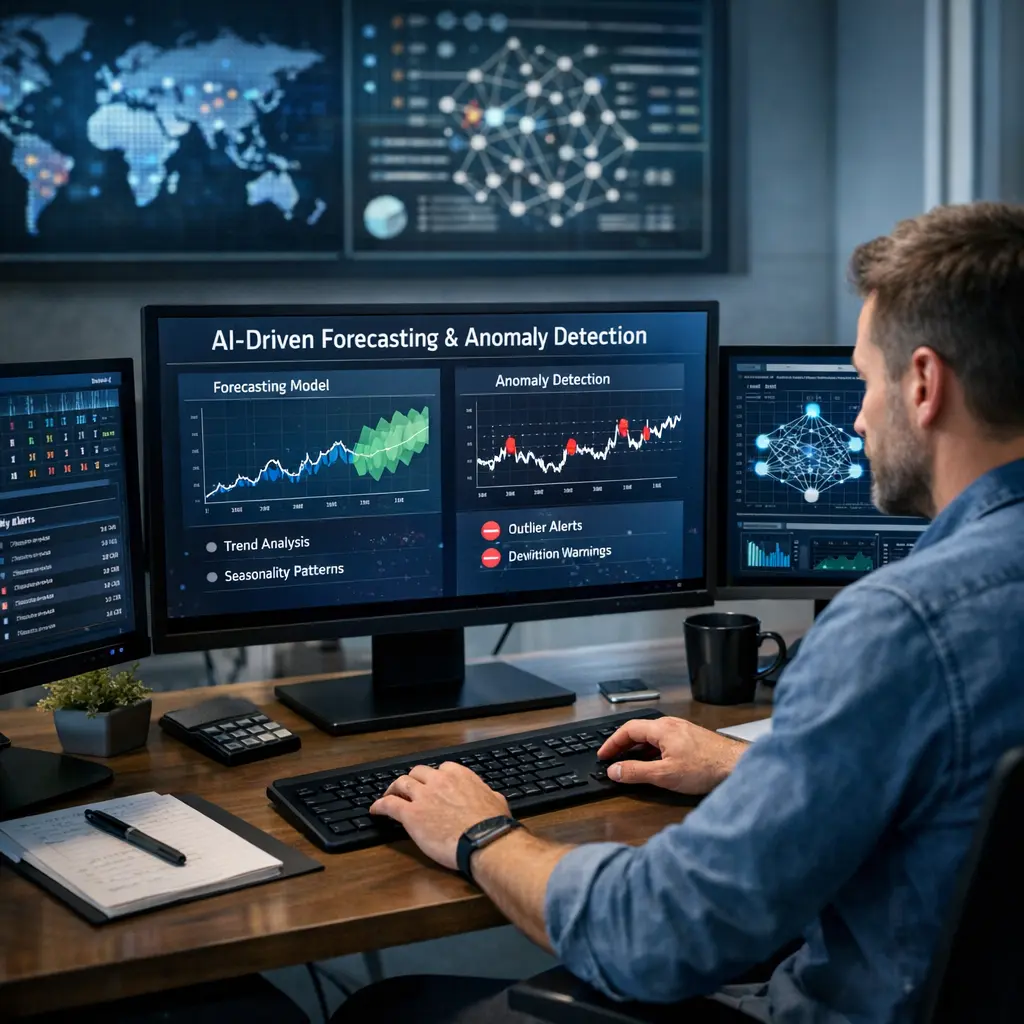
AI-driven forecasting and anomaly detection in financial management and business practices leverage advanced machine learning algorithms to predict future trends, revenues, and expenses with high accuracy. These technologies automatically identify irregularities or unexpected patterns in financial data, enabling organizations to detect fraud, reduce risks, and make proactive decisions. By automating these processes, businesses enhance efficiency, improve financial planning, and maintain greater control over their operations and compliance requirements.
AI-Driven Forecasting & Anomaly Detection
AI-driven forecasting and anomaly detection in financial management and business practices leverage advanced machine learning algorithms to predict future trends, revenues, and expenses with high accuracy. These technologies automatically identify irregularities or unexpected patterns in financial data, enabling organizations to detect fraud, reduce risks, and make proactive decisions. By automating these processes, businesses enhance efficiency, improve financial planning, and maintain greater control over their operations and compliance requirements.
💡 Key Takeaways
- Understand how AI-powered forecasting uses time-series data and machine learning to predict future trends.
- Identify common forecasting models (e.g., ARIMA, Prophet, LSTM) and the role of feature engineering.
- Learn key anomaly detection approaches to spot unusual patterns and outliers in data streams.
- Explore end-to-end workflows for building, validating, and deploying AI forecasting and anomaly detection solutions in production.
❓ Frequently Asked Questions
What is AI-driven forecasting?
AI-driven forecasting uses machine learning models to predict future values from historical data, capturing trends, seasonality and nonlinear patterns beyond traditional methods.
What is anomaly detection in a time series?
Anomaly detection identifies data points or sequences that deviate from the model's expected behavior, signaling unusual events, faults or fraud.
How do AI forecasting and anomaly detection work together?
Forecasting predicts expected values; anomaly detection flags deviations from those forecasts to detect issues early.
What are common techniques used for AI forecasting and anomaly detection?
Forecasting: ARIMA, Prophet, and neural nets. Anomaly detection: Isolation Forest, One-Class SVM, and autoencoder methods.