Animal decision-making processes refer to the ways animals assess situations and choose actions, often involving complex behaviors and instincts. These processes can include selecting food, avoiding predators, finding mates, or navigating environments. Animals use sensory information, past experiences, and social cues to make choices that enhance survival and reproduction. Studying these processes reveals surprising intelligence and adaptability in nature, showcasing how diverse species solve problems in unique and fascinating ways.
Animal Decision-Making Processes
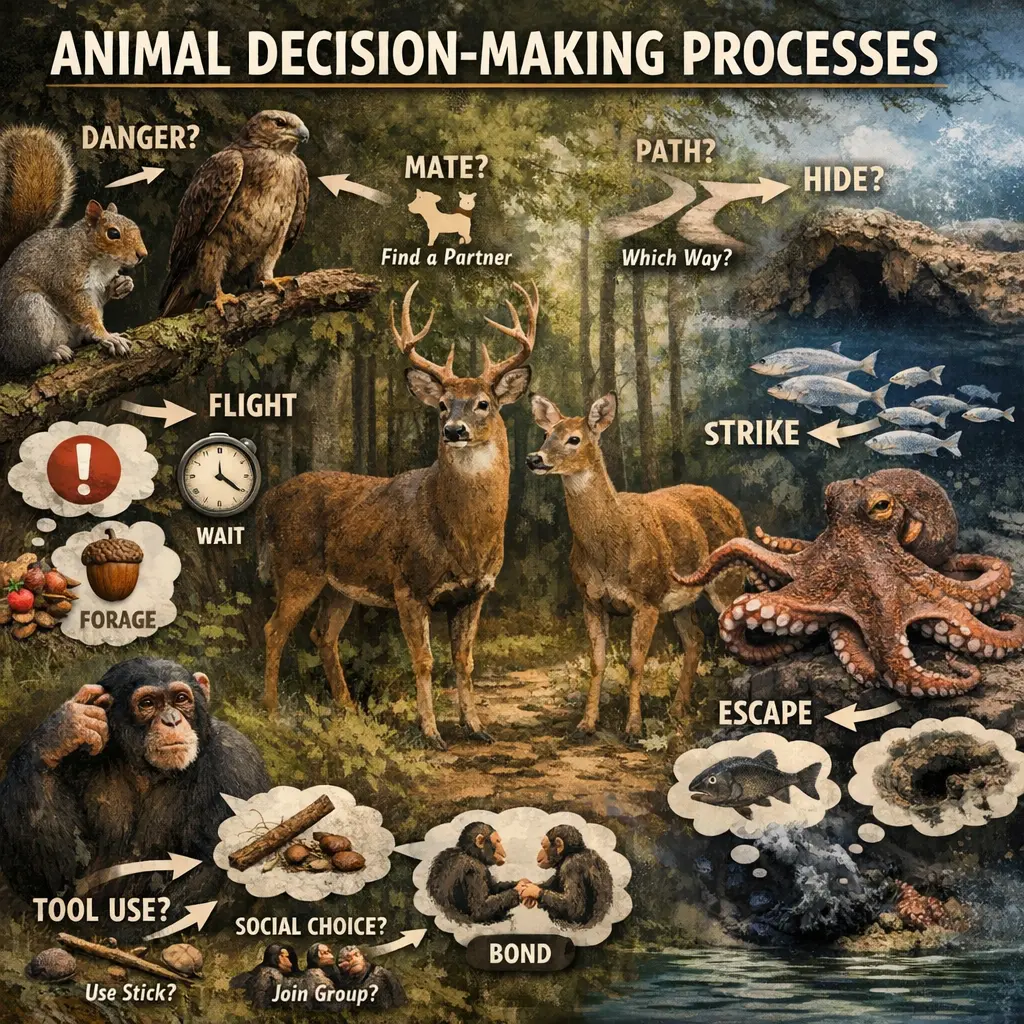
Animal decision-making processes refer to the ways animals assess situations and choose actions, often involving complex behaviors and instincts. These processes can include selecting food, avoiding predators, finding mates, or navigating environments. Animals use sensory information, past experiences, and social cues to make choices that enhance survival and reproduction. Studying these processes reveals surprising intelligence and adaptability in nature, showcasing how diverse species solve problems in unique and fascinating ways.
💡 Key Takeaways
- Explain how animals weigh costs and benefits when choosing between options.
- Identify decision-making strategies used by animals, including instincts, heuristics, and trial-and-error.
- Describe how learning and memory shape future choices and foraging strategies.
- Understand how social information and group dynamics influence collective decisions.
❓ Frequently Asked Questions
What is animal decision-making?
The process by which animals choose actions based on perceptions, internal states, memory, and learning, often aimed at maximizing survival and reproduction.
What factors influence an animal's decisions?
Internal states (hunger, fear, fatigue), external cues (predators, food quality), social context, prior experiences, and the expected costs and rewards of different actions.
Do animals plan ahead or only react to immediate stimuli?
It varies by species and situation. Some show future-oriented planning (e.g., certain birds and primates), while many decisions are rapid reactions guided by learning and simple rules.
How do researchers study animal decision-making?
Through controlled foraging and choice tasks, observations of natural behavior, and models that compare observed choices to predicted costs and benefits; sometimes using neuroscience tools to explore underlying processes.
What is the difference between instinct and decision-making?
Instincts are hard-wired behaviors, while decision-making involves evaluating options and choosing among them, often shaped by learning and context.