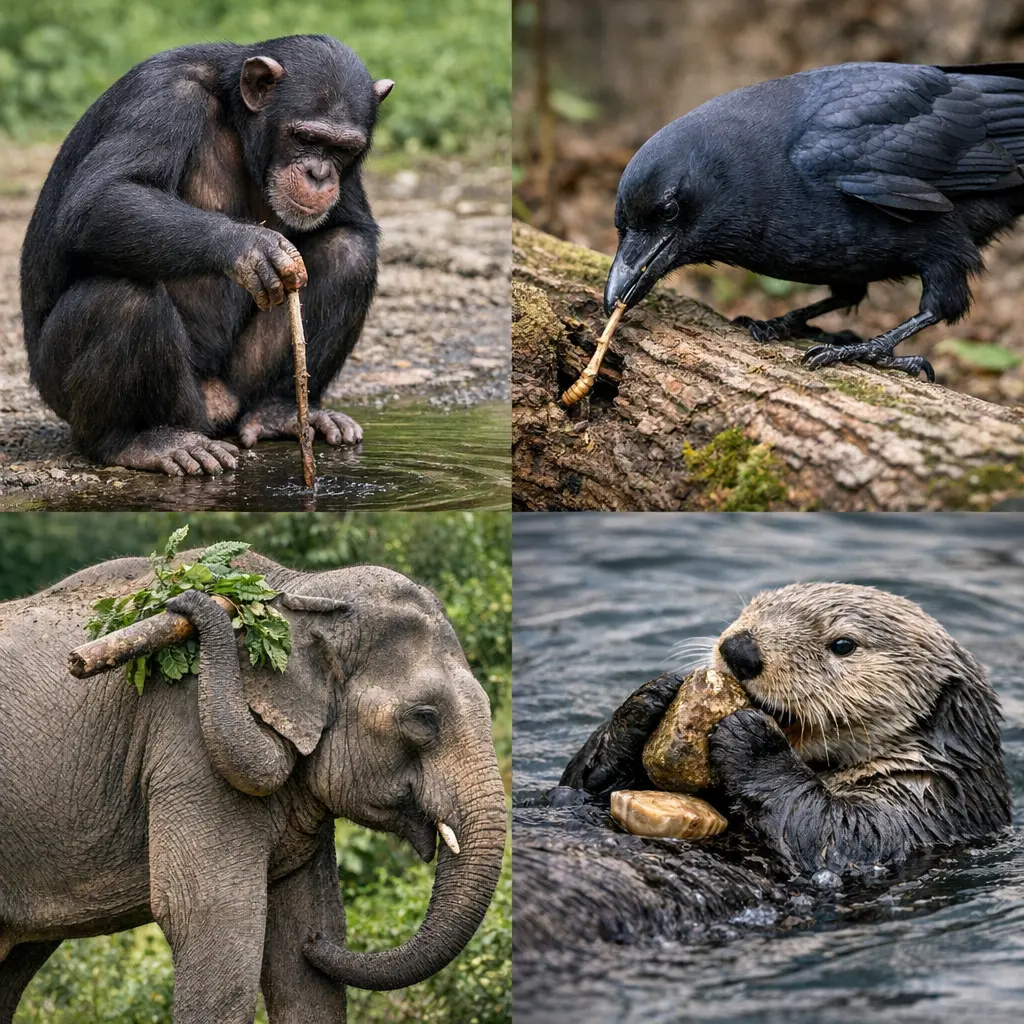
Animal tool use refers to the remarkable ability of certain animals to use objects from their environment as tools to solve problems or obtain food. Examples include chimpanzees using sticks to extract termites, crows bending wires to reach food, and sea otters cracking open shellfish with rocks. This behavior demonstrates intelligence and adaptability, revealing fascinating insights into the cognitive abilities of various animal species in the wild.
Animal Tool Use
Animal tool use refers to the remarkable ability of certain animals to use objects from their environment as tools to solve problems or obtain food. Examples include chimpanzees using sticks to extract termites, crows bending wires to reach food, and sea otters cracking open shellfish with rocks. This behavior demonstrates intelligence and adaptability, revealing fascinating insights into the cognitive abilities of various animal species in the wild.
💡 Key Takeaways
- Define what counts as tool use in animals and how it differs from simple object handling.
- Identify classic and contemporary examples of animal tool use across species (e.g., chimpanzees, crows, octopuses, sea otters).
- Understand the cognitive skills that tool use reveals, such as planning, problem-solving, and learning.
- Recognize the everyday contexts in which animals use tools (foraging, defense, nest-making) and how context matters.
- Learn how researchers observe and study tool use, including common challenges and methods.
❓ Frequently Asked Questions
What is tool use in animals?
Tool use occurs when an animal uses an object to achieve a goal, such as obtaining food or shelter, by manipulating or carrying the object.
Which animals are well-known for using tools?
Species like New Caledonian crows, chimpanzees, orangutans, dolphins, sea otters, and octopuses have been observed making or using tools to solve problems or access food.
Can animal tool use be learned or passed down?
Yes. Tool use is often learned socially and can spread within groups, forming cultural traditions, though some skills may arise independently.
How do scientists study animal tool use?
Researchers use long-term field observations, controlled experiments offering tool-use opportunities, and comparisons across populations to study learning and culture.
What does tool use reveal about animal intelligence?
It shows flexible problem solving, planning, and understanding of object properties, indicating advanced cognition in some species.