Autonomous Vehicles & ADAS Engineering involves designing, developing, and testing advanced technologies that enable vehicles to drive themselves or assist drivers. Professionals in this field work on systems such as sensors, machine learning algorithms, and control software to enhance vehicle safety, efficiency, and user experience. Careers in this area blend skills from robotics, artificial intelligence, software engineering, and automotive design, contributing to the future of transportation and mobility solutions.
Autonomous Vehicles & ADAS Engineering
Autonomous Vehicles & ADAS Engineering involves designing, developing, and testing advanced technologies that enable vehicles to drive themselves or assist drivers. Professionals in this field work on systems such as sensors, machine learning algorithms, and control software to enhance vehicle safety, efficiency, and user experience. Careers in this area blend skills from robotics, artificial intelligence, software engineering, and automotive design, contributing to the future of transportation and mobility solutions.
💡 Key Takeaways
- Distinguish ADAS from fully autonomous driving and SAE levels.
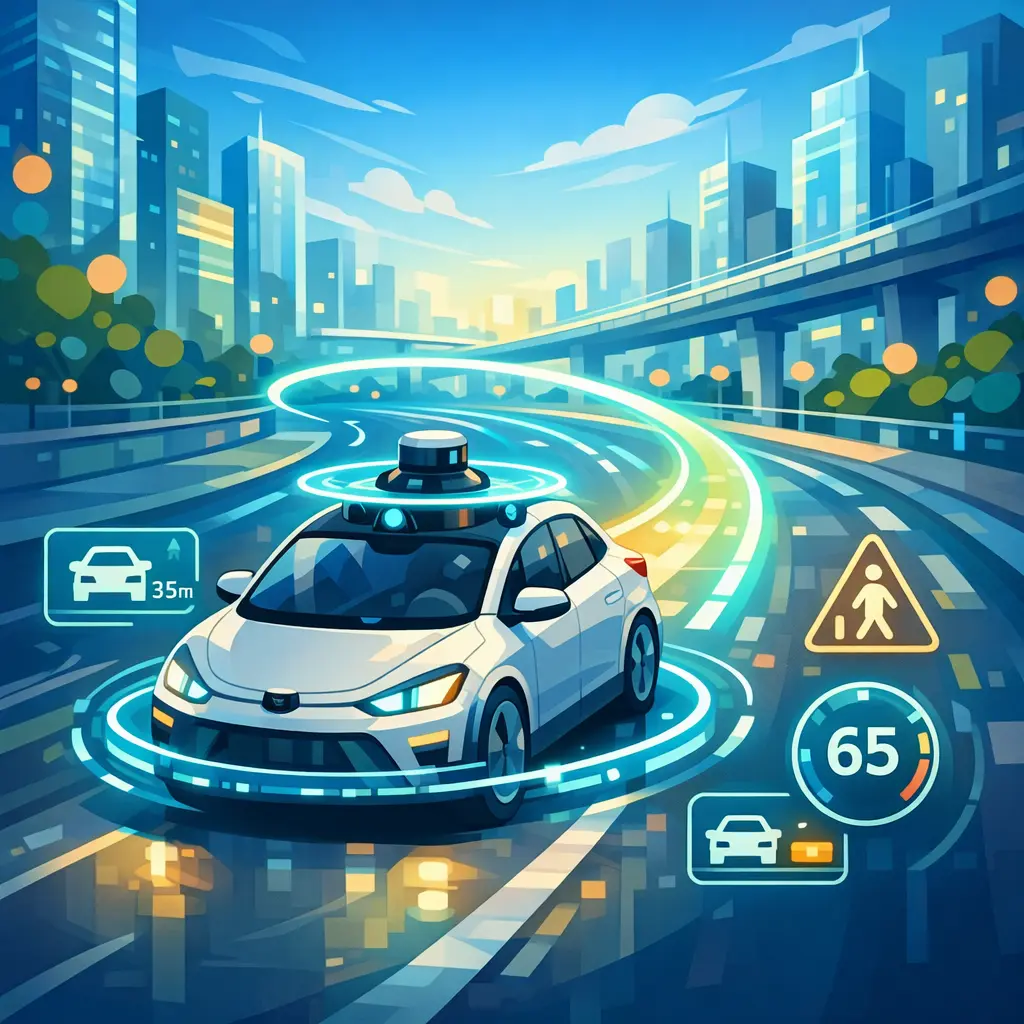
- Identify main sensors (camera, LiDAR, radar) and their roles in perception.
- Understand the AV software stack: perception, localization and mapping, planning, and control.
- Recognize key safety, testing, and regulatory considerations in autonomous driving.
❓ Frequently Asked Questions
What is ADAS and how does it relate to autonomous driving?
ADAS (Advanced Driver Assistance Systems) provides safety and convenience features that typically require driver supervision. Autonomous driving aims to operate the vehicle with little to no human input, representing higher levels of automation.
What sensors are commonly used in ADAS and autonomous vehicles?
Common sensors include cameras, radar, lidar, and ultrasonic sensors. GPS/IMU and V2X data are often used for localization and awareness.
What is the difference between perception, localization, planning, and control in the AV/ADAS stack?
Perception detects objects and the environment; localization estimates the vehicle's position; planning computes a safe trajectory; control executes the trajectory via steering, throttle, and braking.
What are common safety and testing approaches for ADAS/AVs?
Functional safety standards (e.g., ISO 26262), model-based design, simulation, and hardware-in-the-loop (HIL) testing, plus scenario-based real-world validation.
What are the driving automation levels and what do they mean?
Levels range from 0 to 5: 0 = no automation; 2 = combined acceleration and steering; 3 = conditional automation; 4 = high automation in certain conditions; 5 = full automation in all conditions.