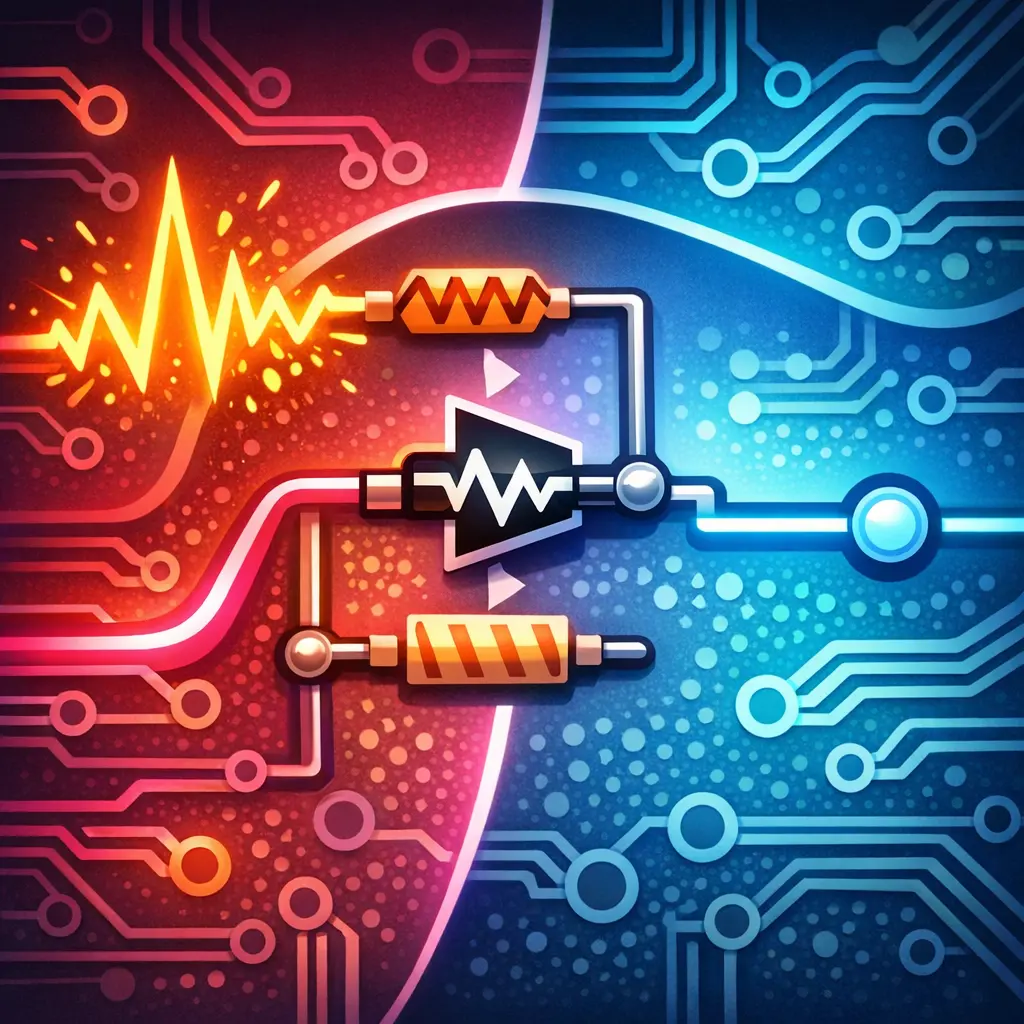
Band-pass and band-stop passive networks are electrical circuits made with resistors, capacitors, and inductors that filter specific frequency ranges. A band-pass network allows signals within a certain frequency range to pass through while blocking frequencies outside that range. Conversely, a band-stop network blocks or attenuates signals within a specific frequency band, letting frequencies outside that range pass. These networks are essential in signal processing and communications for frequency selection or rejection.
Band-Pass & Band-Stop Passive Networks
Band-pass and band-stop passive networks are electrical circuits made with resistors, capacitors, and inductors that filter specific frequency ranges. A band-pass network allows signals within a certain frequency range to pass through while blocking frequencies outside that range. Conversely, a band-stop network blocks or attenuates signals within a specific frequency band, letting frequencies outside that range pass. These networks are essential in signal processing and communications for frequency selection or rejection.
💡 Key Takeaways
- Distinguish band-pass from band-stop passive networks and describe their frequency responses.
- Explain how a passive RLC circuit forms a band-pass or band-stop filter using series/parallel configurations.
- Identify key bandwidth-related terms (center frequency, bandwidth, Q factor, and roll-off) and how they influence selectivity.
- Recognize common practical considerations (component tolerances, parasitics, and losses) when designing passive filters.
❓ Frequently Asked Questions
What is a band-pass passive network?
A circuit made only of passive components (R, L, C) that passes signals within a specified frequency range with minimal loss, while attenuating frequencies outside that range.
What is a band-stop (notch) passive network?
A circuit made only of passive components that attenuates a narrow frequency band (the notch) while allowing frequencies outside that band to pass with less attenuation.
What do center frequency, bandwidth, and Q mean in these networks?
Center frequency is the middle of the pass or notch band. Bandwidth is the width of the frequency range that is passed (band-pass) or attenuated (notch) to a specified level. Q = f0 / Δf; higher Q means a narrower, sharper response.
How do LC components enable these filters?
Inductors and capacitors create resonances at f0 ≈ 1/(2π√(LC)). By arranging LC networks with the source and load, the circuit shapes impedance versus frequency to produce a passband (band-pass) or a notch (band-stop).