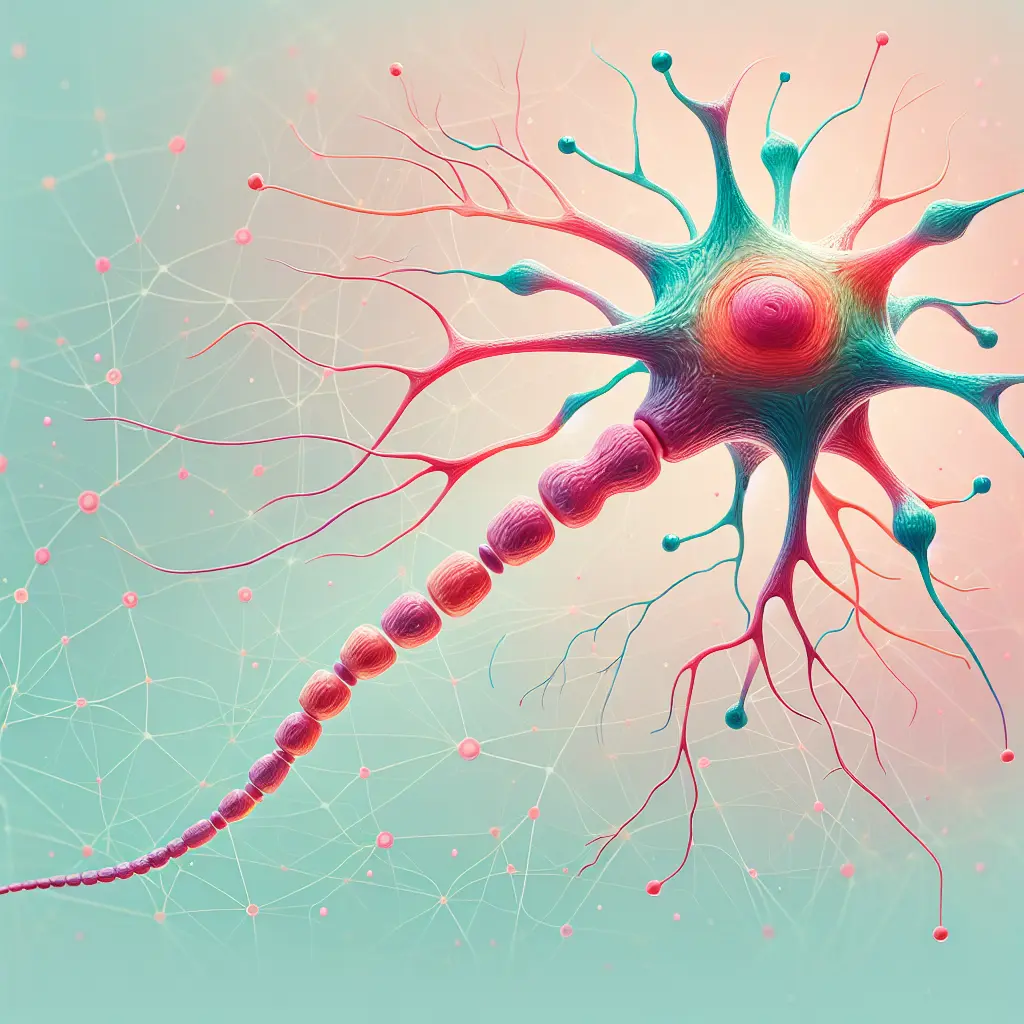
Neurons are specialized cells in the nervous system responsible for transmitting information throughout the body. They consist of three main parts: the cell body, dendrites, and axon. Dendrites receive signals from other neurons, while the axon sends signals to other cells. Neurons communicate through electrical impulses and chemical neurotransmitters at synapses, enabling functions such as sensation, movement, and cognition. Their unique structure and function are fundamental to brain and nervous system activity.
Basic Concepts of Neurons+50
Neurons are specialized cells in the nervous system responsible for transmitting information throughout the body. They consist of three main parts: the cell body, dendrites, and axon. Dendrites receive signals from other neurons, while the axon sends signals to other cells. Neurons communicate through electrical impulses and chemical neurotransmitters at synapses, enabling functions such as sensation, movement, and cognition. Their unique structure and function are fundamental to brain and nervous system activity.
💡 Key Takeaways
- Identify the three main parts of a neuron—the cell body, dendrites, and axon—and their roles.
- Describe how dendrites receive signals and how the axon sends signals to other cells.
- Explain neuron-to-neuron communication at synapses via electrical impulses and neurotransmitters.
- Compare biological neurons with artificial neurons in neural networks, noting key similarities and differences.
❓ Frequently Asked Questions
What are the three main parts of a neuron?
The cell body (soma), dendrites, and an axon.
What is the function of dendrites?
Dendrites receive signals from other neurons and pass them toward the cell body.
What is the function of the axon?
The axon carries signals away from the cell body to other neurons, muscles, or glands.
How do neurons communicate with other neurons?
They communicate at synapses, where neurotransmitters released from the axon terminals cross the gap and bind to receptors on the next neuron.