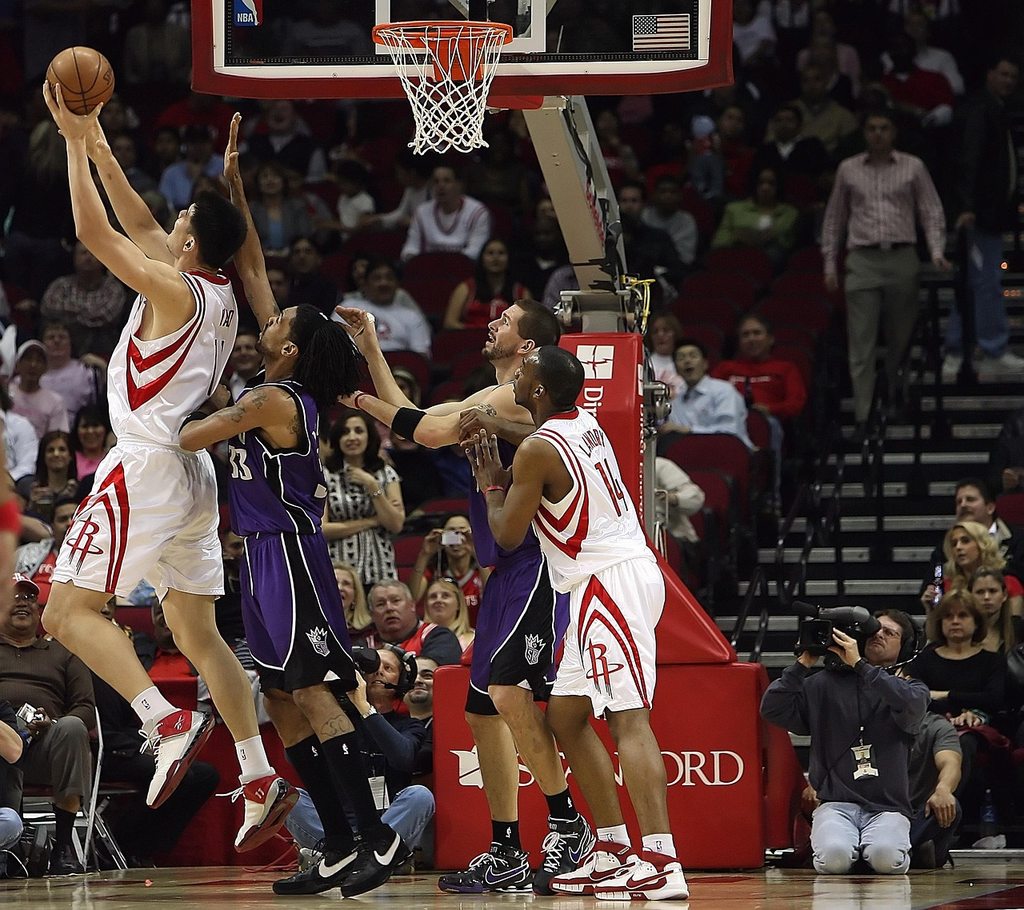
A college basketball court measures 94 feet long by 50 feet wide. Key features include the center circle for tip-offs, free-throw lanes (the “key”) near each basket, and three-point arcs set at 22 feet, 1¾ inches from the basket. Each end has a backboard and rim, with painted restricted areas to prevent charging fouls. Sidelines and baselines mark the court’s boundaries, and team benches are placed along one sideline.
Basketball Court Layout+40
A college basketball court measures 94 feet long by 50 feet wide. Key features include the center circle for tip-offs, free-throw lanes (the “key”) near each basket, and three-point arcs set at 22 feet, 1¾ inches from the basket. Each end has a backboard and rim, with painted restricted areas to prevent charging fouls. Sidelines and baselines mark the court’s boundaries, and team benches are placed along one sideline.
💡 Key Takeaways
- Identify major court markings: baselines, sidelines, center circle, free-throw line, three-point line, the painted key, restricted area, and out-of-bounds.
- Explain the purpose of each area (three-point line, free-throw lane, restricted area, and three-second area) and how it affects play.
- Know standard court dimensions and common variations (NBA, FIBA, college) and where to find them on the court.
- Understand how court layout influences offensive spacing, defensive positioning, and game boundaries.
❓ Frequently Asked Questions
What are the main zones and lines on a basketball court?
The court includes boundary lines (sidelines and baselines), a center line and center circle, the painted lane area (the key), the free-throw line, the 3-point line, the restricted area under the basket, and the backboard with the rim.
How far is the free-throw line from the backboard?
The free-throw line is 15 feet from the backboard, parallel to the endline, forming the free-throw lane.
What is the 3-point line and does its distance vary by league?
The 3-point line is the arc around the basket; shots from beyond it are worth three points. Its distance varies by league (roughly 22–24 feet from the rim; NBA uses 23.75 ft, corners ~22 ft).
What is the restricted area under the basket?
A small semicircular zone beneath the basket where defensive players cannot draw charging fouls; it is typically about a 4-foot radius.