The BDI (Belief-Desire-Intention) Model is an agent architecture used in artificial intelligence to simulate human-like reasoning and decision-making. In this model, "Beliefs" represent the agent's information about the world, "Desires" are the objectives or goals the agent wishes to achieve, and "Intentions" are the plans or actions the agent commits to pursuing. The BDI framework enables agents to make rational choices by continuously updating beliefs and intentions based on changing circumstances.
BDI (Belief-Desire-Intention) Model Basics
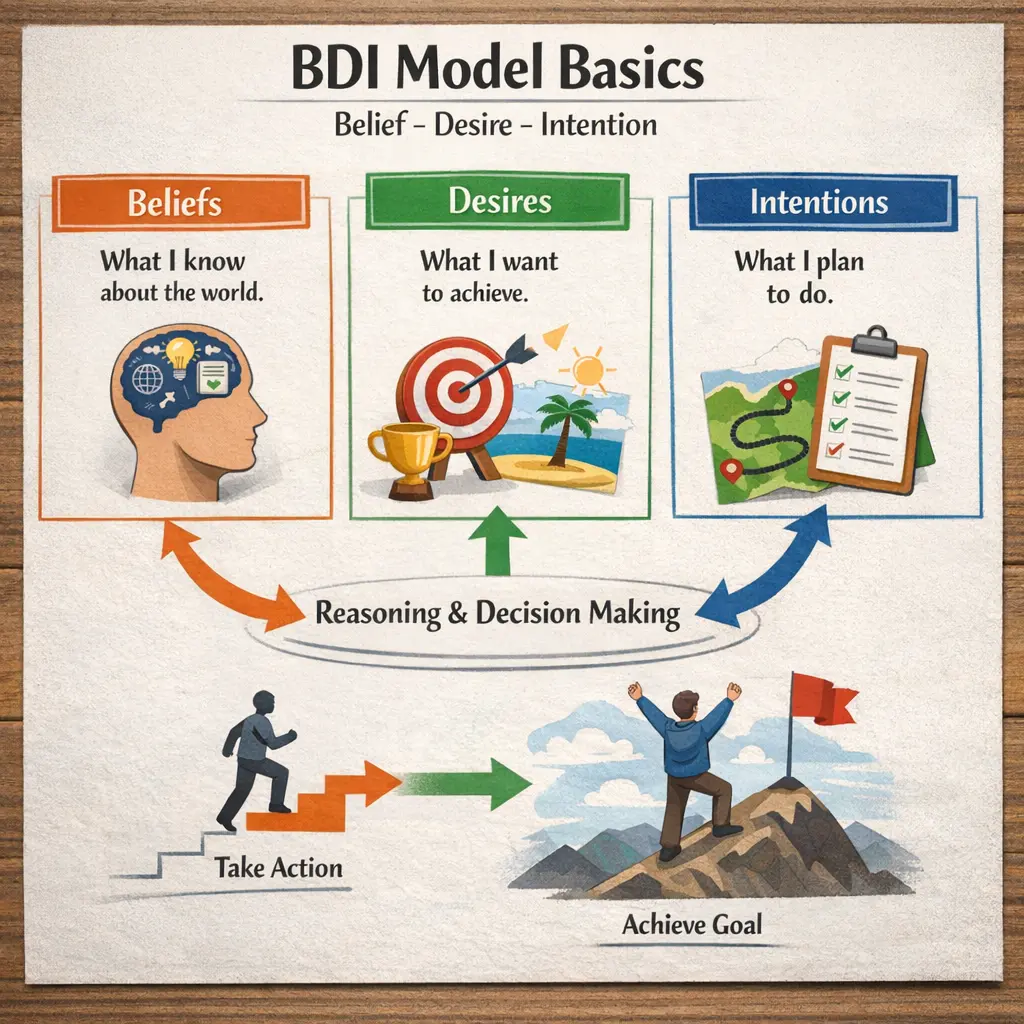
The BDI (Belief-Desire-Intention) Model is an agent architecture used in artificial intelligence to simulate human-like reasoning and decision-making. In this model, "Beliefs" represent the agent's information about the world, "Desires" are the objectives or goals the agent wishes to achieve, and "Intentions" are the plans or actions the agent commits to pursuing. The BDI framework enables agents to make rational choices by continuously updating beliefs and intentions based on changing circumstances.
💡 Key Takeaways
- Identify the three core components of the BDI model—Beliefs, Desires, and Intentions—and their roles in guiding agent behavior.
- Explain how the Belief base reflects the agent’s knowledge about the world and how Desires set the objectives to pursue.
- Describe how Intentions select and commit to plans to achieve goals, including plan libraries and practical reasoning.
- Discuss typical applications and trade-offs of BDI in dynamic, autonomous environments (strengths and limitations).
❓ Frequently Asked Questions
What is the BDI model?
The BDI model is an AI agent architecture that uses three mental states—beliefs (world information), desires (goals), and intentions (committed plans)—to guide reasoning and action.
What do beliefs represent in BDI?
Beliefs are the agent’s information about the world, which can be uncertain or incomplete and are used to reason about what actions are possible.
What are desires and intentions in BDI?
Desires are the objectives the agent wishes to achieve, while intentions are the subset of desires that the agent commits to pursuing with a plan.
How do Beliefs, Desires, and Intentions interact?
Beliefs inform what is feasible, desires generate goals, and intentions select and commit to concrete actions to achieve those goals; the agent updates beliefs, adjusts desires, and acts through its intentions.
Where is the BDI model commonly used?
BDI is used in autonomous agents, robotics, and game AI to enable human-like reasoning and decision-making under uncertainty.