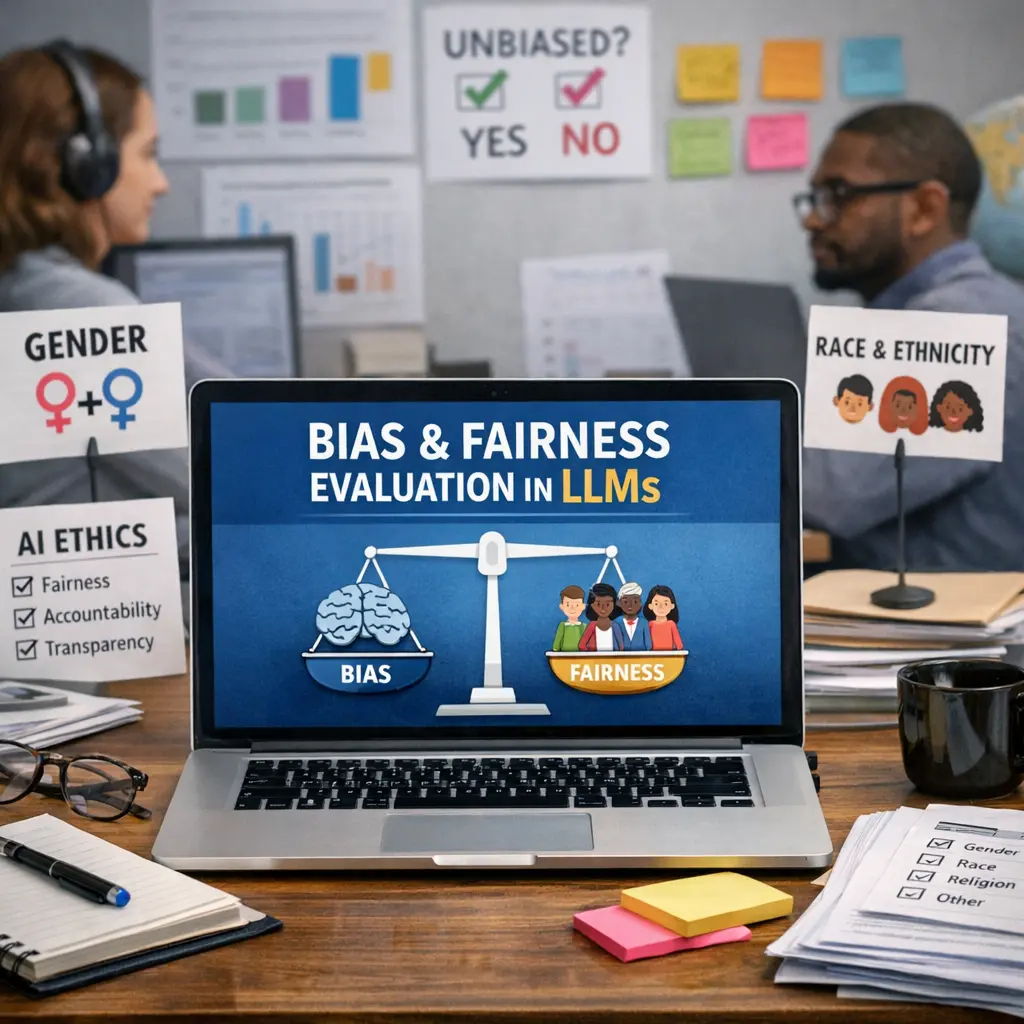
Bias & Fairness Evaluation in LLMs (LLM Evaluations or evals) refers to systematically assessing large language models for unintended prejudices or unequal treatment across demographic groups. This process involves testing models on diverse datasets to identify and measure biases in outputs, ensuring that responses are equitable and do not reinforce harmful stereotypes. Such evaluations help improve model fairness, guide responsible AI deployment, and build trust in language technologies.
Bias & Fairness Evaluation in LLMs+50
Bias & Fairness Evaluation in LLMs (LLM Evaluations or evals) refers to systematically assessing large language models for unintended prejudices or unequal treatment across demographic groups. This process involves testing models on diverse datasets to identify and measure biases in outputs, ensuring that responses are equitable and do not reinforce harmful stereotypes. Such evaluations help improve model fairness, guide responsible AI deployment, and build trust in language technologies.
💡 Key Takeaways
- Understand what bias and fairness mean in the context of LLMs and why evaluating them matters
- Identify common sources of bias in data, prompts, and model outputs
- Learn key evaluation metrics for fairness (e.g., disparities in error rates, calibration, and group parity)
- Apply practical steps to interpret results and mitigate bias during evaluation and deployment
❓ Frequently Asked Questions
What is bias in LLMs?
Bias in large language models is a systematic prejudice in outputs that favors or disadvantages certain groups, often arising from training data, representations, or evaluation methods.
What is fairness evaluation in LLMs?
Fairness evaluation checks whether a model's outputs are equitable across different demographic groups, using predefined metrics and tests to detect and measure disparities.
What are common fairness metrics used in LLM evaluation?
Demographic parity (equal positive rate across groups), Equalized odds (equal false positive and false negative rates), and calibration (predicted likelihoods match actual outcomes).
How can bias in LLMs be mitigated?
Mitigation includes data balancing and curation, fairness-aware training, prompting strategies, and post-processing or auditing with diverse evaluation datasets.