Bias Mitigation Evaluation refers to the systematic assessment of methods used to reduce or eliminate biases in large language models (LLMs). This process involves evaluating the effectiveness of debiasing techniques by measuring how well they address specific biases without significantly compromising model performance or introducing new issues. Trade-offs are also considered, as reducing bias may sometimes impact accuracy, utility, or other important metrics. Evals help ensure balanced, fair, and practical model improvements.
Bias Mitigation Evaluation: Debiasing Effectiveness and Trade-offs
Bias Mitigation Evaluation refers to the systematic assessment of methods used to reduce or eliminate biases in large language models (LLMs). This process involves evaluating the effectiveness of debiasing techniques by measuring how well they address specific biases without significantly compromising model performance or introducing new issues. Trade-offs are also considered, as reducing bias may sometimes impact accuracy, utility, or other important metrics. Evals help ensure balanced, fair, and practical model improvements.
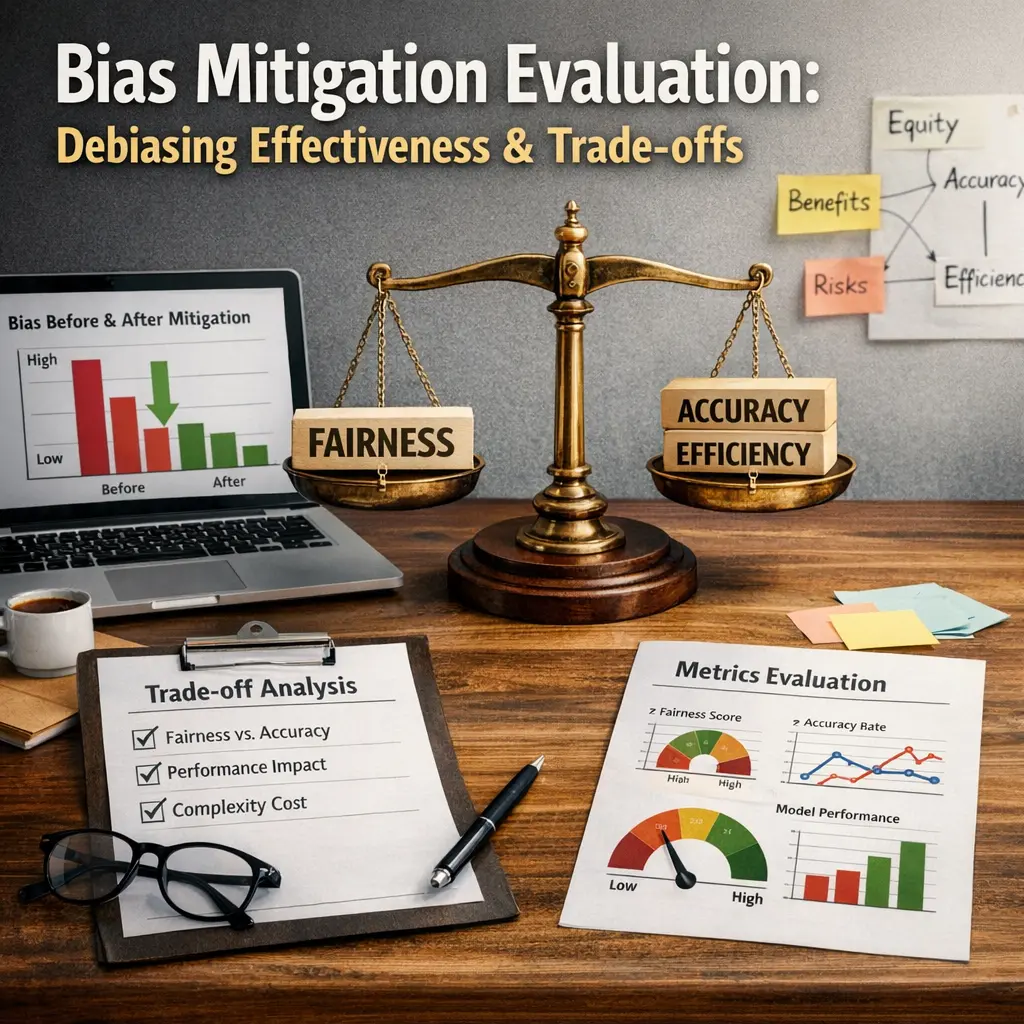
💡 Key Takeaways
- Understand how to measure debiasing effectiveness using fairness metrics (e.g., demographic parity, equalized odds) and utility metrics (accuracy) across groups.
- Grasp the trade-offs between fairness and accuracy, including how increasing fairness can affect overall performance and how to balance competing goals.
- Identify data quality and representativeness issues that influence debiasing outcomes, and consider risks like data leakage or minority group underrepresentation.
- Compare pre-processing, in-processing, and post-processing debiasing strategies and their implications for interpretability and deployment.
- Learn how to design robust evaluation experiments (cross-validation, holdout groups, subgroup analyses) to fairly compare debiasing methods and detect unintended effects.
❓ Frequently Asked Questions
What is bias mitigation evaluation?
Bias mitigation evaluation is the process of assessing how well a debiasing method reduces unfair outcomes in a model while maintaining its core performance on the task.
What does debiasing effectiveness mean?
Debiasing effectiveness measures how well a method lowers unfair impact across protected groups, typically shown through fairness metrics, without significantly harming overall accuracy.
What are common trade-offs when applying debiasing techniques?
Common trade-offs include potential drops in accuracy or utility, possible loss of important signal, calibration changes, and the risk of introducing new biases or unintended effects in some groups.
How can you robustly evaluate debiasing methods?
Use multiple datasets, apply several fairness metrics (e.g., demographic parity, equalized odds, calibration), assess utility metrics, test cross-dataset generalization, examine distribution shifts, and run ablations to understand contributing factors.
What should be included when reporting debiasing results?
Report the chosen metrics for each group, overall task performance, fairness-utility trade-off, confidence intervals, sample sizes, and any limitations or real-world implications of the method.