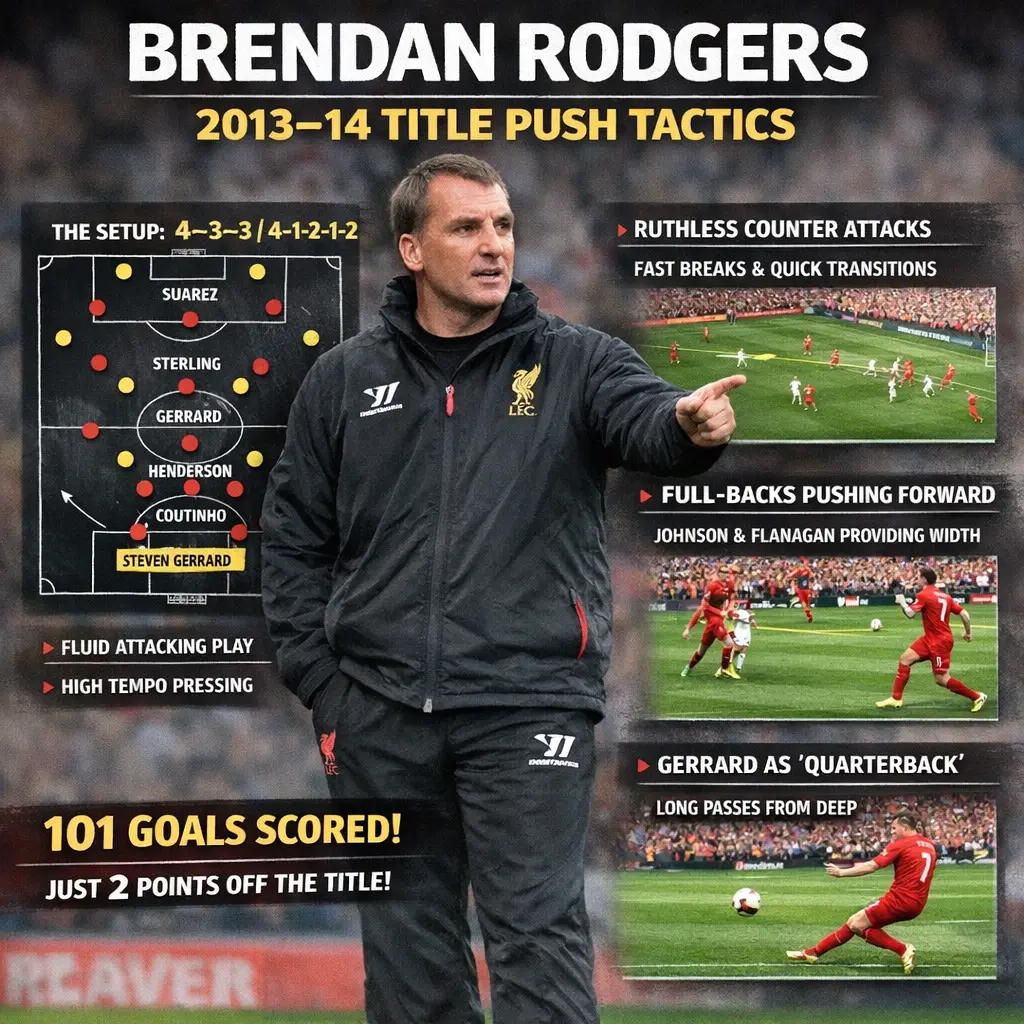
In the 2013–14 season, Brendan Rodgers deployed an attacking, high-tempo style at Liverpool, emphasizing quick transitions, fluid movement, and aggressive pressing. His 4-3-3 and 4-4-2 diamond formations leveraged the pace and creativity of Luis Suárez, Daniel Sturridge, and Raheem Sterling, supported by Steven Gerrard’s deep-lying playmaking. Rodgers’ tactics produced prolific goal-scoring, making Liverpool title contenders, though defensive vulnerabilities ultimately cost them the championship.
Brendan Rodgers: 2013–14 Title Push Tactics
In the 2013–14 season, Brendan Rodgers deployed an attacking, high-tempo style at Liverpool, emphasizing quick transitions, fluid movement, and aggressive pressing. His 4-3-3 and 4-4-2 diamond formations leveraged the pace and creativity of Luis Suárez, Daniel Sturridge, and Raheem Sterling, supported by Steven Gerrard’s deep-lying playmaking. Rodgers’ tactics produced prolific goal-scoring, making Liverpool title contenders, though defensive vulnerabilities ultimately cost them the championship.
💡 Key Takeaways
- Understand how Rodgers' Liverpool used a high-pressing, quick-transition approach to win the ball and create chances.
- See how the front three (Suarez, Sturridge, Sterling) swapped positions to disrupt defenses and exploit space.
- Learn how overlapping full-backs stretched defenses and supplied width for attacks.
- Recognize how the team built play from the back and maintained defensive shape to balance risk and reward during the title push.
❓ Frequently Asked Questions
What was Brendan Rodgers' tactical focus during Liverpool's 2013–14 title push?
A high-pressing, possession-based approach with quick transitions, a compact midfield, and energetic full-backs supporting a potent front line.
Who were the key attacking players for Liverpool in 2013–14 under Rodgers?
Luis Suárez and Daniel Sturridge formed the main strike partnership, with Philippe Coutinho and Raheem Sterling providing creativity and pace in support.
What formations did Rodgers commonly use during that season?
Rodgers often deployed a forward-leaning setup around a 4-3-3 or 4-2-3-1, with Gerrard as a deep-lying midfielder and full-backs pushing high for width.
What were the defensive principles of Rodgers' system in 2013–14?
A compact team shape with high pressing to win the ball early, aiming to deny opponents space in midfield and quickly regain possession.
What was the outcome of Liverpool's 2013–14 title push?
Liverpool finished 2nd in the Premier League, narrowly missing the title as Manchester City won it.