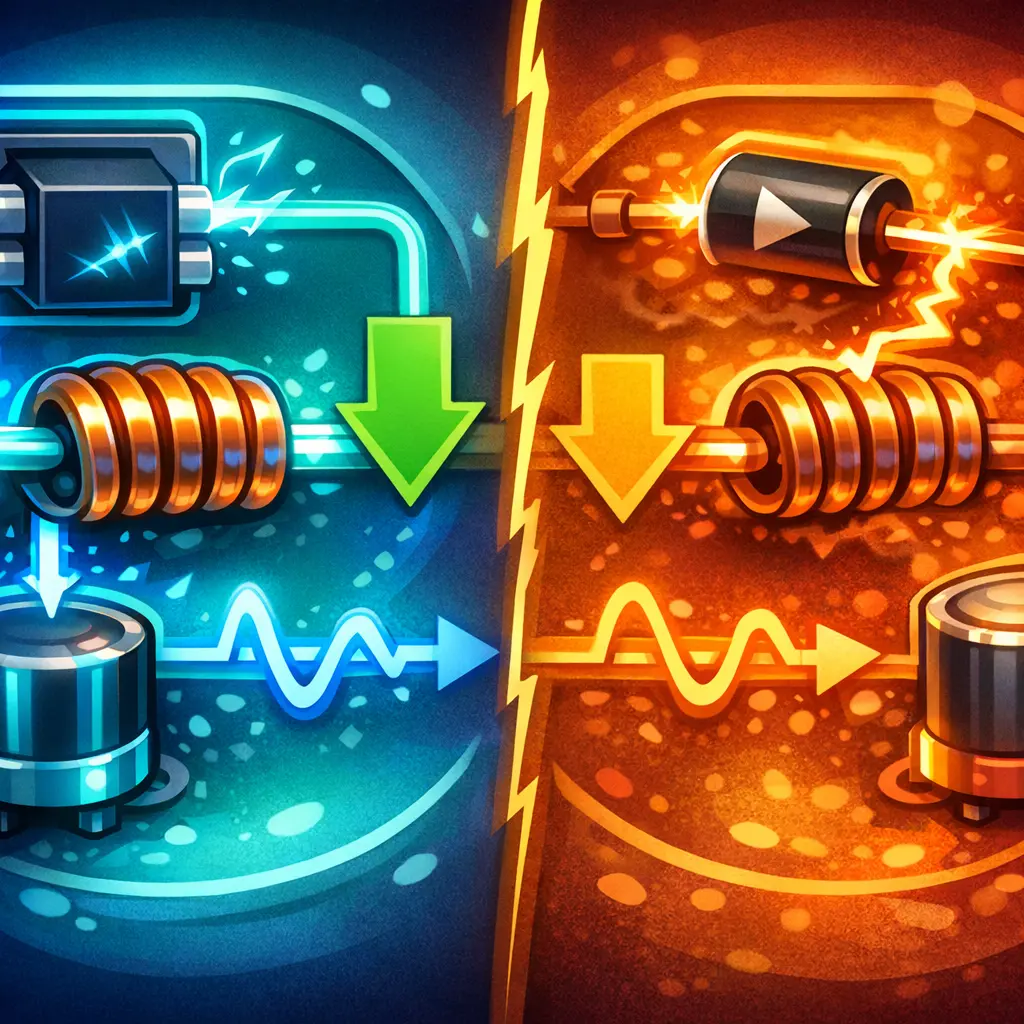
Buck converters are DC-DC voltage regulators that step down voltage. Synchronous buck converters use a MOSFET as the low-side switch, improving efficiency by reducing conduction losses, especially at low output voltages. Non-synchronous buck converters use a diode for the low-side path, which is simpler and cheaper but less efficient due to higher voltage drop and heat dissipation. Synchronous designs are preferred for high-performance, low-voltage applications.
Buck converters: synchronous vs non-synchronous
Buck converters are DC-DC voltage regulators that step down voltage. Synchronous buck converters use a MOSFET as the low-side switch, improving efficiency by reducing conduction losses, especially at low output voltages. Non-synchronous buck converters use a diode for the low-side path, which is simpler and cheaper but less efficient due to higher voltage drop and heat dissipation. Synchronous designs are preferred for high-performance, low-voltage applications.
💡 Key Takeaways
- Understand how a buck converter steps down voltage using a switching element, inductor, and output capacitor.
- Learn what "synchronous" means in this context: using a second MOSFET as a rectifier instead of a diode.
- Compare performance: efficiency and losses differ between synchronous and non-synchronous designs across load ranges.
- Identify practical considerations for choosing one type: cost, control complexity, heat, and layout.
❓ Frequently Asked Questions
What is a buck converter?
A buck converter is a DC-DC converter that steps a higher input voltage down to a lower output voltage by switching a transistor on and off, storing energy in an inductor, and smoothing it with an output capacitor.
What does 'synchronous' mean in buck converters?
Synchronous means the lower-side switch is a MOSFET (not a diode) that provides the freewheeling path when the high-side switch is off, reducing losses and improving efficiency.
What is a non-synchronous (asynchronous) buck converter?
A non-synchronous buck uses a diode for the freewheeling path instead of a low-side MOSFET. It’s simpler and cheaper but has higher losses due to the diode drop, especially at higher currents.
When should you choose synchronous vs non-synchronous?
Choose synchronous for higher efficiency and better heat management at higher powers; choose non-synchronous for simpler, lower-cost designs at lower to moderate power levels where maximum efficiency isn’t critical.