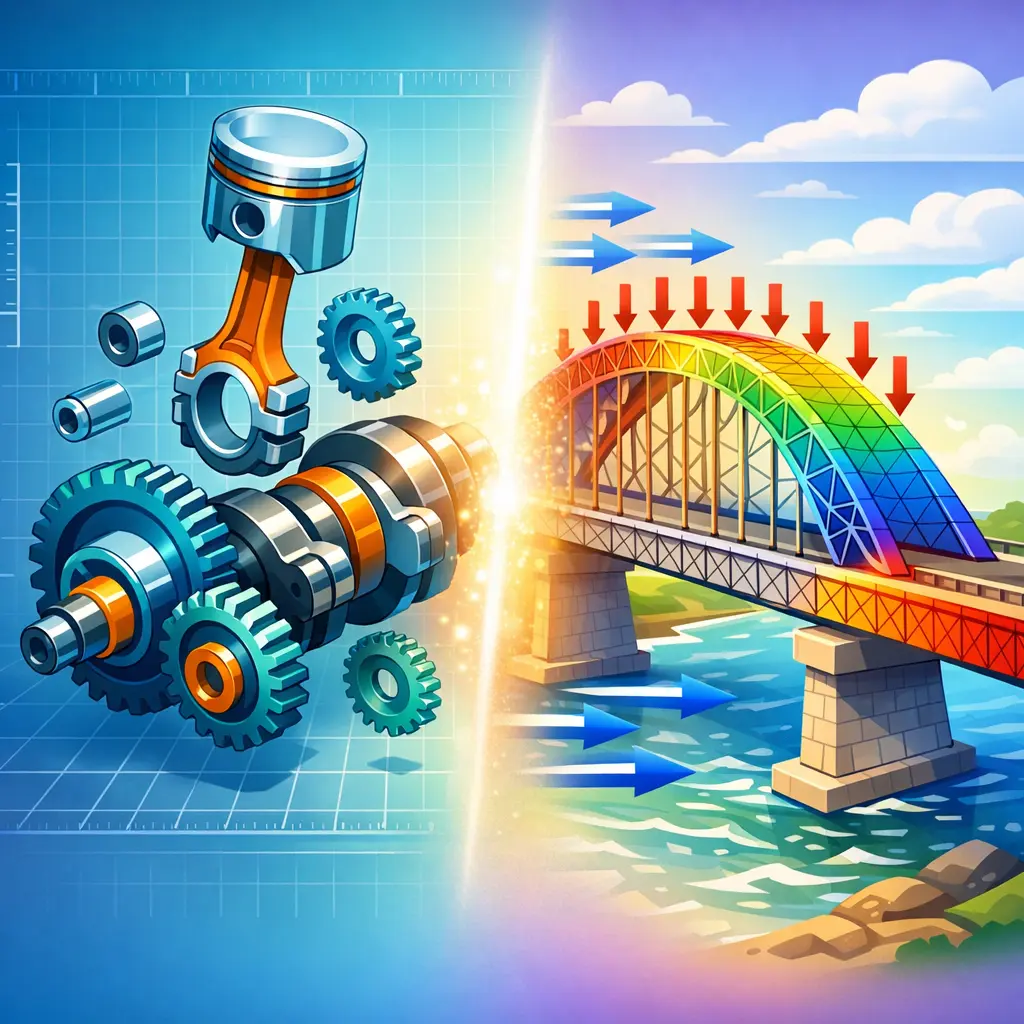
CAD & Simulation skills are essential for Mechanical and Civil Engineering and Technology careers. They involve using specialized software to design, analyze, and optimize structures, components, or systems. Proficiency in these tools enables engineers to create detailed blueprints, test designs virtually, identify potential issues, and improve efficiency. Mastery of CAD and simulation enhances productivity, accuracy, and innovation, making candidates highly valuable in engineering and technology industries.
CAD & Simulation Skills for Mechanical/Civil
CAD & Simulation skills are essential for Mechanical and Civil Engineering and Technology careers. They involve using specialized software to design, analyze, and optimize structures, components, or systems. Proficiency in these tools enables engineers to create detailed blueprints, test designs virtually, identify potential issues, and improve efficiency. Mastery of CAD and simulation enhances productivity, accuracy, and innovation, making candidates highly valuable in engineering and technology industries.
💡 Key Takeaways
- Create precise parametric 3D CAD models for mechanical and civil components using sketches and constraints.
- Build assemblies, define mates/constraints, and generate clear fabrication or construction drawings.
- Run basic simulations (structural, thermal, etc.) to evaluate performance under real-world loads.
- Select materials, assign properties, and apply boundary conditions for accurate analysis.
- Interpret results, optimize designs, and communicate findings with concise reports.
❓ Frequently Asked Questions
What is CAD and why is it used in mechanical and civil fields?
CAD (Computer-Aided Design) lets you create precise 2D drawings and 3D models, add dimensions, tolerances, and documentation for parts, assemblies, and structures.
What is the difference between CAD modeling and simulation (CAE)?
CAD focuses on geometry and drawings; CAE/simulation analyzes performance by applying materials, loads, and constraints to the model to predict behavior such as stresses or deformations.
What is Finite Element Analysis (FEA) and when should you use it?
FEA breaks a complex part into small elements to estimate stresses, strains, and displacements under loads, helpful for validating safety and performance of designs.
What is meshing and why is it important in simulations?
Meshing divides the geometry into elements; a good mesh captures stress/field gradients while balancing accuracy and compute cost. Refine where needed.
How do material properties and boundary conditions affect results?
Material properties (elastic modulus, density, Poisson's ratio) and how the part is fixed or loaded determine the response; incorrect data can mislead outcomes.