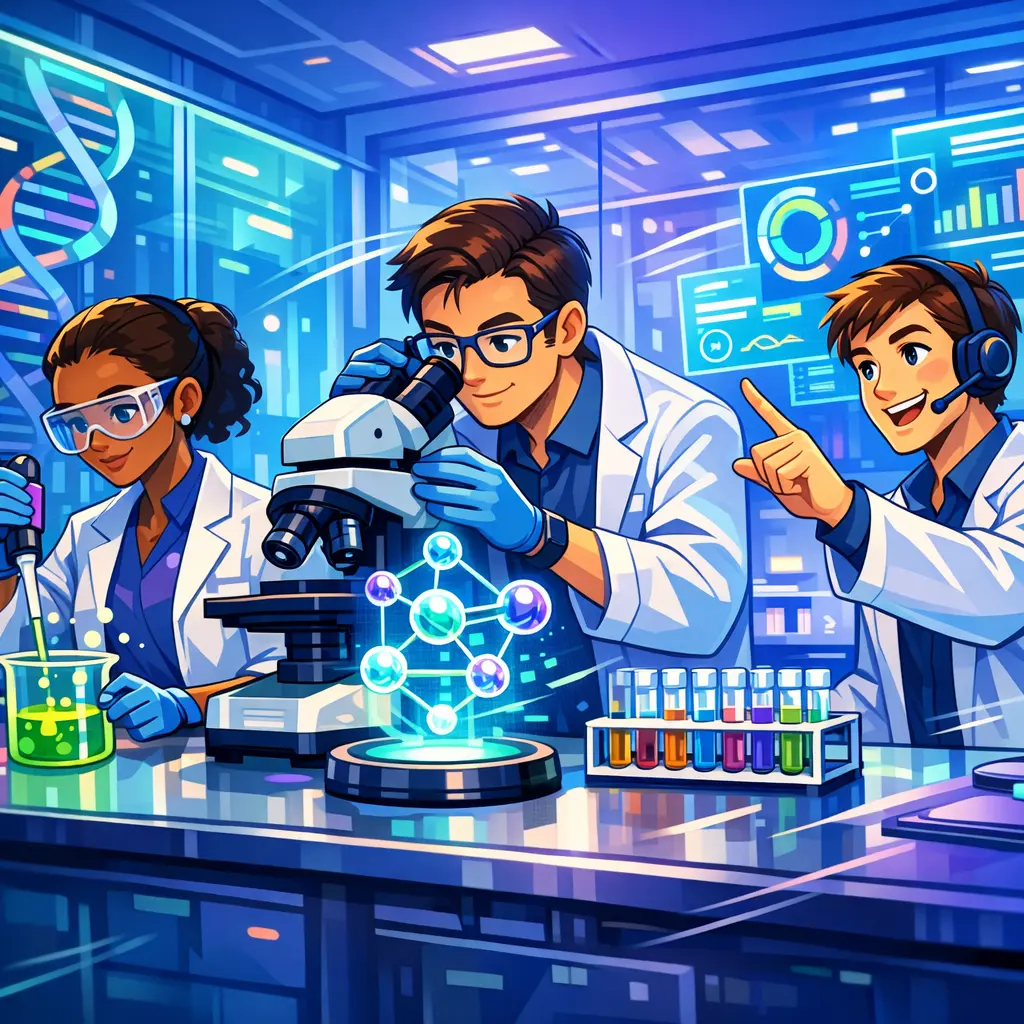
Careers in Research & Labs within healthcare and medicine involve investigating diseases, developing new treatments, and improving patient care through scientific discovery. Professionals in these roles, such as medical scientists, laboratory technicians, and clinical researchers, work in hospitals, universities, or pharmaceutical companies. They conduct experiments, analyze results, and contribute to medical advancements. These careers require strong analytical skills, attention to detail, and a commitment to advancing healthcare knowledge and patient outcomes.
Careers in Research & Labs+50
Careers in Research & Labs within healthcare and medicine involve investigating diseases, developing new treatments, and improving patient care through scientific discovery. Professionals in these roles, such as medical scientists, laboratory technicians, and clinical researchers, work in hospitals, universities, or pharmaceutical companies. They conduct experiments, analyze results, and contribute to medical advancements. These careers require strong analytical skills, attention to detail, and a commitment to advancing healthcare knowledge and patient outcomes.
💡 Key Takeaways
- Identify common career paths in research and lab roles across academia, industry, and government.
- Learn what a typical day in a lab looks like, including experiments, data analysis, and safety practices.
- Discover essential skills for lab careers, from experimental design to record-keeping and collaboration.
- Understand education routes and certifications that prepare you for careers in research environments.
❓ Frequently Asked Questions
What kinds of roles exist in careers in research and labs?
Roles include lab technicians, research scientists, data analysts, clinical researchers, quality control specialists, and lab managers across academia, industry, government, and nonprofit sectors.
What education is typically required for these careers?
Most roles require at least a bachelor’s degree in a STEM field. Advanced research roles often need a master's or PhD; many technician roles require an associate degree or diploma plus on-the-job training.
How do the roles of lab technician, research scientist, and principal investigator differ?
Lab technicians perform experiments and support tasks; research scientists design studies, collect and analyze data; principal investigators lead projects, secure funding, supervise staff, and oversee research direction.
What skills are valuable in research and lab careers?
Attention to detail, problem-solving, data analysis, familiarity with lab equipment and safety protocols, communication, and collaboration are particularly important.