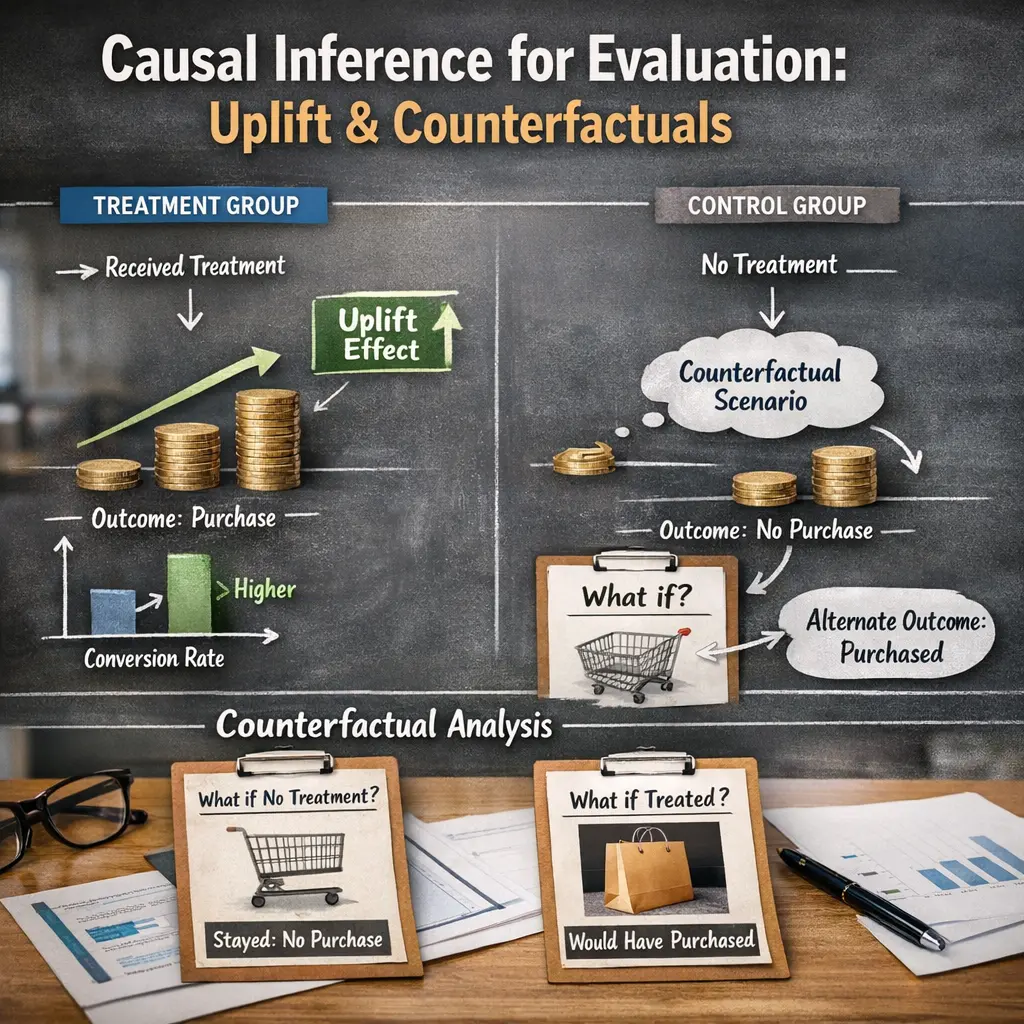
Causal inference for evaluation, particularly uplift and counterfactuals, involves assessing the true impact of interventions or treatments by comparing what actually happened (factual) with what would have occurred otherwise (counterfactual). In the context of LLM evaluations (evals), this approach helps determine how model changes or features affect outcomes, isolating the specific effect of modifications and enabling more accurate measurement of improvements or regressions, rather than relying solely on observed results.
Causal Inference for Evaluation: Uplift and Counterfactuals
Causal inference for evaluation, particularly uplift and counterfactuals, involves assessing the true impact of interventions or treatments by comparing what actually happened (factual) with what would have occurred otherwise (counterfactual). In the context of LLM evaluations (evals), this approach helps determine how model changes or features affect outcomes, isolating the specific effect of modifications and enabling more accurate measurement of improvements or regressions, rather than relying solely on observed results.
💡 Key Takeaways
- Learn the potential outcomes framework and how it defines the effect of an intervention as what would happen with and without treatment.
- Understand uplift modeling and how it highlights heterogeneous treatment effects across individuals or groups.
- Explore how counterfactuals are estimated in evaluation, using randomized experiments and quasi-experimental designs to compare observed results to the unobserved alternatives.
- Familiarize yourself with common causal effect metrics (e.g., ATE, ATT) and the key assumptions needed for valid inference (randomization, overlap, and no unmeasured confounding).
❓ Frequently Asked Questions
What is causal inference in evaluation?
Causal inference aims to determine whether a treatment actually causes a change in an outcome, using counterfactual reasoning and methods that separate causation from mere correlation.
What is an uplift model?
An uplift model predicts the individual-level incremental effect of a treatment, estimating how much a person’s outcome would improve if they receive the treatment versus if they do not.
What are counterfactuals in this context?
Counterfactuals are the hypothetical outcomes that would have occurred under different actions. They are used to estimate treatment effects by comparing actual results to these imagined alternatives.
How do you evaluate uplift models or causal estimates?
Use metrics that capture incremental gains (e.g., uplift/Qini curves and AUUC) and, when possible, validate with randomized experiments to estimate the true treatment effect.