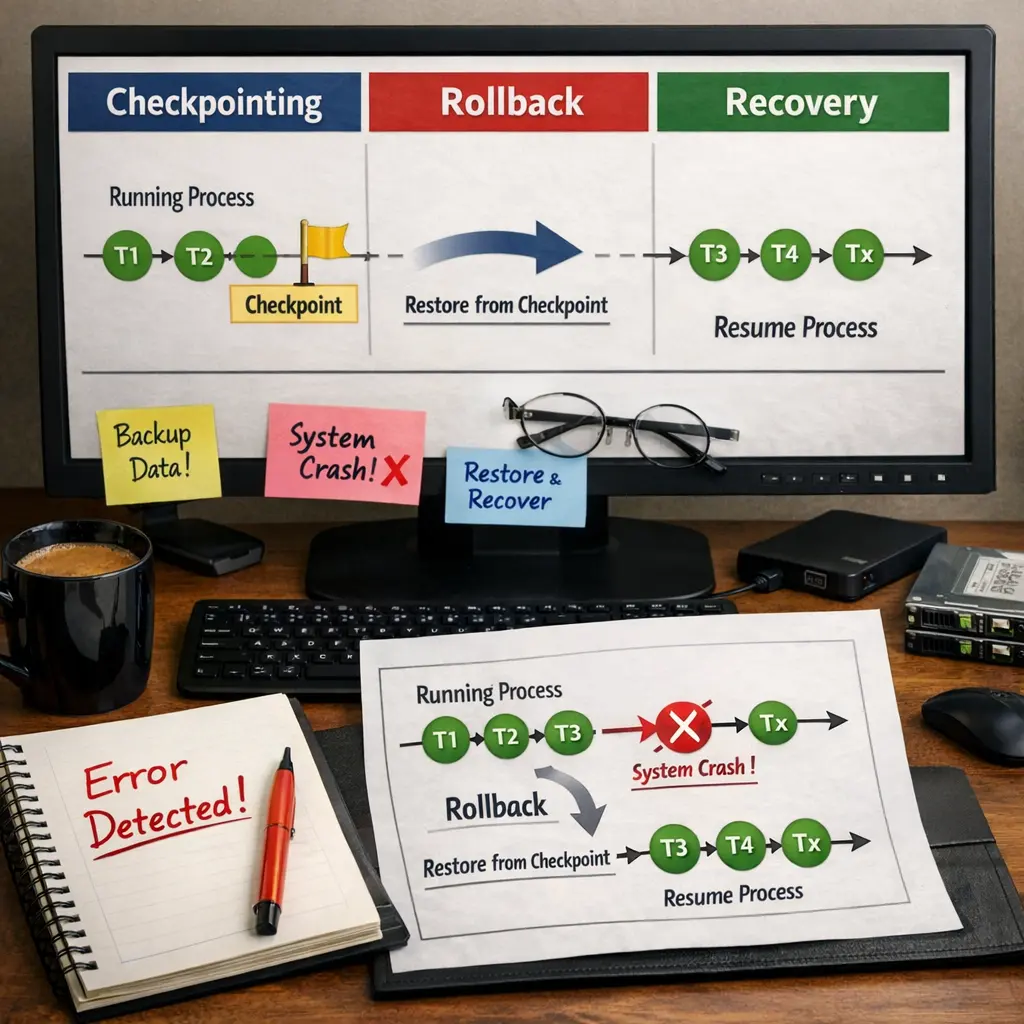
Checkpointing, rollback, and recovery in agent architecture refer to mechanisms that enhance system reliability and fault tolerance. Checkpointing involves periodically saving an agent’s state, so if a failure occurs, the system can roll back to the most recent checkpoint rather than restarting entirely. Rollback is the process of reverting to this saved state. Recovery uses checkpoint data to restore the agent’s operations, minimizing data loss and downtime after errors or crashes.
Checkpointing, Rollback & Recovery
Checkpointing, rollback, and recovery in agent architecture refer to mechanisms that enhance system reliability and fault tolerance. Checkpointing involves periodically saving an agent’s state, so if a failure occurs, the system can roll back to the most recent checkpoint rather than restarting entirely. Rollback is the process of reverting to this saved state. Recovery uses checkpoint data to restore the agent’s operations, minimizing data loss and downtime after errors or crashes.
💡 Key Takeaways
- Understand checkpointing and how saving the system state at intervals helps with recovery.
- Learn how rollback to a saved checkpoint restores computations after a failure.
- Identify recovery strategies (roll-forward vs roll-back) and their use cases.
- Compare factors in checkpoint design (frequency, storage, performance) and trade-offs for effective recovery.
❓ Frequently Asked Questions
What is checkpointing?
Checkpointing saves the current state of a program or process at a known point so it can be resumed from there after a failure.
What is a rollback in computing?
A rollback undoes recent work to revert to a previously known good state, often using logs or checkpoints.
What is system recovery?
Recovery is the process of restoring a system to normal operation after a failure, using backups, logs, and checkpoints.
What are common checkpointing strategies?
Full (image-based) checkpoints save the entire state; incremental checkpoints save only changes since the last checkpoint, and can be done synchronously or asynchronously.