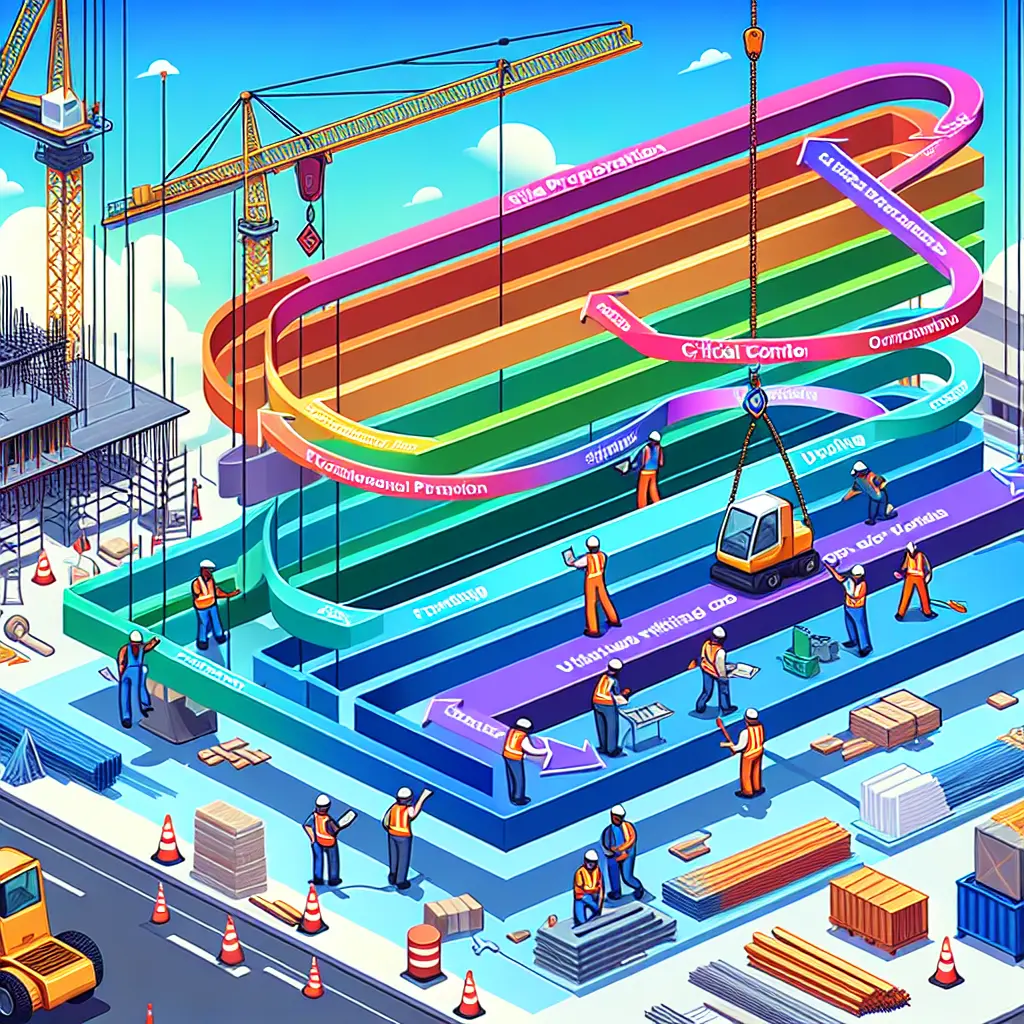
Construction Scheduling (CPM), or Critical Path Method, is a project management technique used to plan, schedule, and control complex construction projects. It involves identifying all essential tasks, estimating their durations, and determining dependencies between them. By mapping these tasks on a timeline, CPM highlights the longest sequence of dependent activities—known as the critical path—which dictates the shortest possible project duration. This helps managers allocate resources efficiently and anticipate potential delays.
Construction Scheduling (CPM)
Construction Scheduling (CPM), or Critical Path Method, is a project management technique used to plan, schedule, and control complex construction projects. It involves identifying all essential tasks, estimating their durations, and determining dependencies between them. By mapping these tasks on a timeline, CPM highlights the longest sequence of dependent activities—known as the critical path—which dictates the shortest possible project duration. This helps managers allocate resources efficiently and anticipate potential delays.
💡 Key Takeaways
- Understand the purpose of CPM in planning, scheduling, and controlling complex construction projects.
- Identify the critical path and learn how it sets the project’s minimum duration and prioritizes key tasks for trades.
- Learn how to estimate task durations and define task dependencies (precedence relationships).
- Map tasks to compute early/late start and finish times and use float to monitor and adjust the schedule for trades and field work.
❓ Frequently Asked Questions
What is CPM in construction scheduling?
Construction Scheduling (CPM) is a project management method used to plan, schedule, and control complex construction projects by identifying essential tasks, estimating durations, and mapping dependencies to optimize the timeline.
What is the critical path?
The critical path is the longest sequence of dependent tasks from start to finish; it determines the earliest possible project completion. Delays on these tasks delay the project.
How are task dependencies shown in CPM?
Dependencies link tasks with relationships (finish-to-start, start-to-start, finish-to-finish, or start-to-finish) and are depicted on a network diagram to define the task sequence.
What is float (slack) in CPM?
Float is the amount of time a task can be delayed without delaying the project’s completion. Critical path tasks typically have zero float.