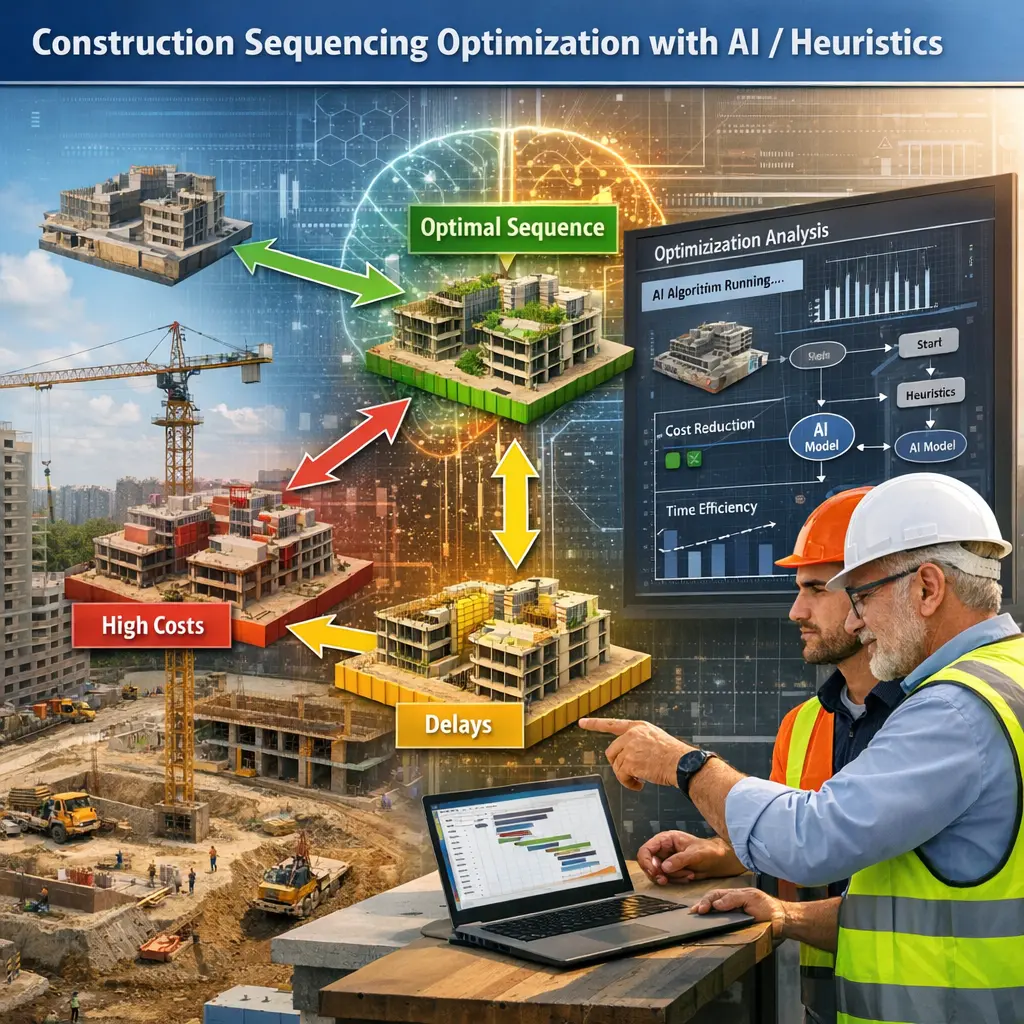
Construction Sequencing Optimization with AI/Heuristics refers to the use of artificial intelligence and heuristic algorithms in digital applications to plan and arrange construction activities efficiently. By analyzing project data, these technologies identify optimal sequences for tasks, reducing delays and resource conflicts. This approach enhances project timelines, minimizes costs, and improves overall productivity, allowing construction managers to make data-driven decisions and adapt quickly to changing site conditions.
Construction Sequencing Optimization with AI/Heuristics
Construction Sequencing Optimization with AI/Heuristics refers to the use of artificial intelligence and heuristic algorithms in digital applications to plan and arrange construction activities efficiently. By analyzing project data, these technologies identify optimal sequences for tasks, reducing delays and resource conflicts. This approach enhances project timelines, minimizes costs, and improves overall productivity, allowing construction managers to make data-driven decisions and adapt quickly to changing site conditions.
💡 Key Takeaways
- Learn how AI and heuristic methods optimize construction sequencing to save time and money.
- Model dependencies, resource constraints, and site logistics to generate feasible construction sequences.
- Explore common AI/heuristic approaches (genetic algorithms, simulated annealing, and priority-rule heuristics) and where they apply.
- Evaluate trade-offs between time, cost, safety, and risk, and how to interpret optimization results for practical planning.
❓ Frequently Asked Questions
What is construction sequencing optimization?
It's the process of arranging construction activities in the most efficient order to complete a project faster, cheaper, and safely while meeting constraints like resources and site access.
How do AI and heuristics improve sequencing?
They explore many possible activity orders to find near-optimal schedules quickly, handling uncertainty and complex constraints better than manual planning.
What methods are commonly used in AI/heuristic sequencing?
Techniques include constraint programming, optimization solvers (MILP), genetic algorithms, simulated annealing, tabu search, and reinforcement learning.
What metrics gauge the quality of a construction sequence?
Total project duration, critical path length, resource leveling, cost, safety, site congestion, and resilience to disruptions.