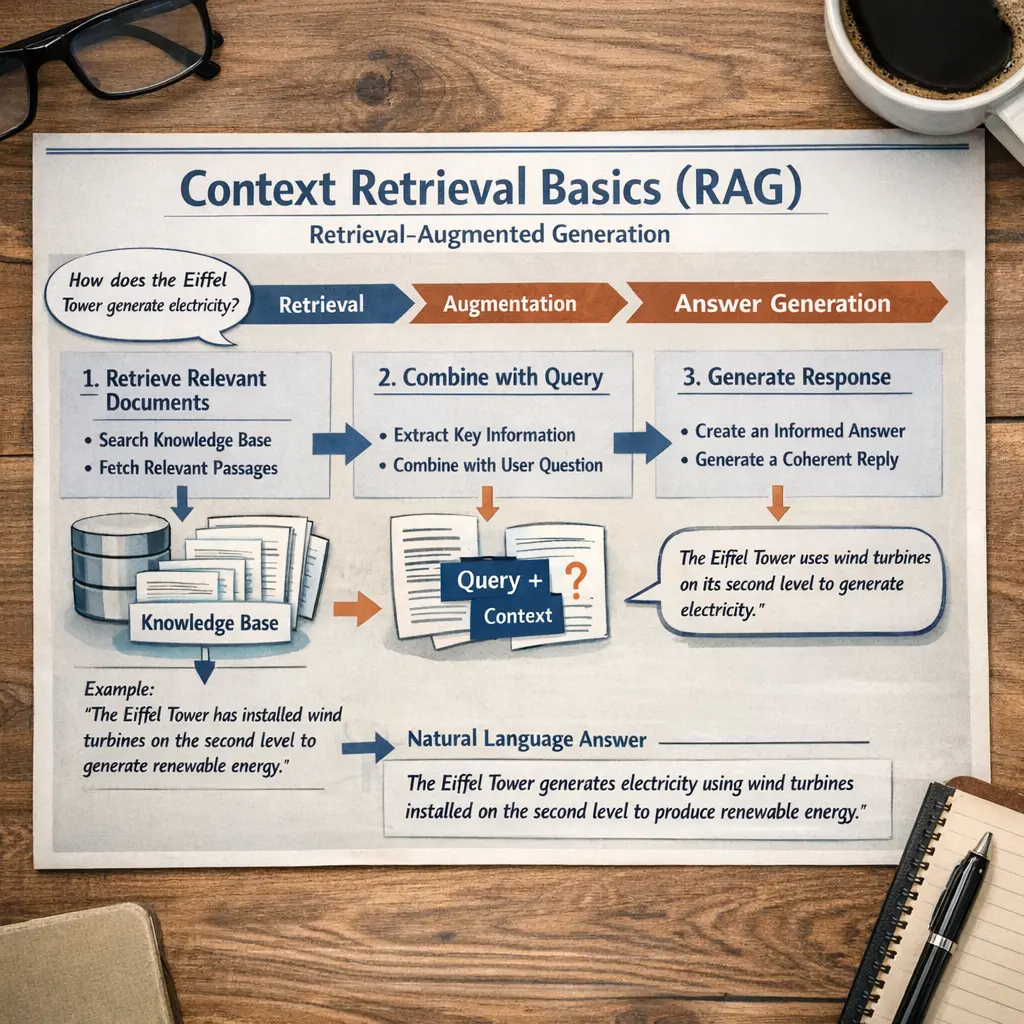
Context Retrieval Basics (RAG) (Agent Architecture) refers to a framework where AI systems combine retrieval of relevant external information (such as documents or knowledge bases) with generative models to answer queries more accurately. In this architecture, an agent retrieves pertinent context and integrates it with its own reasoning, resulting in improved responses. This approach enhances the agent’s ability to provide precise, context-aware answers by leveraging both stored knowledge and dynamic information retrieval.
Context Retrieval Basics (RAG)
Context Retrieval Basics (RAG) (Agent Architecture) refers to a framework where AI systems combine retrieval of relevant external information (such as documents or knowledge bases) with generative models to answer queries more accurately. In this architecture, an agent retrieves pertinent context and integrates it with its own reasoning, resulting in improved responses. This approach enhances the agent’s ability to provide precise, context-aware answers by leveraging both stored knowledge and dynamic information retrieval.
💡 Key Takeaways
- Understand Retrieval-Augmented Generation (RAG) and why external context improves answers
- Identify the core RAG components: retriever, index, and reader/generator
- Learn how context is retrieved (embeddings and similarity search) and fused into the final response
- Recognize common RAG challenges and best practices like data quality, latency, and hallucination mitigation
❓ Frequently Asked Questions
What is Retrieval-Augmented Generation (RAG)?
RAG is a framework that combines a retriever to fetch relevant documents with a generator to produce an answer. The retrieved passages ground the response, improving accuracy and reducing hallucinations.
How does RAG incorporate retrieved context into generation?
The generator conditions on the retrieved passages—often by appending them to the prompt or using them in attention mechanisms—so the produced text cites and relies on real evidence.
What are the main components of a RAG system?
A retriever (dense embeddings or sparse methods like BM25), a generator/reader to craft the answer from the retrieved text, and optional fusion or reranking steps to select the best evidence and present a coherent response.
What are dense and sparse retrieval in RAG, and how do they differ?
Dense retrieval uses learned vector embeddings to find semantically similar passages, while sparse retrieval relies on keyword-based indexes (e.g., BM25). Dense captures meaning beyond exact terms; sparse emphasizes exact term matches.
When is RAG particularly beneficial?
RAG shines when up-to-date or domain-specific knowledge is needed, or when factual grounding is important. It improves accuracy, supports citations, and handles questions that go beyond the model’s training data.