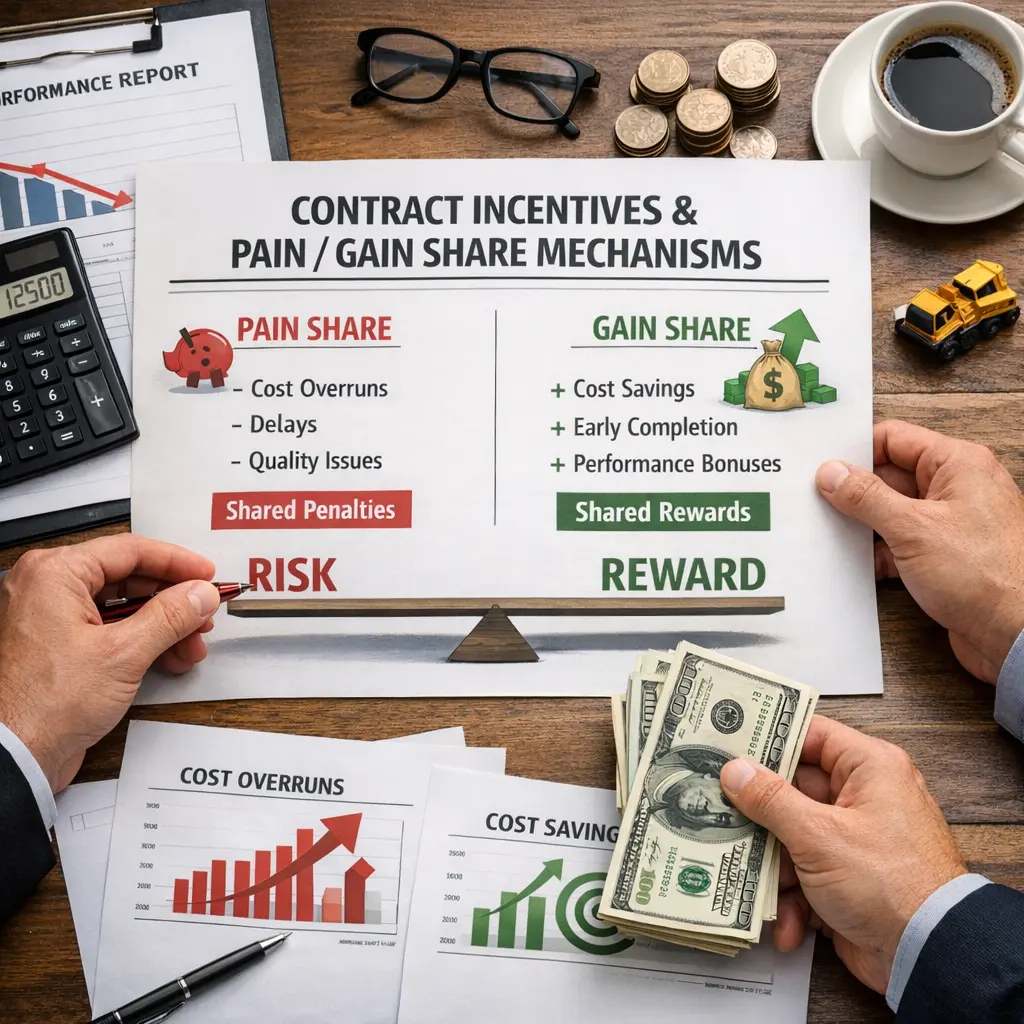
Contract incentives and pain/gain share mechanisms in tender and procurement refer to strategies that align the interests of clients and suppliers by rewarding positive performance (gain) or penalizing underperformance (pain). These mechanisms motivate suppliers to deliver projects efficiently, on time, and within budget, as they share in the financial benefits of success or bear part of the losses from failures, fostering collaboration and risk-sharing throughout the contract lifecycle.
Contract Incentives and Pain/Gain Share Mechanisms
Contract incentives and pain/gain share mechanisms in tender and procurement refer to strategies that align the interests of clients and suppliers by rewarding positive performance (gain) or penalizing underperformance (pain). These mechanisms motivate suppliers to deliver projects efficiently, on time, and within budget, as they share in the financial benefits of success or bear part of the losses from failures, fostering collaboration and risk-sharing throughout the contract lifecycle.
💡 Key Takeaways
- Define contract incentives and pain/gain sharing and why they matter for alignment of goals.
- Explain how pain/gain sharing aligns risk and reward between contracting parties.
- Identify common incentive mechanisms (bonuses, penalties, equity stakes, and shared savings) used in contracts.
- Assess design considerations to mitigate moral hazard and ensure measurability, timing, and fairness of incentives.
❓ Frequently Asked Questions
What are contract incentives and pain/gain share mechanisms?
Contract incentives are provisions that encourage performance by rewarding or penalizing outcomes. Pain/gain sharing means costs and savings are shared between the client and contractor based on performance relative to a baseline.
How does a pain/gain share mechanism typically work?
A baseline target cost and schedule are set. If actual performance results in savings, the savings are split according to a predefined ratio. If there are overruns or delays, a portion of the extra cost is absorbed by the parties per the agreed pain-share ratio. Caps, floors, and open-book accounting are common features.
What elements should a pain/gain share clause include?
Baseline and target cost/schedule, gain-share and pain-share ratios, caps and floors, trigger events (milestones or thresholds), measurement and accounting methods, audit rights, dispute resolution, and governance/duration.
What are the advantages and challenges of using pain/gain share mechanisms?
Advantages include better alignment of incentives and reduced adversarial behavior. Challenges include complexity in measurement, data reliability, and potential misalignment if ratios or baselines are poorly defined; robust governance helps mitigate these risks.