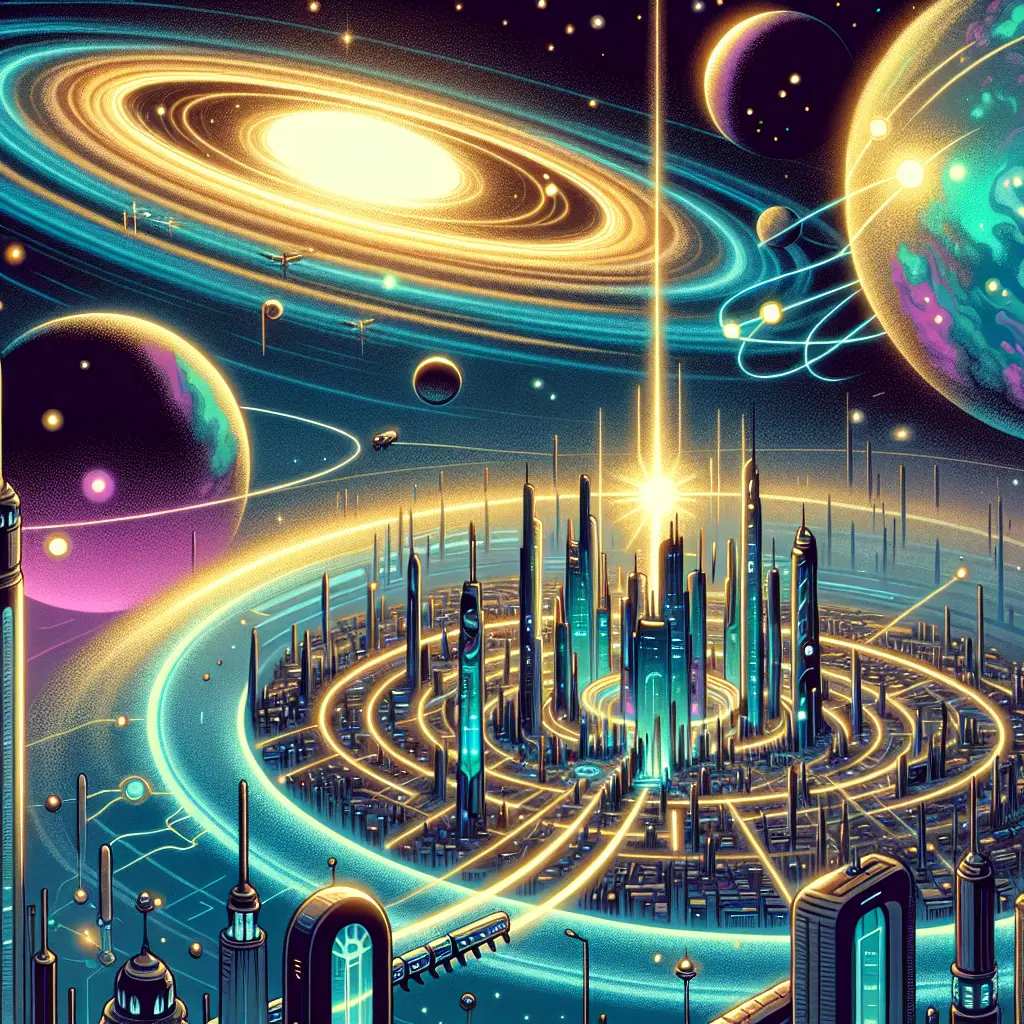
Cosmic civilizations refer to advanced societies that exist beyond Earth, potentially throughout the universe. The Kardashev Scale is a theoretical framework for measuring a civilization's technological advancement based on its energy consumption. It categorizes civilizations into three main types: Type I (planetary), harnessing all energy available on their planet; Type II (stellar), utilizing the energy of their star; and Type III (galactic), controlling energy on the scale of their entire galaxy.
Cosmic Civilizations & Kardashev Scale
Cosmic civilizations refer to advanced societies that exist beyond Earth, potentially throughout the universe. The Kardashev Scale is a theoretical framework for measuring a civilization's technological advancement based on its energy consumption. It categorizes civilizations into three main types: Type I (planetary), harnessing all energy available on their planet; Type II (stellar), utilizing the energy of their star; and Type III (galactic), controlling energy on the scale of their entire galaxy.
💡 Key Takeaways
- Define cosmic civilizations and why they feature in sci-fi and futurology.
- Explain the Kardashev Scale and how energy use measures a civilization's progression.
- Differentiate Type I, II, and III civilizations as planetary, stellar, and galactic energy scales.
- Explore how higher-energy civilizations influence sci-fi narratives, technology, and cyber futures.
❓ Frequently Asked Questions
What is a cosmic civilization?
A hypothetical, extremely advanced society beyond Earth that may span multiple star systems or galaxies, powered by vast technologies.
What is the Kardashev Scale?
A theoretical framework that classifies civilizations by how much energy they can harness: Type I uses planetary energy, Type II uses stellar energy, and Type III uses galactic energy.
How do Type I, II, and III civilizations differ?
Type I taps planetary energy, Type II taps a star (often via megastructures), and Type III taps an entire galaxy.
Why is this scale popular in sci‑fi and future speculations?
It provides a simple, scalable way to imagine a civilization's reach, technology, and potential capabilities like megastructures and interstellar exploration.