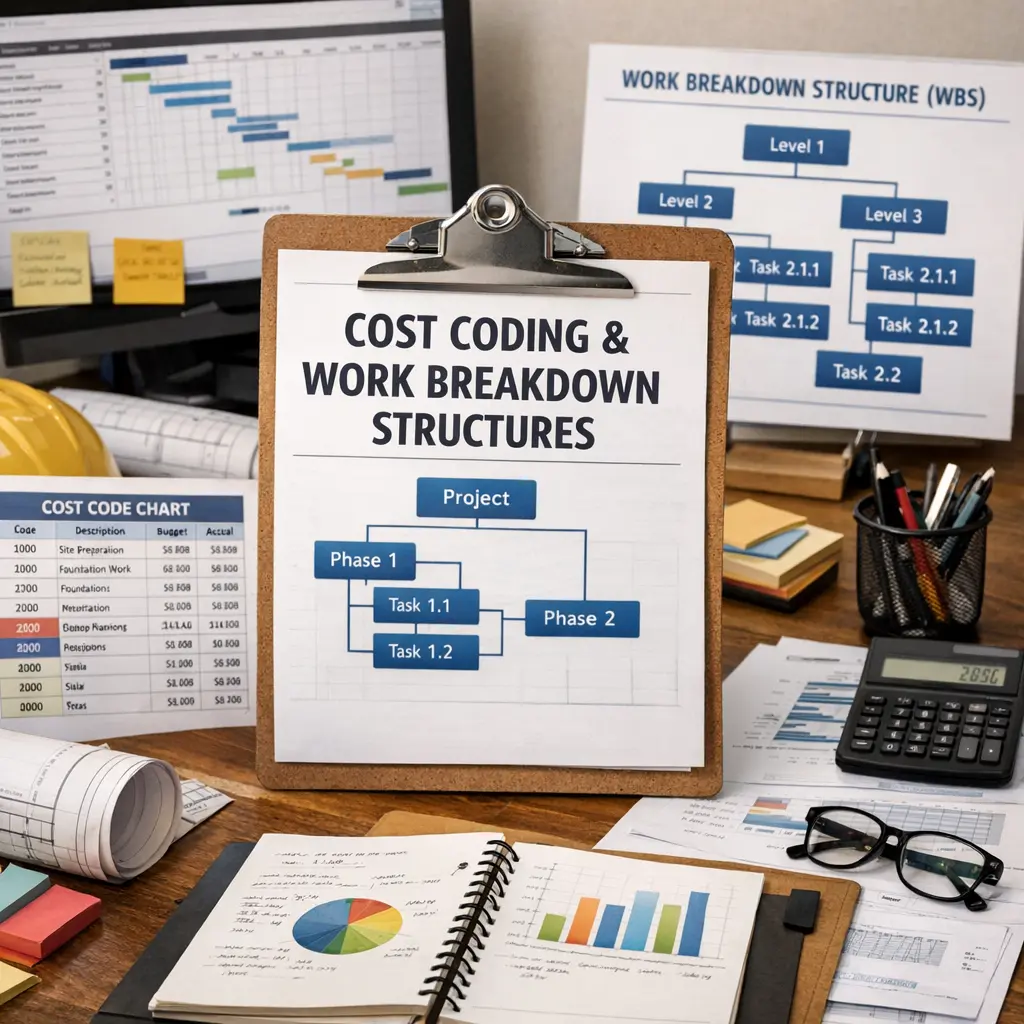
Cost coding and work breakdown structures (WBS) are essential tools in financial management and business practices. Cost coding involves assigning specific codes to various project expenses, enabling accurate tracking and reporting. Work breakdown structures decompose a project into manageable sections or tasks, providing a clear framework for budgeting, scheduling, and resource allocation. Together, they facilitate effective cost control, enhance transparency, and support informed decision-making throughout a project’s lifecycle.
Cost Coding & Work Breakdown Structures
Cost coding and work breakdown structures (WBS) are essential tools in financial management and business practices. Cost coding involves assigning specific codes to various project expenses, enabling accurate tracking and reporting. Work breakdown structures decompose a project into manageable sections or tasks, providing a clear framework for budgeting, scheduling, and resource allocation. Together, they facilitate effective cost control, enhance transparency, and support informed decision-making throughout a project’s lifecycle.
💡 Key Takeaways
- Understand what a Work Breakdown Structure (WBS) is and how it divides a project into deliverables.
- Learn how cost coding assigns budget numbers to WBS elements for accurate cost tracking.
- Practice mapping project activities to the appropriate WBS elements to improve clarity and control.
- Discover how WBS and cost codes support budgeting, forecasting, and reporting.
❓ Frequently Asked Questions
What is a Work Breakdown Structure (WBS)?
A WBS is a hierarchical breakdown of the project scope into deliverables and work packages, used to plan, estimate costs, and manage project work.
How do cost codes relate to a WBS?
Cost codes are identifiers attached to WBS elements to track expenses. The coding scheme mirrors the WBS so costs can be rolled up by component, phase, or department.
Why is WBS-based cost coding important?
It improves budgeting accuracy, enables effective cost control, and provides clear reporting by linking expenditures to specific project components.
What are typical levels in a WBS?
Common levels: Level 1 = project, Level 2 = major deliverables, Level 3 = sub-deliverables, Level 4 = work packages that can be funded and tracked.
How do you create a cost code structure that matches a WBS?
Define a coding standard, map each WBS element to a code, use a consistent format (e.g., 1.2.3 or WBS-1-2-3), and enforce consistent use across budgeting, procurement, and accounting.