Creep and relaxation are fundamental concepts in materials science, describing how materials respond to stress over time. Creep refers to the slow, permanent deformation that occurs when a material is subjected to a constant load for an extended period, especially at high temperatures. Relaxation, on the other hand, describes the gradual decrease in stress experienced by a material under constant strain. Both phenomena are critical for predicting material performance and longevity in engineering applications.
Creep and Relaxation Fundamentals
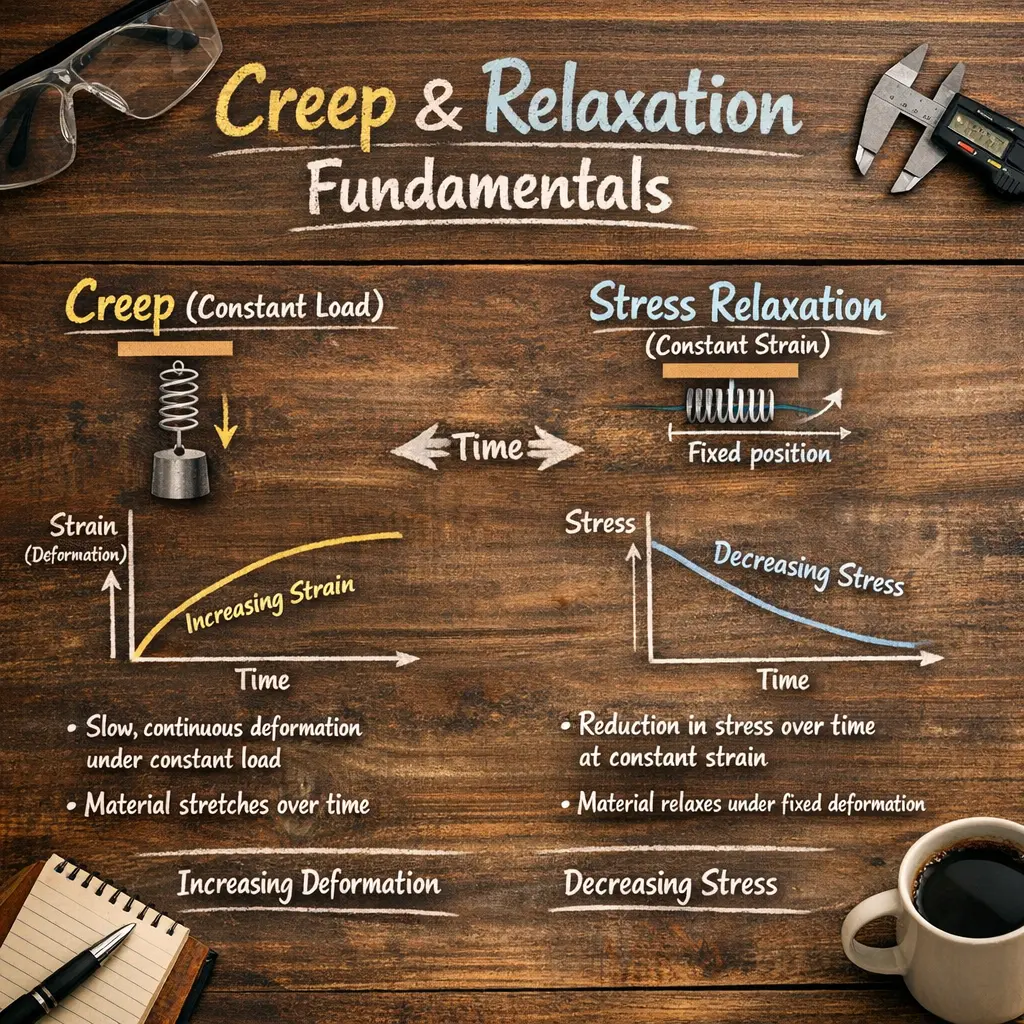
Creep and relaxation are fundamental concepts in materials science, describing how materials respond to stress over time. Creep refers to the slow, permanent deformation that occurs when a material is subjected to a constant load for an extended period, especially at high temperatures. Relaxation, on the other hand, describes the gradual decrease in stress experienced by a material under constant strain. Both phenomena are critical for predicting material performance and longevity in engineering applications.
💡 Key Takeaways
- Define creep and relaxation and explain the key differences between time-dependent deformation and stress decay.
- Identify the main creep mechanisms (dislocation processes and diffusion) and the factors that accelerate creep (temperature, applied stress, and material microstructure).
- Describe the three creep stages—primary, secondary (steady-state), and tertiary—and how to interpret a creep curve.
- Explain stress relaxation under constant strain and outline practical strategies to mitigate creep and relaxation through material selection, design, and processing.
❓ Frequently Asked Questions
What is creep?
Creep is the time-dependent deformation of a material under a constant load, especially at elevated temperatures, leading to increasing strain over time.
What is stress relaxation?
Stress relaxation is the decrease in internal stress over time when a material is held at a fixed strain, due to viscoelastic rearrangements.
What are the three stages of creep?
Primary creep: decreasing rate of deformation; secondary creep: steady-state (constant rate); tertiary creep: accelerating rate leading to failure.
How are creep and relaxation tested?
Creep test: apply a constant stress and measure strain over time. Relaxation test: impose a constant strain and measure how stress decays over time.