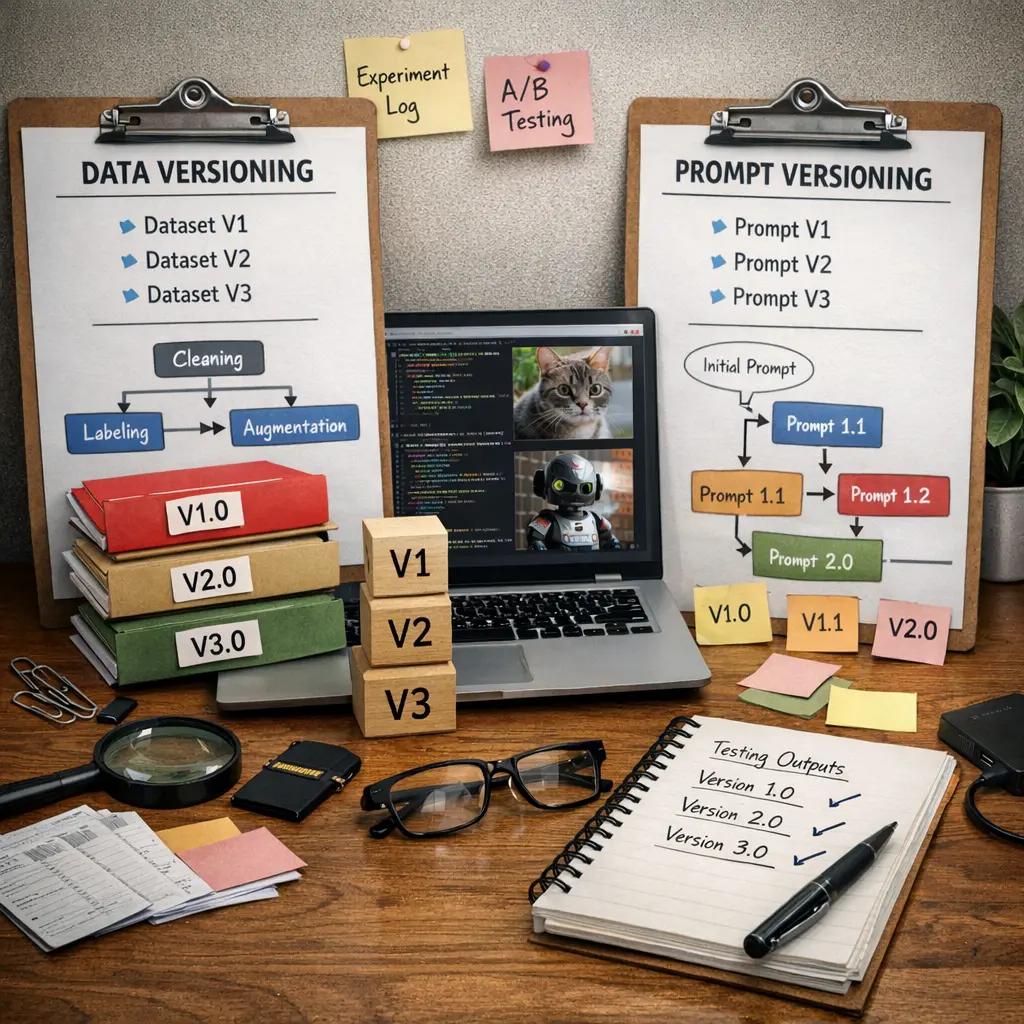
Data & Prompt Versioning in agent architecture refers to systematically tracking and managing changes in both datasets and prompt formulations used by AI agents. This process ensures that every modification—whether in training data, input prompts, or instructions—is recorded with version history. Such versioning enables reproducibility, facilitates debugging, and supports collaborative development, allowing teams to compare performance across different versions and maintain consistency in agent behavior over time.
Data & Prompt Versioning
Data & Prompt Versioning in agent architecture refers to systematically tracking and managing changes in both datasets and prompt formulations used by AI agents. This process ensures that every modification—whether in training data, input prompts, or instructions—is recorded with version history. Such versioning enables reproducibility, facilitates debugging, and supports collaborative development, allowing teams to compare performance across different versions and maintain consistency in agent behavior over time.
💡 Key Takeaways
- Grasp the purpose of data versioning and how it supports reproducibility and auditability in AI workflows.
- Learn how to version prompts and templates to track changes in behavior and outputs.
- Explore common versioning strategies (semantic versioning, changelogs, diff tracking) and when to apply them to data and prompts.
- Practice best practices for labeling, storing, and rolling back data and prompts to ensure traceability.
❓ Frequently Asked Questions
What is data versioning and why is it important?
Data versioning tracks changes to datasets over time (snapshots, history, lineage). It ensures reproducibility, auditability, and safe rollback if results change.
What is prompt versioning and why is it important?
Prompt versioning tracks the exact prompts used to query AI models, along with context and settings. It helps reproduce results and compare how different prompts affect outcomes.
How do data and prompt versioning work together in experiments?
Versioning both data and prompts provides end-to-end traceability: you can see which data and which prompt produced a given result, enabling fair comparisons and reproducibility.
What are practical ways to implement versioning?
Use Git to version prompts, and data versioning tools (e.g., DVC, Quilt, Delta Lake) to snapshot datasets. Maintain metadata (version, date, source), and automate with reproducible pipelines.