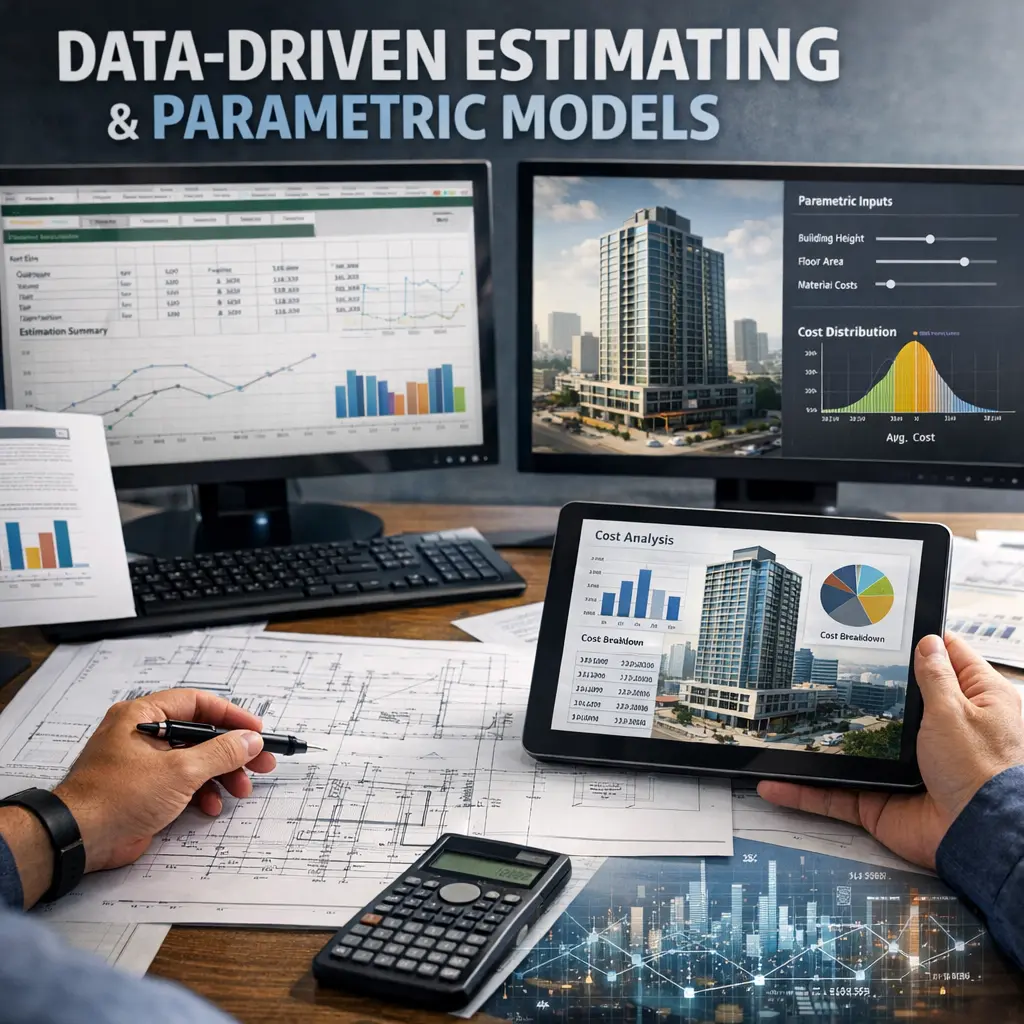
Data-driven estimating and parametric models involve using historical data and statistical techniques to predict costs, resources, or outcomes in financial management and business practices. By analyzing past performance and identifying key variables, organizations can create mathematical models that generate more accurate and objective estimates. This approach enhances budgeting, forecasting, and decision-making processes, reducing reliance on subjective judgment and improving efficiency and transparency in managing financial resources and business operations.
Data-Driven Estimating & Parametric Models
Data-driven estimating and parametric models involve using historical data and statistical techniques to predict costs, resources, or outcomes in financial management and business practices. By analyzing past performance and identifying key variables, organizations can create mathematical models that generate more accurate and objective estimates. This approach enhances budgeting, forecasting, and decision-making processes, reducing reliance on subjective judgment and improving efficiency and transparency in managing financial resources and business operations.
💡 Key Takeaways
- Understand what data-driven estimation is and how it differs from traditional guesswork
- Recognize common parametric models and what their parameters represent
- Learn how to fit a parametric model to data using simple estimation methods
- Validate and compare models to select the best performing approach
❓ Frequently Asked Questions
What is data-driven estimating?
Estimating quantities using historical data and statistical models rather than relying only on intuition or expert judgment.
What are parametric models?
Models that assume a specific mathematical form with a finite set of parameters to describe relationships in the data (e.g., linear, exponential).
How are parameters estimated in data-driven models?
By fitting the model to data using methods such as least squares, maximum likelihood, or Bayesian approaches, often with validation to avoid overfitting.
When should you use parametric vs. non-parametric approaches?
Use parametric models when you have a reasonable expectation of a functional form and limited data; use non-parametric methods when you want flexibility and have ample data to avoid misspecifying the form.
What are common pitfalls in parametric estimation?
Misspecified model form, overfitting with too many parameters, extrapolating beyond observed data, and reliance on poor quality data.