Debounce and timing filters using RC networks are essential in digital electronics to eliminate unwanted noise or rapid fluctuations caused by mechanical switches or signal transitions. An RC (resistor-capacitor) network smooths out these irregularities by charging and discharging the capacitor, effectively filtering out short, spurious signals. This ensures that only stable, valid transitions are recognized by digital circuits, improving reliability in computing systems and preventing false triggering or multiple counts from a single switch press.
Debounce & Timing Filters with RC Networks
Debounce and timing filters using RC networks are essential in digital electronics to eliminate unwanted noise or rapid fluctuations caused by mechanical switches or signal transitions. An RC (resistor-capacitor) network smooths out these irregularities by charging and discharging the capacitor, effectively filtering out short, spurious signals. This ensures that only stable, valid transitions are recognized by digital circuits, improving reliability in computing systems and preventing false triggering or multiple counts from a single switch press.
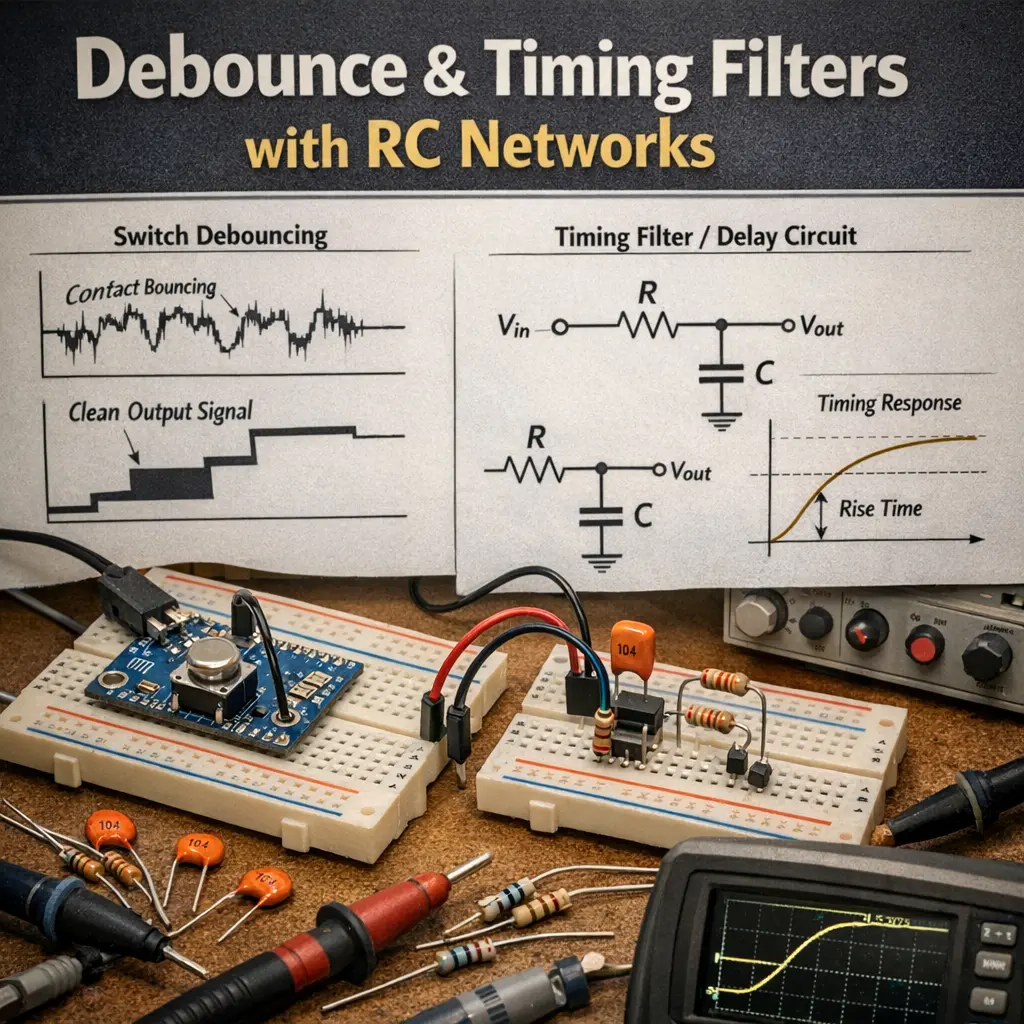
💡 Key Takeaways
- Understand what debouncing is and how RC networks clean noisy switch signals
- Learn how an RC timing network creates a controllable delay using the time constant tau = R × C
- Calculate resistor and capacitor values to achieve a target debounce duration
- Apply passive RC debounce circuits to MCU inputs and know when to add a Schmitt-trigger or buffer for reliable edges
❓ Frequently Asked Questions
What is debouncing in electronics?
Debouncing reduces multiple rapid transitions caused by a mechanical switch. A debounce circuit makes a single clean transition when the switch is pressed or released.
How can RC networks debounce a switch?
An RC network slows the input edge: the capacitor charges/discharges through a resistor, smoothing fast bounces. The time constant RC determines how long the output stays in its current state after the switch changes.
What is the role of the RC time constant in timing filters?
The time constant (tau = R × C) controls how quickly the network responds. Larger tau yields more delay and smoothing; smaller tau allows faster response.
How does a Schmitt-trigger debounce differ from a simple RC debounce?
A Schmitt-trigger adds hysteresis with two threshold levels, providing a clean, decisive transition and better noise immunity when used with RC debouncing.