Defensive shapes and pressing schemes across eras at Manchester United F.C. refer to the evolution of the team's tactical organization without the ball. From the rigid, disciplined formations under Sir Alex Ferguson to the high-pressing, aggressive approaches seen under later managers, United’s strategies have adapted to changing football philosophies. These shifts reflect how the club has balanced compact defensive lines with proactive pressing to disrupt opponents and regain possession efficiently.
Defensive Shapes and Pressing Schemes Across Eras
Defensive shapes and pressing schemes across eras at Manchester United F.C. refer to the evolution of the team's tactical organization without the ball. From the rigid, disciplined formations under Sir Alex Ferguson to the high-pressing, aggressive approaches seen under later managers, United’s strategies have adapted to changing football philosophies. These shifts reflect how the club has balanced compact defensive lines with proactive pressing to disrupt opponents and regain possession efficiently.
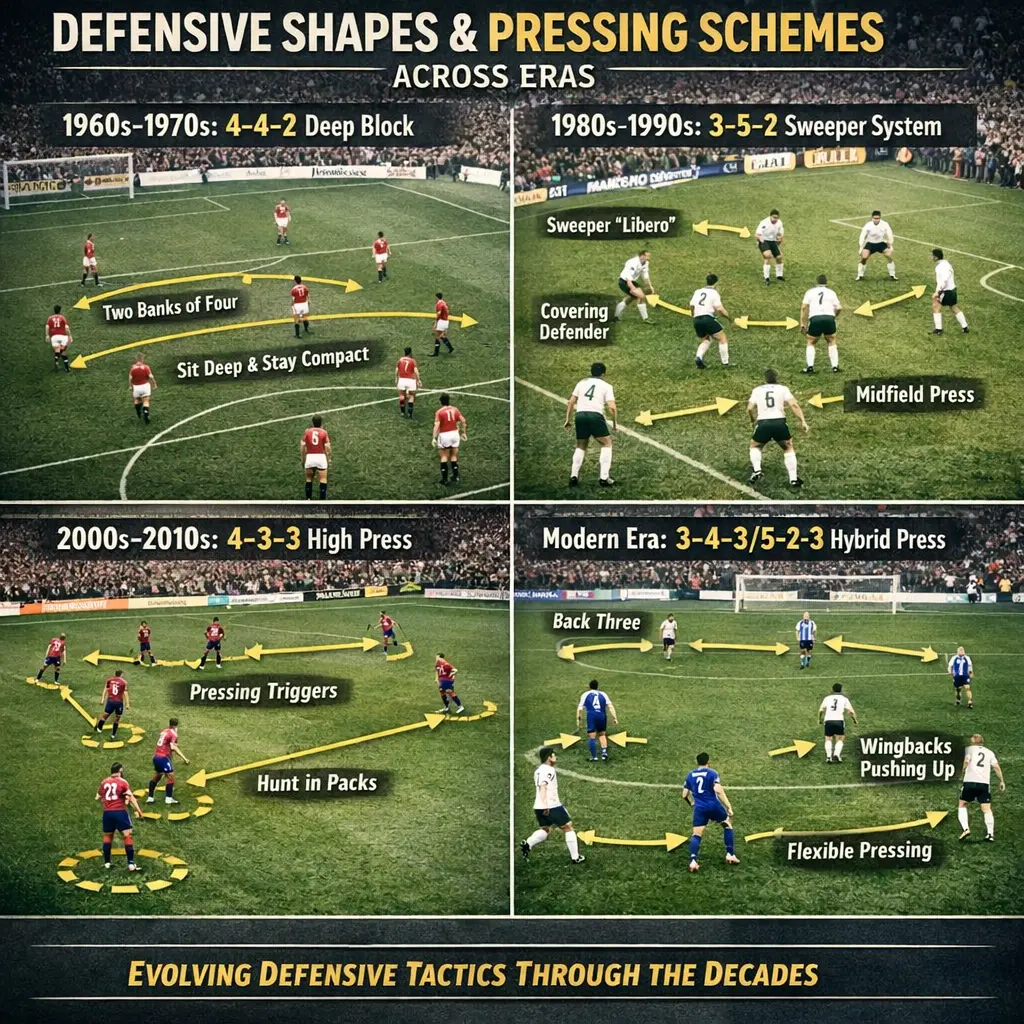
💡 Key Takeaways
- Trace the evolution of defensive shapes from early formations to modern systems.
- Describe historical pressing schemes and when teams pressed or absorbed pressure.
- Differentiate between zonal defense and man-marking across eras.
- Explain how space, pace, and ball progression influenced defensive decisions over time.
- Identify key eras and movements associated with notable defensive tactics.
❓ Frequently Asked Questions
What is a defensive shape in football, and why does it matter across eras?
The arrangement of players when defending (lines, spacing, and coverage). It determines how space is blocked, how easy it is to press, and how transitions are managed across different eras.
What is pressing, and how have pressing schemes evolved over time?
Pressing is actively trying to win back the ball by applying pressure on the ball carrier. Earlier eras favored compact, low-block defenses with limited pressing, while modern systems use coordinated high-press or gegenpressing to trap opponents higher up.
What are common defensive shapes used in different eras?
Common shapes include a back four (4-4-2, 4-3-3), a back three with wing-backs (3-5-2, 3-4-3), and deeper five-man defenses (5-3-2). Shapes adapt to era, opponent, and tactical philosophy.
What is the difference between a high press, mid-block, and low block?
High press positions defenders high to pressure near the opponent’s goal; a mid-block sits in the middle of the pitch; a low block defends deep, inviting play and protecting space behind the line.
How did catenaccio influence defensive shapes and pressing?
Catenaccio emphasized a very compact, deep defensive shape with a sweeper and counterattacks, contrasting with later eras that favored aggressive pressing and flexible shapes.