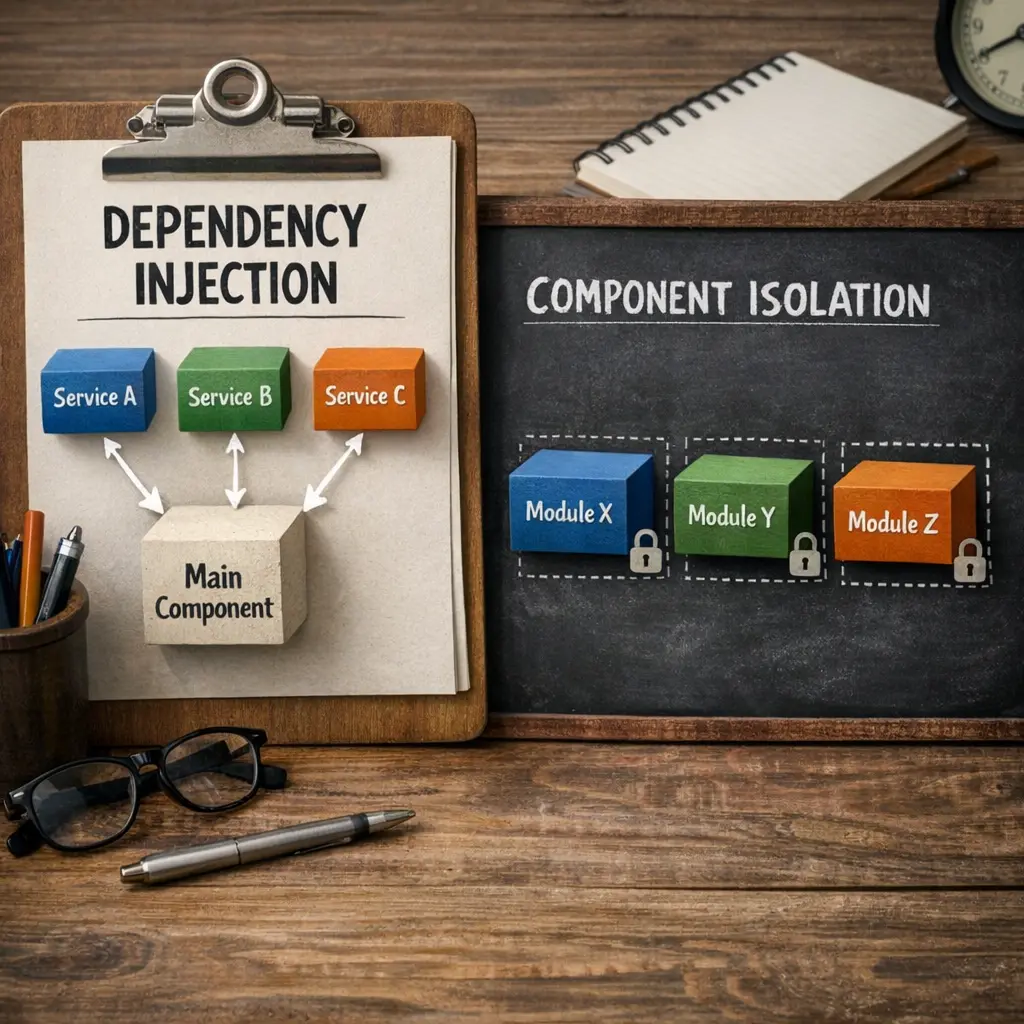
Dependency Injection is a design pattern where components receive their dependencies from external sources rather than creating them internally, enhancing modularity and testability. Component Isolation ensures that each software component or agent operates independently, with minimal coupling to others. In Agent Architecture, these principles allow agents to function autonomously, interact through well-defined interfaces, and be easily replaced or updated without affecting the overall system, promoting scalability and maintainability.
Dependency Injection & Component Isolation
Dependency Injection is a design pattern where components receive their dependencies from external sources rather than creating them internally, enhancing modularity and testability. Component Isolation ensures that each software component or agent operates independently, with minimal coupling to others. In Agent Architecture, these principles allow agents to function autonomously, interact through well-defined interfaces, and be easily replaced or updated without affecting the overall system, promoting scalability and maintainability.
💡 Key Takeaways
- Understand dependency injection and how it reduces coupling between components
- Identify DI patterns (constructor, setter, and interface injection) and their use cases
- Explain component isolation and how interfaces and mocks improve testability and maintainability
- Recognize benefits and pitfalls of DI and when to use a DI container or manual injection
❓ Frequently Asked Questions
What is dependency injection?
A design pattern where an object's dependencies are supplied from the outside rather than created internally; a DI container wires components together.
What is component isolation?
Keeping components self-contained with clear interfaces so they can be developed, tested, and replaced independently, reducing shared state and side effects.
How does dependency injection improve testability?
Dependencies can be replaced with mocks or stubs during tests, enabling isolated unit tests without real implementations.
What are common ways to implement dependency injection?
Constructor injection, setter (property) injection, and interface-based injection; DI containers often manage lifetimes and wiring.
How do dependency injection and component isolation relate to maintainability?
They decouple components, improve modularity and reusability, and make swapping implementations or testing easier without touching the rest of the code.