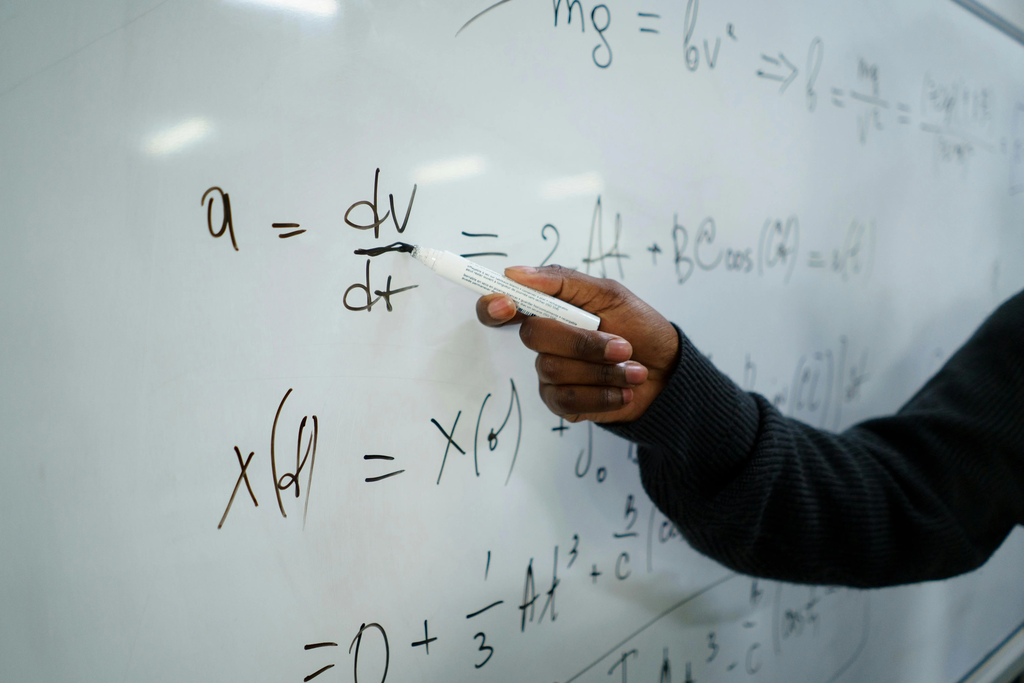
Derivatives for rates and optimization refer to the use of calculus, specifically derivatives, to measure how quantities change and to find maximum or minimum values of functions. In rates, derivatives determine how one variable changes with respect to another, such as velocity being the rate of change of position. For optimization, derivatives help identify critical points where functions reach their highest or lowest values, which is essential in fields like economics, engineering, and science.
Derivatives for Rates and Optimization
Derivatives for rates and optimization refer to the use of calculus, specifically derivatives, to measure how quantities change and to find maximum or minimum values of functions. In rates, derivatives determine how one variable changes with respect to another, such as velocity being the rate of change of position. For optimization, derivatives help identify critical points where functions reach their highest or lowest values, which is essential in fields like economics, engineering, and science.
💡 Key Takeaways
- Interpret derivatives as instantaneous rates of change and apply to real-world rate problems (e.g., velocity).
- Differentiate functions to compute rates of change with respect to a chosen variable (time, distance, etc.).
- Solve related rates problems by applying the chain rule to connect changing quantities.
- Identify critical points and use the first and second derivative tests to locate and classify maxima and minima.
- Set up and interpret optimization problems to find best values and justify results in context.
❓ Frequently Asked Questions
What is a derivative and why is it called a rate of change?
A derivative measures how a function changes as its input changes; it's the limit of the average rate of change as the input change approaches zero, i.e., the instantaneous rate of change (slope) at a point.
How do derivatives help model rates of change in practical problems?
Use related rates and the chain rule: relate quantities with an equation, differentiate with respect to time, and solve for the rate of the desired quantity (for example, how fast a boundary is moving given another changing quantity).
How can derivatives be used to optimize a function to find maxima or minima?
1) Find critical points where f'(x) = 0 or undefined. 2) Use the second derivative test or analyze sign changes of f' to classify as max or min. 3) Compare values (and endpoints if the domain is finite) to identify the optimum.
What is the difference between instantaneous and average rate of change?
Average rate over [a,b] is (f(b) - f(a)) / (b - a). The instantaneous rate at x0 is f'(x0), the limit of the average rate as the interval around x0 shrinks to zero.