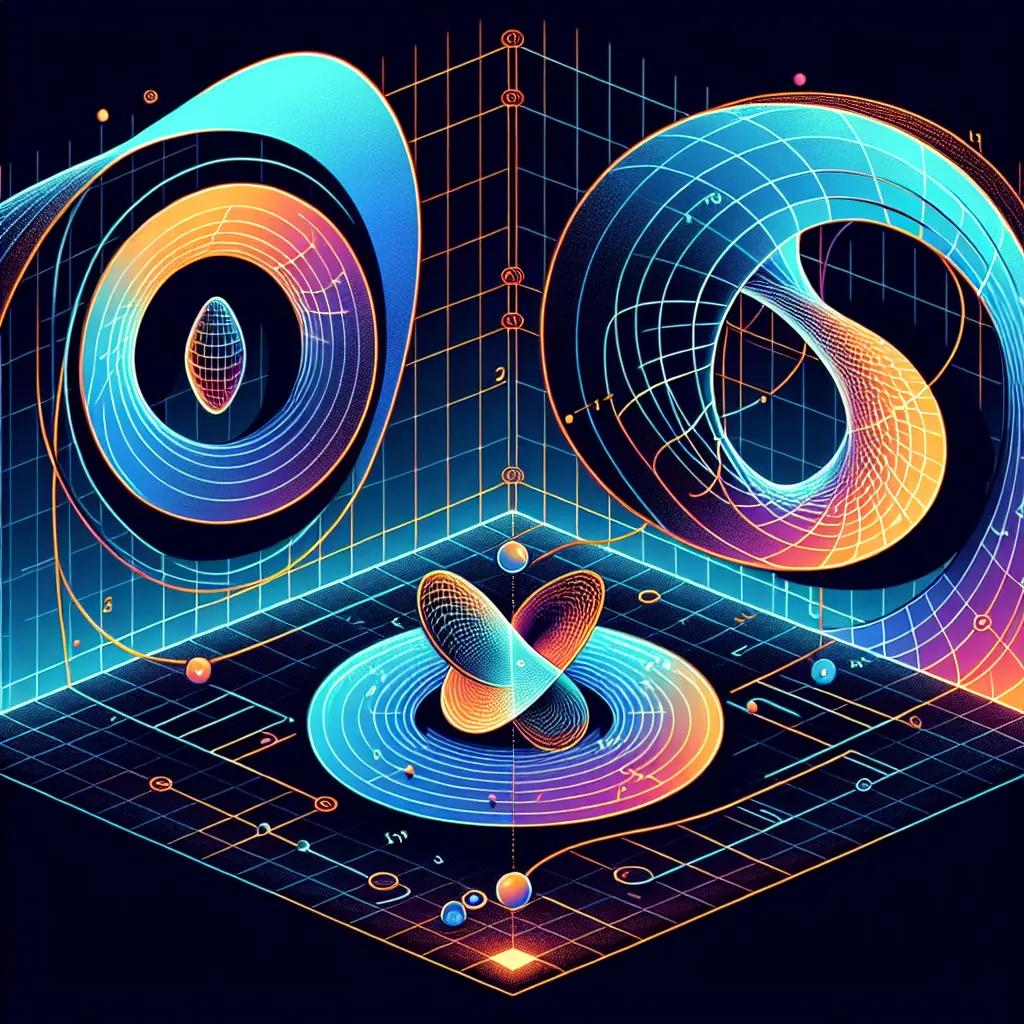
"Differential Geometry III: Geodesics & Curvature Tensor" refers to the study of curves that represent the shortest paths between points (geodesics) on curved spaces, and the mathematical objects (curvature tensors) that measure how these spaces bend. This area explores how geodesics generalize straight lines to curved surfaces, and how curvature tensors quantify intrinsic geometric properties, playing a crucial role in fields like general relativity and advanced mathematics.
Differential Geometry III: Geodesics & Curvature Tensor
"Differential Geometry III: Geodesics & Curvature Tensor" refers to the study of curves that represent the shortest paths between points (geodesics) on curved spaces, and the mathematical objects (curvature tensors) that measure how these spaces bend. This area explores how geodesics generalize straight lines to curved surfaces, and how curvature tensors quantify intrinsic geometric properties, playing a crucial role in fields like general relativity and advanced mathematics.
💡 Key Takeaways
- Understand geodesics as curves that locally minimize distance and satisfy the geodesic equation with Christoffel symbols.
- Learn how the Levi-Civita connection defines parallel transport and leads to geodesic equations on any manifold.
- Grasp the curvature tensor (Riemann curvature tensor) as a measure of how a space bends, distinguishing flat from curved manifolds.
- Explore geodesic deviation via the Jacobi equation to see how curvature influences the separation of nearby geodesics.
- Apply the concepts to classic surfaces (plane, sphere, cylinder) to visualize how curvature shapes geodesics in familiar settings.
❓ Frequently Asked Questions
What is a geodesic?
In differential geometry, a geodesic is a curve that locally minimizes distance and has zero covariant acceleration; it satisfies the geodesic equation using the manifold's connection. On flat Euclidean space, geodesics are straight lines.
How do you compute geodesics on a curved space?
Compute the Christoffel symbols from the metric, then solve the geodesic equations d^2x^k/dt^2 + Γ^k_{ij}(x) dx^i/dt dx^j/dt = 0 with given initial point and velocity.
What is the curvature tensor and why is it important?
The Riemann curvature tensor R^i_{jkl} measures how parallel transport around an infinitesimal loop fails to preserve a vector, encoding the intrinsic curvature of the space. It gives rise to sectional, Ricci, and scalar curvatures.
How are geodesics related to curvature?
Curvature affects how geodesics bend and diverge. In flat space, geodesics are straight lines; in curved spaces, nearby geodesics may converge or diverge (described by the Jacobi equation), with curvature controlling this behavior. In physics, freely falling particles follow geodesics.