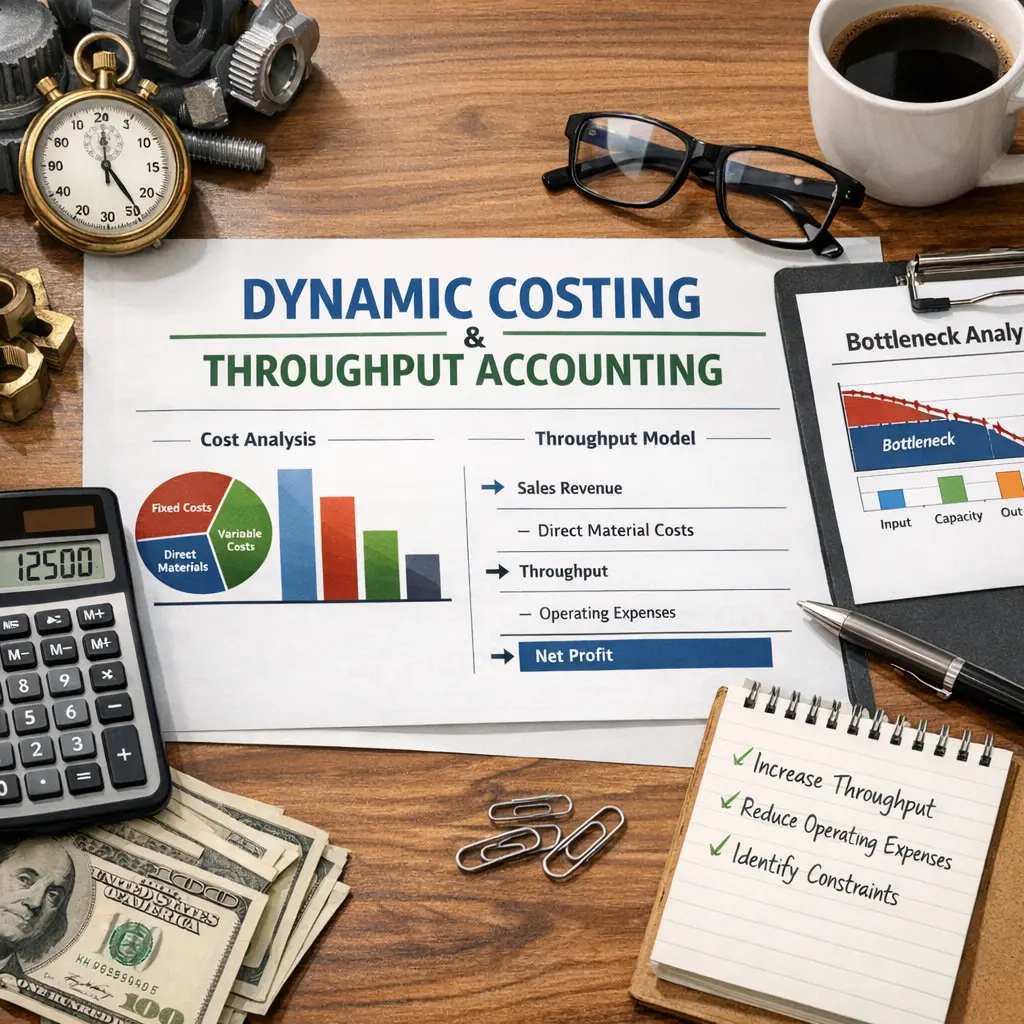
Dynamic Costing & Throughput Accounting are modern financial management approaches. Dynamic costing adapts cost allocation in real-time, reflecting changes in production and resource use. Throughput accounting focuses on maximizing the rate at which a business generates money through sales, emphasizing constraint management and minimizing inventory. Together, they enable businesses to make agile, informed decisions, improve efficiency, and optimize profitability by aligning financial practices closely with operational realities.
Dynamic Costing & Throughput Accounting
Dynamic Costing & Throughput Accounting are modern financial management approaches. Dynamic costing adapts cost allocation in real-time, reflecting changes in production and resource use. Throughput accounting focuses on maximizing the rate at which a business generates money through sales, emphasizing constraint management and minimizing inventory. Together, they enable businesses to make agile, informed decisions, improve efficiency, and optimize profitability by aligning financial practices closely with operational realities.
💡 Key Takeaways
- Understand how throughput accounting differs from traditional costing and identify the key metrics: Throughput (T), Investment (I), and Operating Expenses (OE).
- Identify bottlenecks in a system and learn strategies to exploit and subordinate to them to improve overall throughput.
- Apply the throughput formula—Throughput = Sales minus Total Variable Costs—and use it to evaluate profitability and guide decision making.
- Learn how dynamic costing reflects capacity and demand changes in real time to support better pricing, planning, and resource allocation.
- Translate throughput insights into actionable decisions, prioritizing high-throughput orders and reducing bottlenecks to boost utilization and profitability.
❓ Frequently Asked Questions
What is throughput accounting?
Throughput accounting (TA) is a management approach inspired by the Theory of Constraints that focuses on maximizing throughput (the rate money is generated) while minimizing invested capital (inventory) and operating expenses.
How does throughput accounting differ from traditional cost accounting?
Traditional cost accounting allocates fixed and overhead costs to products, which can distort profitability. TA uses throughput (selling price minus truly variable costs) and focuses on bottlenecks to improve overall flow and profit.
What is dynamic costing?
Dynamic costing is a flexible approach that updates cost estimates as conditions change, emphasizing incremental or marginal costs for decision-making rather than static fixed-cost allocations.
What metrics are used in throughput accounting?
The core TA metrics are Throughput (T), Inventory/Investment (I), and Operating Expense (OE). The goal is to maximize T while minimizing I and OE.
How can I apply dynamic costing and throughput accounting in decisions?
Identify bottlenecks, assess how changes affect throughput, inventory, and operating costs, and use incremental contributions to guide pricing, product mix, and process improvements.