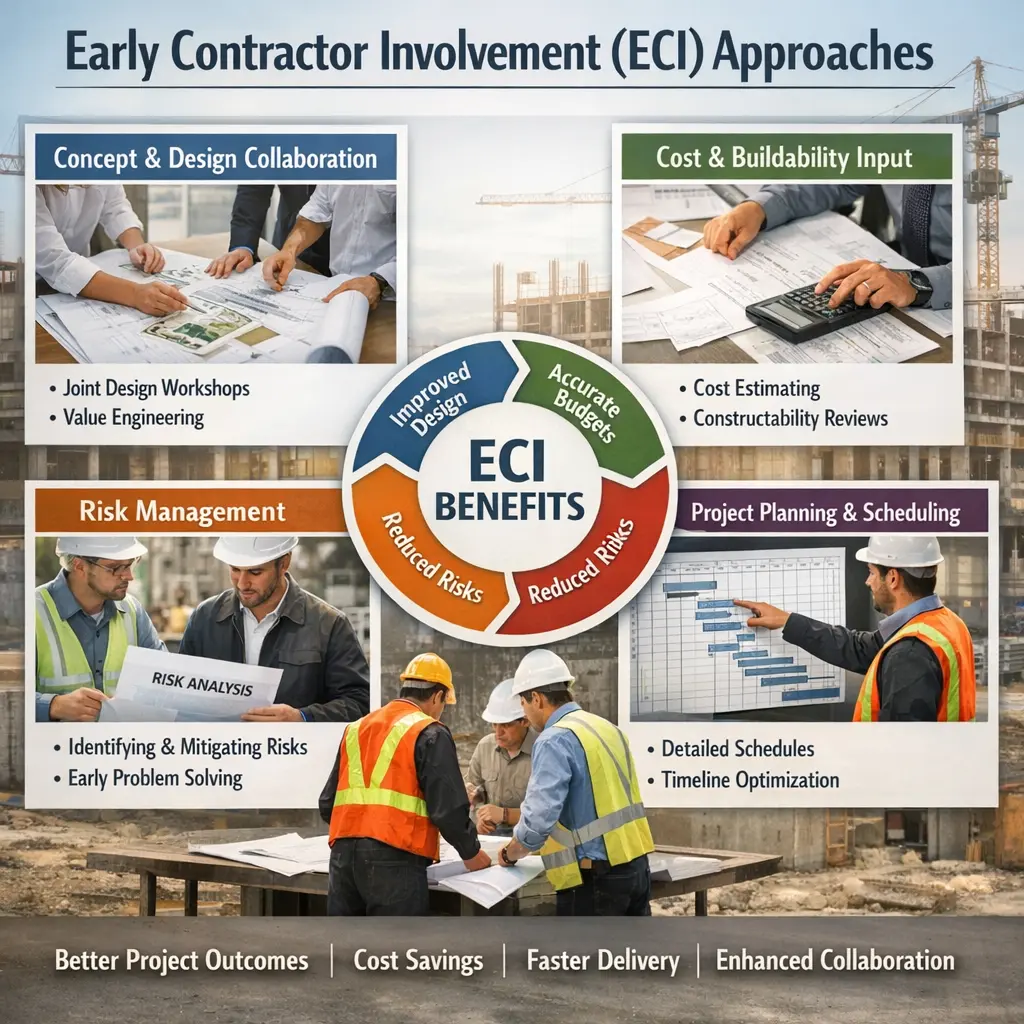
Early Contractor Involvement (ECI) approaches in tender and procurement processes engage contractors during the initial project design and planning stages, rather than after finalization. This collaboration allows contractors to contribute expertise, identify risks, suggest innovations, and improve constructability, cost efficiency, and timelines. By integrating contractor input early, ECI fosters better communication, reduces project uncertainties, and enhances overall project outcomes compared to traditional procurement methods where contractors join later.
Early Contractor Involvement (ECI) Approaches
Early Contractor Involvement (ECI) approaches in tender and procurement processes engage contractors during the initial project design and planning stages, rather than after finalization. This collaboration allows contractors to contribute expertise, identify risks, suggest innovations, and improve constructability, cost efficiency, and timelines. By integrating contractor input early, ECI fosters better communication, reduces project uncertainties, and enhances overall project outcomes compared to traditional procurement methods where contractors join later.
💡 Key Takeaways
- Understand what Early Contractor Involvement (ECI) is and why it's used.
- Learn various ECI approaches, such as design workshops, constructability reviews, and phased procurement.
- See how ECI can reduce project duration, cost variance, and risk through early collaboration.
- Recognize contract and governance options in ECI (open-book pricing, target cost, shared savings).
- Get practical tips for selecting an ECI partner and integrating contractor input into the design process.
❓ Frequently Asked Questions
What is Early Contractor Involvement (ECI)?
ECI is a procurement approach where the contractor is engaged early in the project design phase to provide constructability input, cost estimation, and scheduling expertise, helping optimize design and reduce risk.
What are the main benefits of ECI?
ECI improves design feasibility and constructability, provides better cost certainty, speeds up delivery, reduces change orders, enables early procurement of long-lead items, and fosters closer collaboration among project stakeholders.
How does ECI differ from traditional design-bid-build?
In ECI, a contractor is selected early and works with designers during the design phase, enabling concurrent design and construction planning. Traditional design-bid-build completes design first and engages contractors later.
When is ECI most effective?
ECI is most valuable on complex or fast-tracked projects, where early input from the contractor can improve design quality, schedule, and cost outcomes, and where a collaborative, risk-sharing approach is feasible.