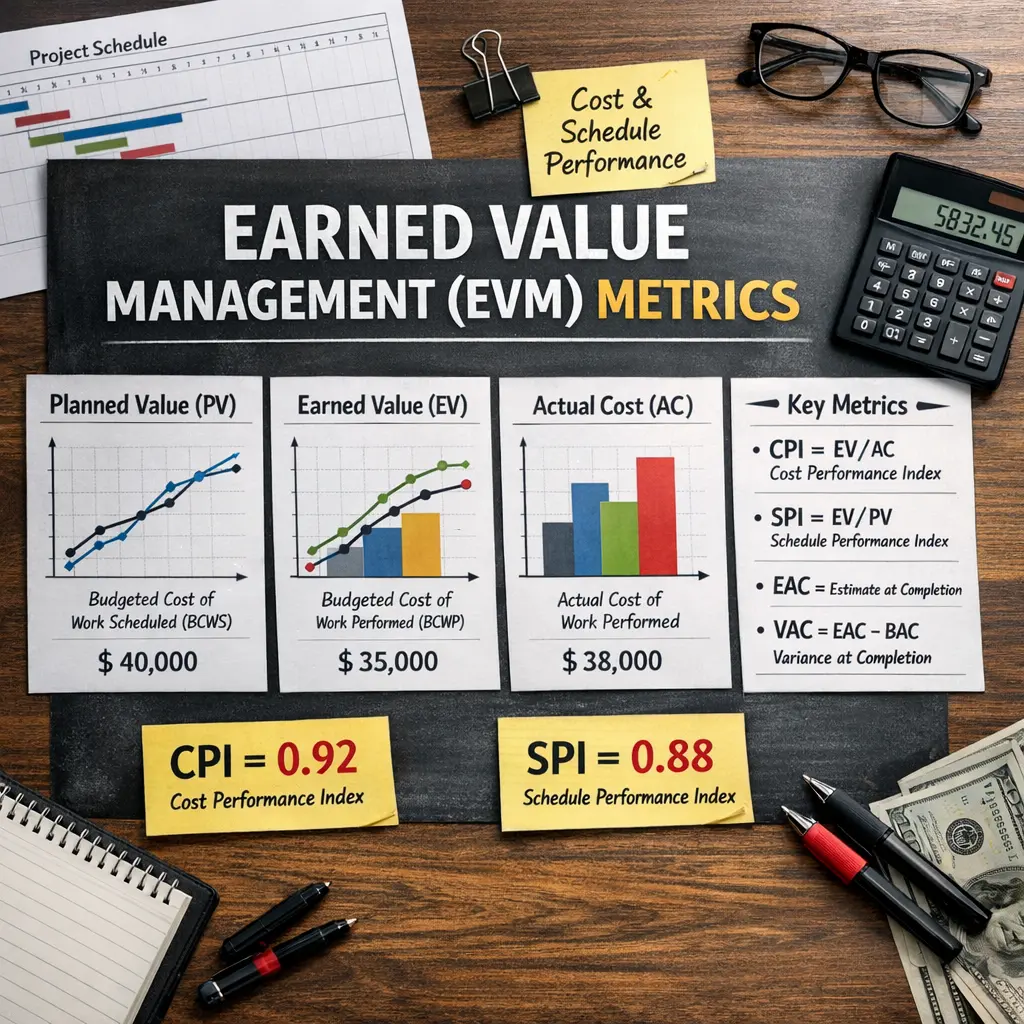
Earned Value Management (EVM) metrics are quantitative tools used in project management to assess project performance and progress. By integrating project scope, schedule, and cost data, EVM metrics such as Planned Value (PV), Earned Value (EV), and Actual Cost (AC) enable managers to measure project health, forecast future performance, and identify variances. These metrics support informed decision-making, ensuring effective financial management and adherence to business practices throughout the project lifecycle.
Earned Value Management (EVM) Metrics
Earned Value Management (EVM) metrics are quantitative tools used in project management to assess project performance and progress. By integrating project scope, schedule, and cost data, EVM metrics such as Planned Value (PV), Earned Value (EV), and Actual Cost (AC) enable managers to measure project health, forecast future performance, and identify variances. These metrics support informed decision-making, ensuring effective financial management and adherence to business practices throughout the project lifecycle.
💡 Key Takeaways
- Understand the purpose of Earned Value Management (EVM) in project performance measurement
- Identify core EVM metrics: Planned Value (PV), Earned Value (EV), and Actual Cost (AC)
- Learn how to interpret Schedule Variance (SV) and Cost Variance (CV) and what they reveal about project performance
- Calculate and interpret key indices: Cost Performance Index (CPI) and Schedule Performance Index (SPI)
- Use EVM data to forecast project completion, budget needs, and guide corrective actions
❓ Frequently Asked Questions
What is Earned Value Management (EVM)?
EVM is a project performance technique that combines scope, schedule, and cost to measure planned value, actual work completed, and money spent.
What are Planned Value (PV), Earned Value (EV), and Actual Cost (AC)?
PV is the budgeted cost for planned work; EV is the budgeted cost for work actually completed; AC is the actual money spent to complete that work.
What do CPI and SPI indicate in EVM?
CPI = EV/AC measures cost efficiency; SPI = EV/PV measures schedule efficiency. Values >1 are favorable; <1 are unfavorable; close to 1 means on track.
What are Cost Variance (CV) and Schedule Variance (SV)?
CV = EV − AC indicates cost performance; SV = EV − PV indicates schedule performance. Positive values signal favorable performance.
What are BAC and EAC, and how are they used?
BAC is Budget at Completion (total project budget). EAC is Estimate at Completion (forecast of total cost). Common formulas include EAC ≈ BAC/CPI or EAC ≈ AC + (BAC − EV)/CPI, helping predict final cost.