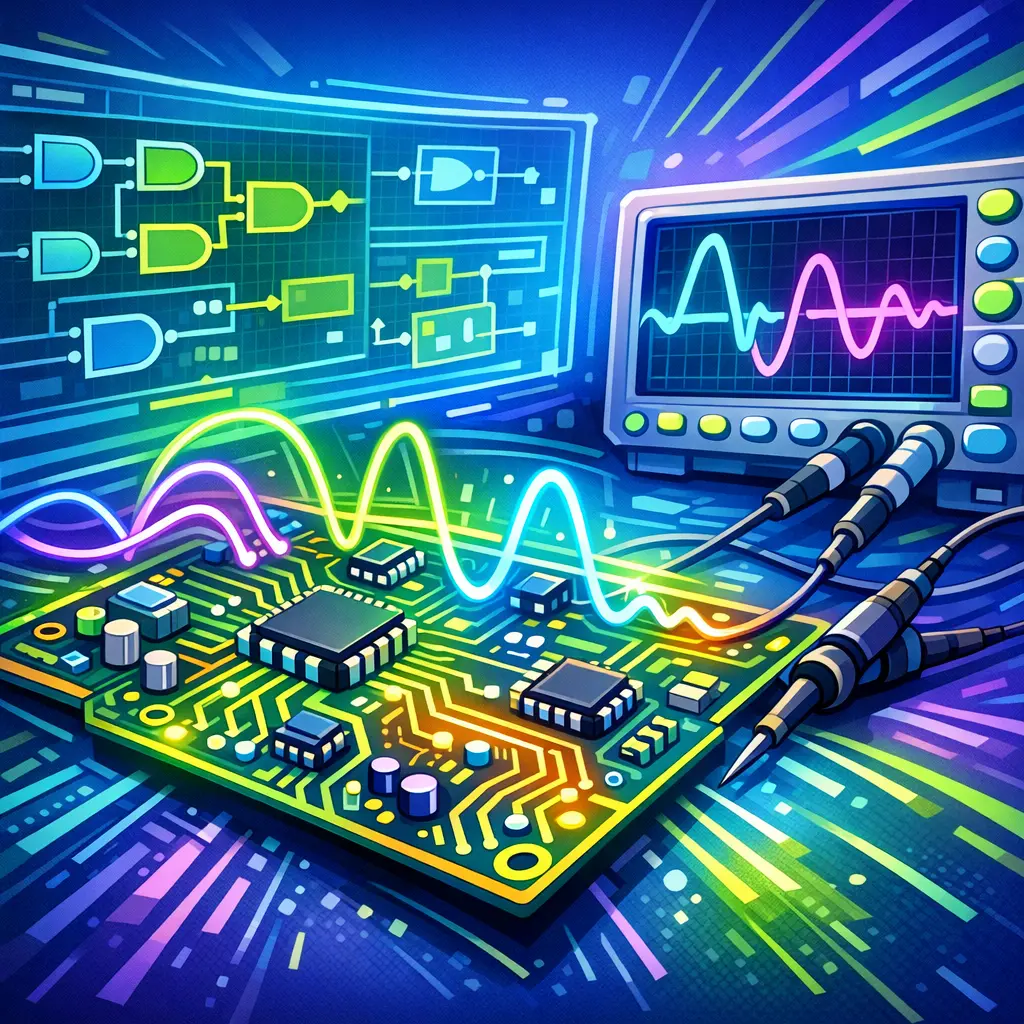
EDA & Test encompasses electronic design automation (EDA) tools and testing equipment used in engineering and technology careers. SPICE is a simulation program for analyzing electronic circuits, while PCB CAD refers to software for designing printed circuit boards. Oscilloscopes are instruments used to observe electrical signals in real time. Together, these tools are essential for designing, simulating, building, and testing electronic systems, ensuring functionality and reliability in modern electronic products.
EDA & Test: SPICE, PCB CAD & Oscilloscopes
EDA & Test encompasses electronic design automation (EDA) tools and testing equipment used in engineering and technology careers. SPICE is a simulation program for analyzing electronic circuits, while PCB CAD refers to software for designing printed circuit boards. Oscilloscopes are instruments used to observe electrical signals in real time. Together, these tools are essential for designing, simulating, building, and testing electronic systems, ensuring functionality and reliability in modern electronic products.
💡 Key Takeaways
- Understand how SPICE simulates analog circuits (DC, transient, AC) and how to interpret the resulting waveforms.
- Learn the PCB CAD workflow from schematic capture to layout, including design rule checks and generating manufacturing outputs (Gerbers, BOM).
- Understand how oscilloscopes are used for time-domain measurements, probing techniques, and triggering to validate signals.
- See how SPICE, PCB CAD, and oscilloscope testing fit into the product development cycle and how to mitigate parasitics and measurement loading.
❓ Frequently Asked Questions
What is SPICE and why is it used in EDA?
SPICE (Simulation Program with Integrated Circuit Emphasis) is a circuit simulator used to model analog/mixed-signal circuits. It predicts voltages, currents and timing under DC, AC, and transient conditions to catch design issues before prototyping.
What is PCB CAD and why is it important in PCB design?
PCB CAD refers to computer-aided design software for creating schematic diagrams and PCB layouts. It automates netlists, component placement, routing, and design-rule checks to ensure the board is manufacturable and functions as intended.
How do oscilloscopes help when testing circuits?
An oscilloscope displays how a signal varies over time, showing waveform shape, amplitude, frequency, timing, and noise. It’s essential for debugging, timing analysis, and validating signal integrity.
How do SPICE simulations and PCB CAD work together in the design flow?
SPICE validates the circuit behavior at the schematic level, while PCB CAD translates that circuit into a manufacturable board layout. Using both helps ensure the design behaves correctly before fabrication.