Electric motors convert electrical energy into mechanical motion and are vital in various applications. DC motors use direct current and offer simple speed control, while AC motors operate on alternating current, commonly used for industrial power. Brushless DC (BLDC) motors provide high efficiency and reliability, ideal for precise control tasks. In telecoms, motors manage signals and equipment movement, while in power systems, they drive pumps, fans, and other essential machinery.
Electric Motors Basics (DC, AC, BLDC)
Electric motors convert electrical energy into mechanical motion and are vital in various applications. DC motors use direct current and offer simple speed control, while AC motors operate on alternating current, commonly used for industrial power. Brushless DC (BLDC) motors provide high efficiency and reliability, ideal for precise control tasks. In telecoms, motors manage signals and equipment movement, while in power systems, they drive pumps, fans, and other essential machinery.
💡 Key Takeaways
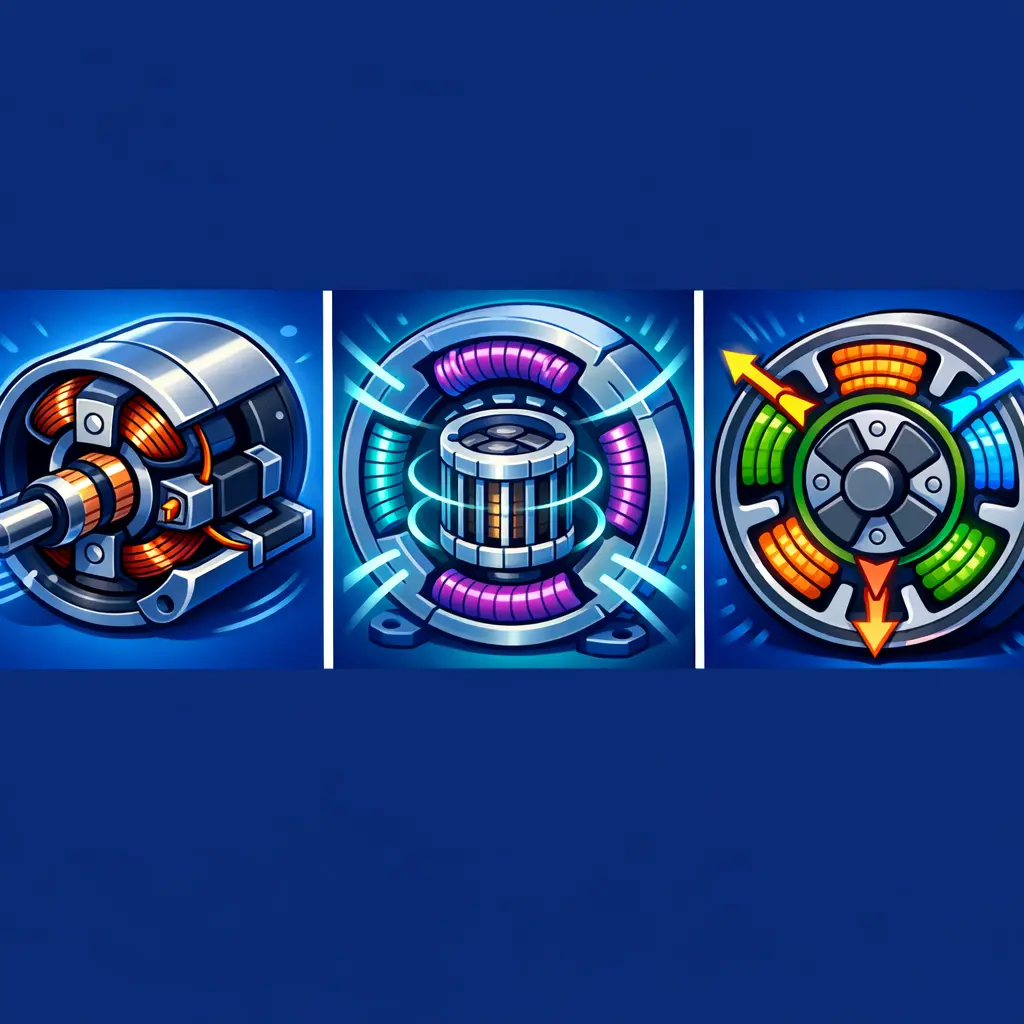
- Compare the core differences among DC, AC, and BLDC motors and where each type is commonly used.
- Explain how DC motors produce torque and how BLDC motors use electronic commutation and sensors.
- Describe how AC motors rely on a rotating magnetic field and how variable frequency drives control speed.
- Identify key trade-offs in efficiency, maintenance, cost, and control requirements when selecting motor types.
❓ Frequently Asked Questions
What are the main motor types covered in this article?
DC motors, AC motors, and brushless DC (BLDC) motors. DC motors run on direct current, AC motors run on alternating current, and BLDC motors are brushless and electronically commuted.
How does a brushed DC motor work?
Current through rotor windings interacts with the stator magnetic field to produce torque. A commutator and brushes switch the current each half-turn to keep the rotor spinning.
How does an AC motor work?
AC motors use an alternating current to create a rotating magnetic field in the stator. In induction motors, rotor currents lag the stator field (slip) and produce torque; speed is set by supply frequency and motor design.
What is a BLDC motor and how is it controlled?
A BLDC motor uses permanent magnets on the rotor and electronically commutated windings on the stator. A controller (ESC/driver) sequences the windings based on rotor position (from Hall sensors or sensorless estimation).
What are common trade-offs or typical use cases for each motor type?
Brushed DC: simple and cheap but requires brushes and maintenance; good for variable speed with voltage. AC induction: rugged, inexpensive, low maintenance; widely used for fixed or variable speed with drives. BLDC: high efficiency and precise control; requires electronic drive and sensors.