"Embedded C Basics & Bare-Metal Drivers (Digital Electronics & Computing)" refers to foundational concepts in programming microcontrollers using Embedded C, focusing on direct hardware manipulation without relying on operating systems or abstraction layers. It covers essential digital electronics principles and the development of bare-metal drivers—software that interfaces directly with hardware components like GPIOs, timers, and communication peripherals—enabling efficient control and operation of embedded systems in computing applications.
Embedded C Basics & Bare-Metal Drivers
"Embedded C Basics & Bare-Metal Drivers (Digital Electronics & Computing)" refers to foundational concepts in programming microcontrollers using Embedded C, focusing on direct hardware manipulation without relying on operating systems or abstraction layers. It covers essential digital electronics principles and the development of bare-metal drivers—software that interfaces directly with hardware components like GPIOs, timers, and communication peripherals—enabling efficient control and operation of embedded systems in computing applications.
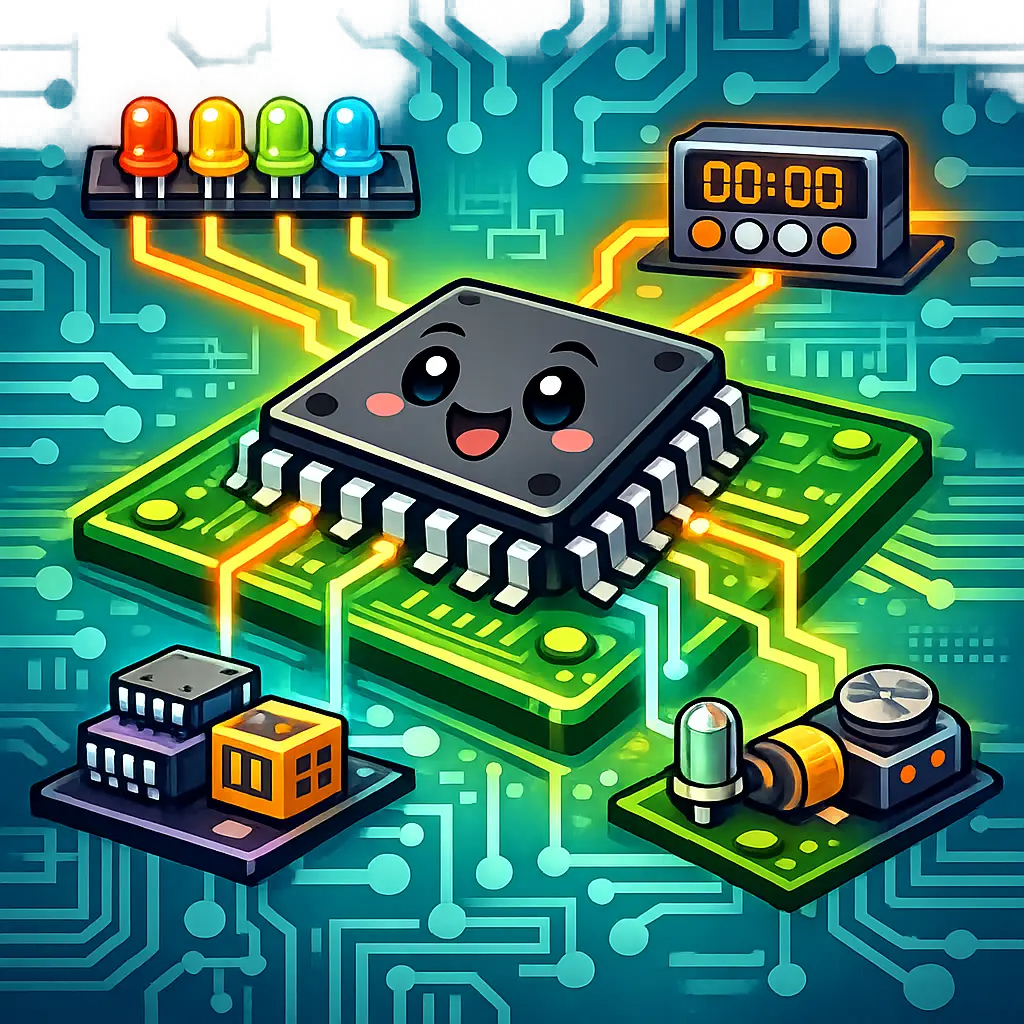
💡 Key Takeaways
- Understand what Embedded C is and how bare-metal code differs from standard C (no OS, tighter resource constraints).
- Learn memory-mapped I/O concepts and how to access hardware registers using pointers and the volatile qualifier.
- Create a basic bare-metal driver, starting with GPIO to read inputs and toggle outputs.
- Implement a simple UART driver for serial communication in a bare-metal environment.
- Grasp interrupt basics: enabling interrupts, writing simple ISRs, and choosing polling vs interrupt-driven I/O.
❓ Frequently Asked Questions
What is Embedded C, and how does it differ from standard C?
Embedded C is a subset of C tailored for microcontrollers. It emphasizes direct hardware access, fixed memory layouts, deterministic timing, and often avoids dynamic memory and standard libraries.
What is a bare-metal driver?
A driver that directly controls hardware peripherals without an operating system, using memory-mapped registers and interrupts or polling.
How do you access a hardware register in Embedded C?
Use memory-mapped, volatile access to a fixed address, typically via a pointer or a structured peripheral map, ensuring each read/write occurs as written.
What is an interrupt service routine (ISR) and how should it be used in bare-metal code?
An ISR is a function invoked by hardware interrupts. In bare-metal code, keep ISRs short, set a volatile flag if work is deferred, and avoid blocking calls.