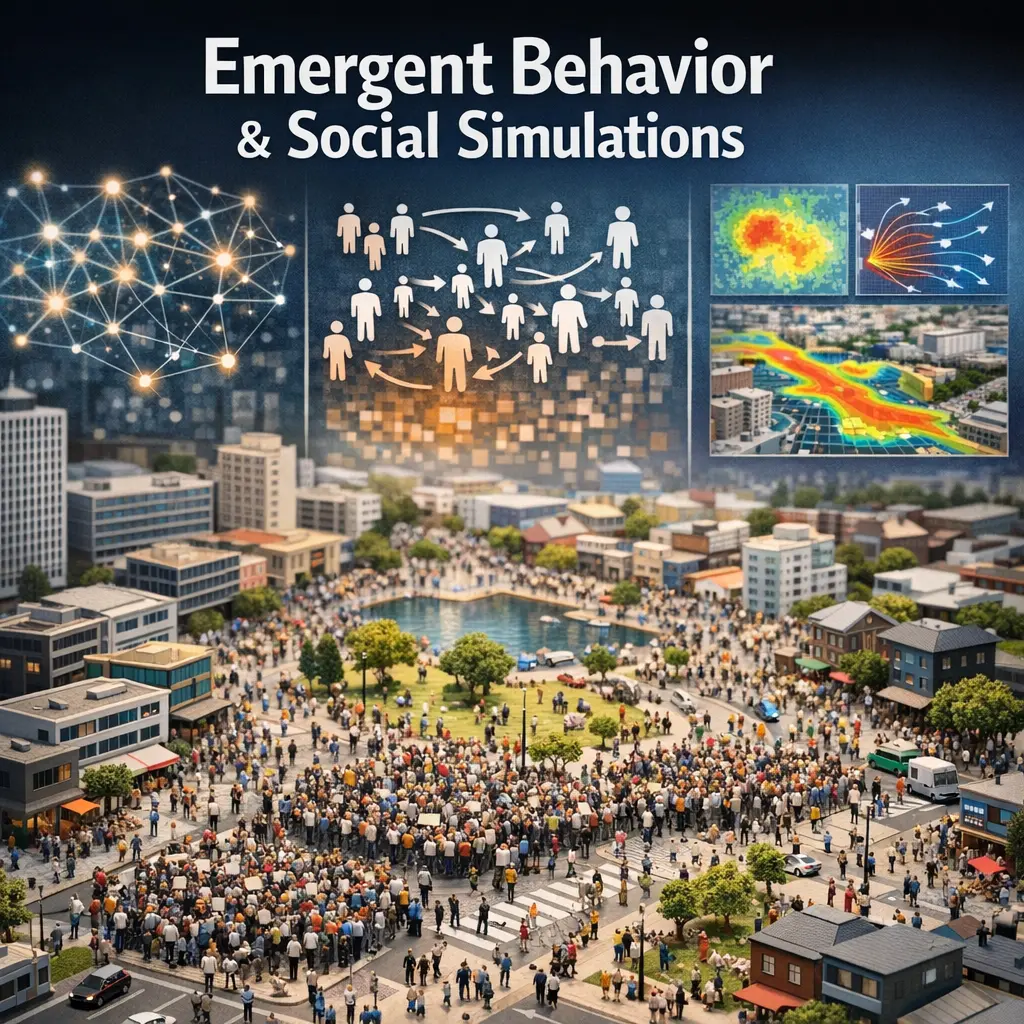
Emergent behavior refers to complex patterns or outcomes that arise from simple interactions among individual agents within a system, without centralized control. In social simulations, agent architecture defines how these agents perceive, decide, and act within their environment. By modeling agents with specific rules and attributes, social simulations can reproduce and study collective phenomena—such as cooperation, competition, or social norms—that emerge from local interactions, providing insights into real-world social dynamics.
Emergent Behavior & Social Simulations
Emergent behavior refers to complex patterns or outcomes that arise from simple interactions among individual agents within a system, without centralized control. In social simulations, agent architecture defines how these agents perceive, decide, and act within their environment. By modeling agents with specific rules and attributes, social simulations can reproduce and study collective phenomena—such as cooperation, competition, or social norms—that emerge from local interactions, providing insights into real-world social dynamics.
💡 Key Takeaways
- Define emergent behavior and how it arises from simple local interactions in social systems
- Explain how agent-based models simulate individuals and rules to produce collective patterns
- Identify common emergent phenomena in social simulations, such as traffic flow, crowd dynamics, and opinion diffusion
- Discuss limitations and interpretation of simulations, including sensitivity to initial conditions and parameter choices
❓ Frequently Asked Questions
What is emergent behavior in social systems?
Emergent behavior refers to complex, system-scale patterns that arise from many local interactions among individuals, not from any single person following a global rule.
What are social simulations and what are they used for?
Social simulations are computational models that mimic agents and their interactions to explore how individual actions lead to collective outcomes, such as opinion spread, cooperation, crowd movement, or disease dynamics.
What is an agent-based model (ABM)?
An ABM is a type of simulation where many autonomous agents follow simple rules and interact with each other and the environment to produce emergent patterns at the group level.
How can researchers validate emergent behaviors observed in simulations?
Researchers compare simulation results with real-world data, calibrate parameters, perform sensitivity analyses, and test multiple scenarios to assess robustness.