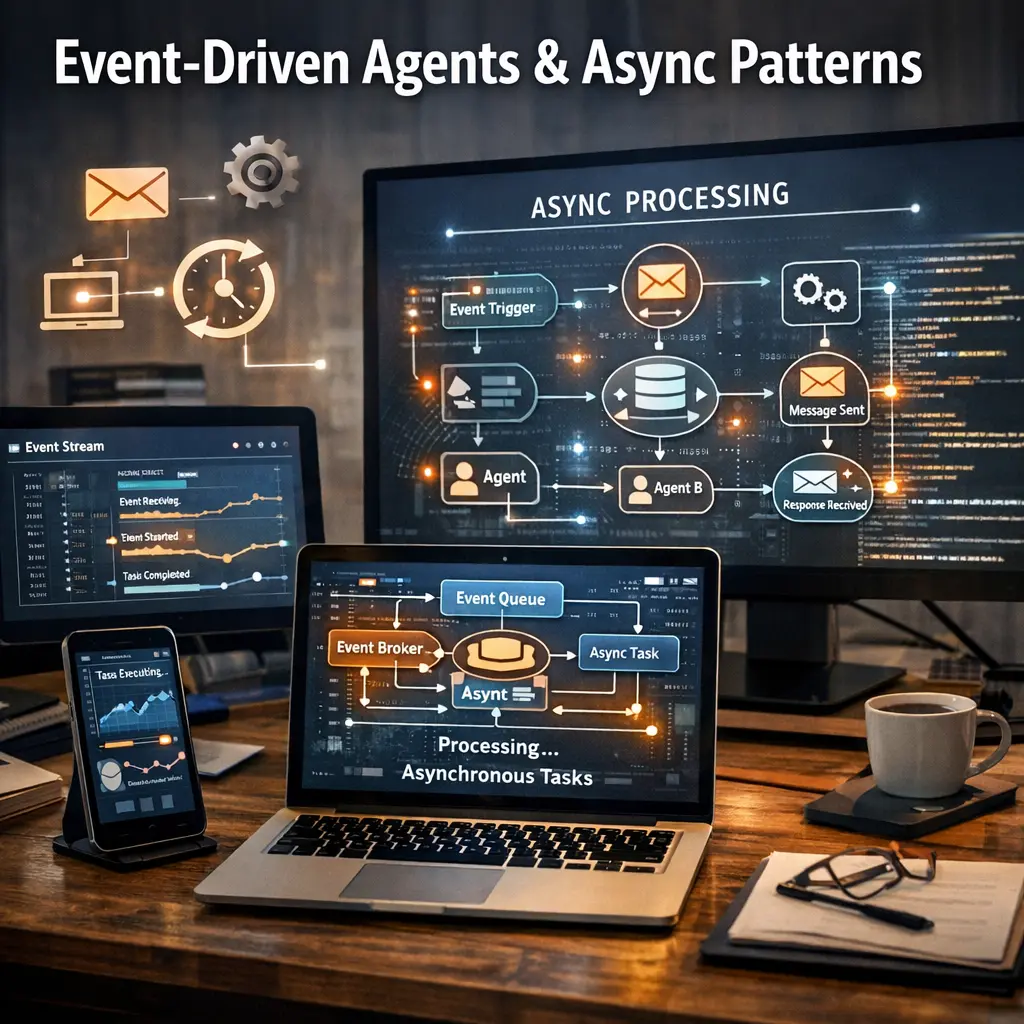
Event-driven agents and async patterns in agent architecture refer to systems where autonomous agents react to specific events or messages, often operating concurrently. These agents use asynchronous programming to handle tasks without blocking, enabling efficient processing of multiple requests or events simultaneously. This approach enhances scalability, responsiveness, and fault tolerance, making it ideal for distributed applications, real-time systems, and environments requiring dynamic, adaptive behavior based on incoming stimuli.
Event-Driven Agents & Async Patterns
Event-driven agents and async patterns in agent architecture refer to systems where autonomous agents react to specific events or messages, often operating concurrently. These agents use asynchronous programming to handle tasks without blocking, enabling efficient processing of multiple requests or events simultaneously. This approach enhances scalability, responsiveness, and fault tolerance, making it ideal for distributed applications, real-time systems, and environments requiring dynamic, adaptive behavior based on incoming stimuli.
💡 Key Takeaways
- Understand what makes an agent event-driven and how it responds to external events
- Learn common async patterns (callbacks, promises/futures, async/await) used in event-driven systems
- Explore non-blocking communication and message passing (pub/sub, queues)
- Assess the trade-offs of event-driven architectures, including latency, complexity, and error handling
❓ Frequently Asked Questions
What is an event-driven agent?
An agent that responds to external events or messages rather than polling continuously for work.
What is an asynchronous pattern in this context?
A non-blocking approach that lets the agent start work, wait for results, and continue handling other tasks (e.g., callbacks, promises, async/await).
How do event-driven agents typically communicate?
They publish and subscribe to events on a bus or stream; publishers emit events and agents react, often triggering further processing.
What are common challenges with event-driven async designs?
Tracing flow across components, race conditions, event ordering, backpressure, and robust error handling.