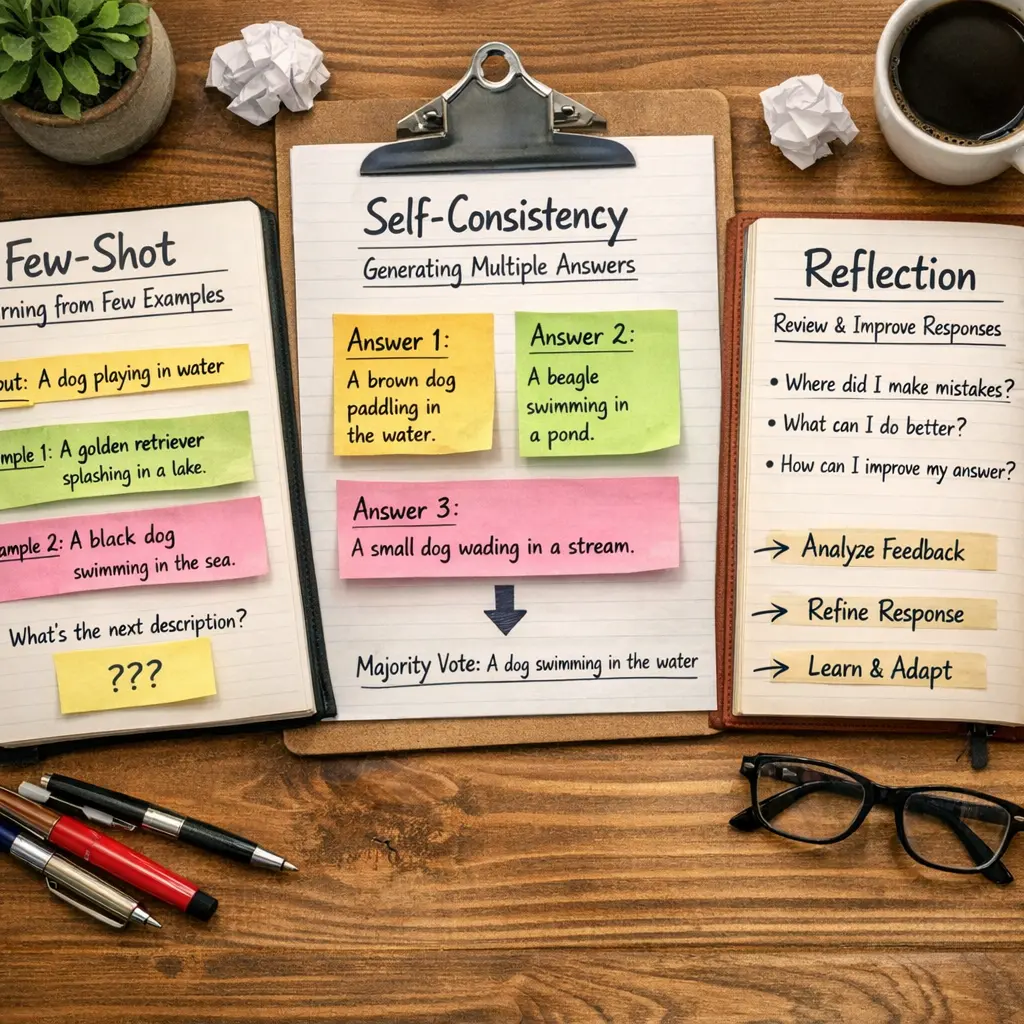
Few-Shot, Self-Consistency & Reflection (Agent Architecture) refers to an AI system design where agents learn tasks with minimal examples (few-shot), ensure reliability by cross-verifying multiple outputs or reasoning paths (self-consistency), and improve performance by reviewing and analyzing their own decisions or mistakes (reflection). This architecture enhances adaptability, robustness, and self-improvement, enabling agents to tackle complex problems efficiently with limited supervision or data.
Few-Shot, Self-Consistency & Reflection
Few-Shot, Self-Consistency & Reflection (Agent Architecture) refers to an AI system design where agents learn tasks with minimal examples (few-shot), ensure reliability by cross-verifying multiple outputs or reasoning paths (self-consistency), and improve performance by reviewing and analyzing their own decisions or mistakes (reflection). This architecture enhances adaptability, robustness, and self-improvement, enabling agents to tackle complex problems efficiently with limited supervision or data.
💡 Key Takeaways
- Understand how few-shot learning lets models generalize from a small number of examples.
- Explain self-consistency and how using multiple reasoning paths can improve answers.
- Learn how reflection helps re-evaluate and revise outputs to reduce mistakes.
- Apply practical prompting strategies to combine few-shot, self-consistency, and reflection in real tasks.
❓ Frequently Asked Questions
What is few-shot learning?
A learning setup where a model adapts to a new task using only a few labeled examples, leveraging prior knowledge from pretraining and demonstrations to guide its behavior.
What is self-consistency in AI reasoning?
A technique that generates multiple reasoning paths for a problem and uses the most common final answer across those paths to improve reliability.
What is reflection in AI prompting?
A method where the model reviews and revises its own reasoning after an initial attempt, catching errors and refining the final answer.
How do these ideas work together to improve quiz answers?
Few-shot prompts provide task guidance; self-consistency explores alternative reasoning paths to reduce errors; reflection allows rechecking and correcting steps—together they boost accuracy, especially on hard or unfamiliar questions.